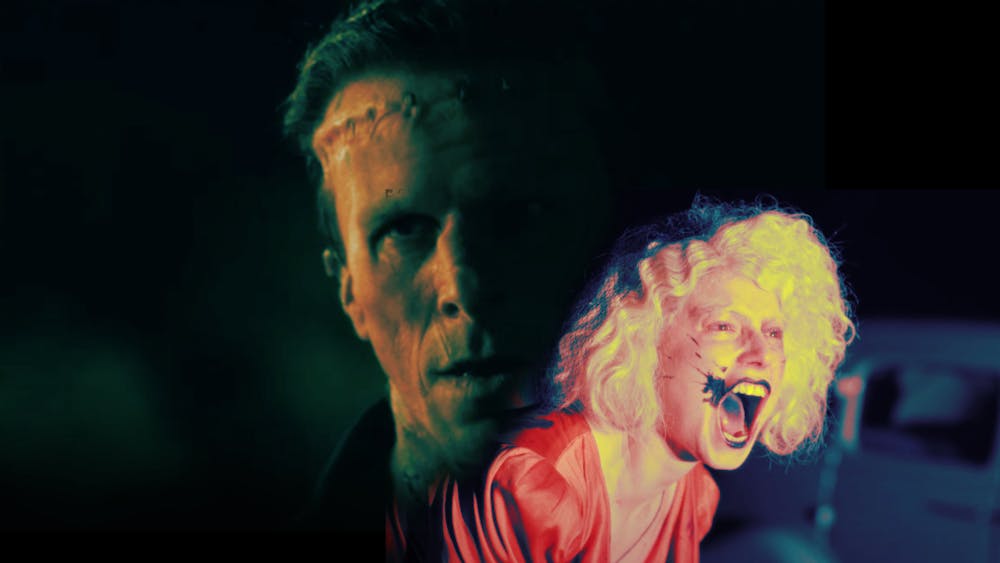
Over 90 years after Bride of Frankenstein (1935) turned a silent, two–minute performance into one of cinema’s most enduring images, Maggie Gyllenhaal is revisiting the myth from a different angle. The Bride!, which arrives in theaters March 6, stars Christian Bale as Frankenstein’s creature and Jessie Buckley as both Mary Shelley and the titular Bride—an intentional echo of Elsa Lanchester’s dual role in the original film. Where James Whale’s version is essentially about the Bride in name only, Gyllenhaal’s film shifts the emphasis away from horror, instead focusing on autonomy, companionship, and identity.
I had the opportunity to attend a virtual roundtable with nine other college journalists and ask questions of Bale, Gyllenhaal, and Buckley about how they approach characters that audiences think they already know.
For Bale, the appeal of playing Frankenstein’s creature (referred to as “Frank” in the film) lies not in its legacy as a monster, but in its emotional starting point. He speaks less about fear or spectacle and more about time—specifically, the effect of decades spent alone. In describing his approach, he frames the character as an exaggerated version of a universal condition: solitude. “His loneliness is really extreme as well and lasts for decades,” says Bale. That emphasis reframes the creature’s motivations entirely. Rather than being driven by vengeance or chaos, Bale describes Frank as someone defined by absence, someone whose needs are disarmingly simple: “All he wants is just somebody who he can sit with … and [to] know he’s not alone anymore.”
That emotional simplicity informs how Bale thought about the character’s trajectory. He describes Frank as beginning in a state of arrested development—a “man child” who has committed terrible acts and lived long enough to regret them without ever escaping the isolation that followed. The film’s arc, as he sees it, is less about discovering humanity than reclaiming it. “[He’s] a man who has been treated like a monster for so long,” Bale explains, “[that he] has to kind of regain his humanity.” Even moments that might appear theatrical on the surface are grounded in this internal process. A sequence involving dance, for example, is framed by Bale not as performance but as release: “[It’s] a very different kind of expression … kind of a possession,” he says. One that builds into something collective and transformative. Bale also frames the story as one of responsibility and abandonment, calling it “so much to do with accountability.” He even jokes that Victor Frankenstein is “possibly the worst father ever,” as he creates Frank only to run from him.
If Bale approaches the creature as someone whose emotional life has been shaped by neglect and distance, Gyllenhaal begins from a different premise altogether: absence within the source material itself. In Whale’s 1935 film, the Bride has no dialogue, yet her visual iconography has endured for nearly a century. That paradox became the film’s starting point. “She doesn’t speak … and yet she’s made this major impact on our culture,” Gyllenhaal notes. In her view, the original characterization left more space than substance. That absence became an opportunity to imagine what the story might look like from her perspective.
Buckley’s approach to filling that space drew less from the monster–movie tradition and more from early cinema. She describes watching pre–code talkies to find a voice and rhythm for the Bride, noting that actresses of that era carried a “direct and sassy and survival kind of energy.” That influence shapes not just how the character speaks, but how she occupies space—someone defined not by obligation, but by autonomy. The performance builds on Buckley’s existing collaboration with Gyllenhaal, which began on The Lost Daughter. As Buckley puts it, the two “speak a similar language,” allowing for a creative shorthand that deepened the film’s thematic ambitions.
Those ambitions extend beyond the characters themselves. Gyllenhaal frames the project as resonant for younger audiences navigating expectations around identity and belonging. She describes the film as “a celebration of people who just do not, will not, cannot fit into their box.” In this version, the Bride becomes unsettling not because she is strange, but because she is unfiltered—someone who expresses desire and need without the social constraints that typically govern behavior. That openness, Gyllenhaal suggests, is precisely what others find threatening: “She doesn’t have the same filter that all of us have … and that’s very scary for people.”
Across both performances, the emphasis shifts away from monstrosity and toward self–definition. Bale’s Frank is not simply a creation, but someone learning to live beyond the identity imposed on him. Buckley’s Bride is not merely a counterpart, but an individual asking questions the original film never posed. Together, they form a reinterpretation less concerned with spectacle than with what happens after creation—when the figures at the center of a myth begin to define themselves rather than fulfill someone else’s design.