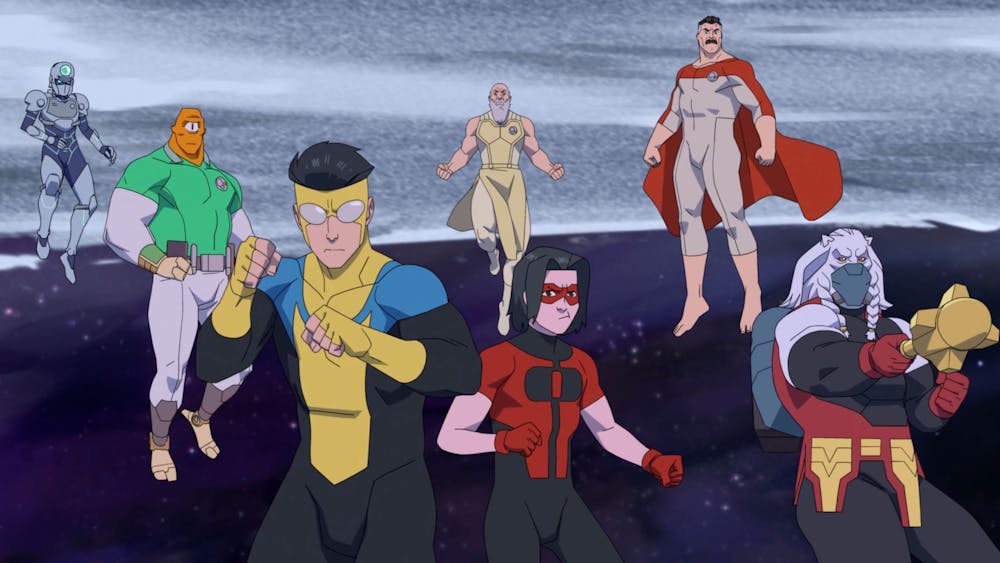
Invincible has gone through four seasons in five years. That pace is somewhat unheard of in modern television, especially for an animated series. But if there’s anything my economics major has taught me, it’s that every decision involves a trade–off. When you’re adapting a beloved and already completed comic series, you’re not starting from scratch—you already know where the story is going, which removes the burden of figuring out what happens next even as it introduces a different pressure to get it right. But faster production means tight animation schedules, and certain stylistic trade–offs have been evident since Season 1.
“But it’s Amazon—just throw money at it!” Oh, simple reader, they do. A lot. $10 million per episode. But a significant portion of that budget is clearly going to the celebrity voice cast: Steven Yeun, J. K. Simmons, Sandra Oh, and many more. So what would you rather have: elite voice performances from Oscar–winners or top–tier animation? Like I said—trade offs.
The intensity of that debate makes more sense once you consider the scale of the comic series being adapted. By “comic series”, I don’t mean some plotless newspaper “funnies” strip. No, I mean a modern, 144–issue, 12–year run from Image Comics, with fully realized characters, long–term arcs, and a definitive ending already in place.
Even with that scope, Invincible is beloved by both critics and fans—more importantly, it’s consistently enjoyable. There’s been remarkably little drop–off in enthusiasm (and especially viewership) across its run, a rarity for a show airing for half a decade. So if you somehow haven’t watched it and/or are just doomscrolling Street, here’s the simplest pitch: the show is good, and you will probably like it.
This season, however, has been a bit of a mixed bag.
One of Invincible’s recurring issues is how often it slips into a “villain of the week” structure. With only eight episodes per season viewers come into every scene expecting something of substance. Season 1 gets a pass—Omni–Man’s (J.K. Simmons) murderous agenda is hidden, and Mark (Steven Yeun) is learning what it means to be a hero, culminating in one of the most iconic finales in recent memory. And to the show’s credit, that late–season strength hasn’t faded—Invincible knows how to stick the landing, every time.
But these explosive finales often come after long stretches that feel like filler. Half of every season is spent on aimless side plots, while the other half slowly builds toward the Viltrum conflict—the show’s one consequential storyline. Season 4 follows the same pattern, though the weaker material is more front–loaded.
Season 4 still has strong character moments, especially with Mark’s ongoing struggle over whether killing can ever be justified. But the rotating lineup of villains becomes frustrating, especially when they’re not even new. Titan (Todd Williams), Mr. Liu (Tzi Ma), the Sequids—we’ve seen all of this before, and none of it is nearly as interesting as the larger Viltrum narrative. Yes, comic books are famous for lacking any real consequences, but that pattern becomes tiring when it means that the same side–villains show up over and over again, even after being defeated.
That repetition is partly a result of how faithfully Invincible follows the comics. Adaptations often walk a line between faithfulness and reinvention, from books to video games, but they rarely sit evenly between the two. As an example, look at The Boys, which shares almost nothing with its comic counterpart beyond character names and a gritty tone. Invincible takes the opposite approach, sticking closely to the original material with only minor tweaks—occasional gender swaps, expanded dialogue, and pacing adjustments.
That is, until Season 4, Episode 4.
This episode introduces a completely original storyline, and it is easily the weakest in the series. It attempts to expand on side characters and their literal demon underworld, but it fails at satisfying the one key goal of entertainment: being entertaining. The fans’ hellish (pun very much intended) reaction to the episode doesn’t mean the show shouldn’t take risks, but originality alone isn’t enough—the execution still has to be compelling. People aren’t opposed to new stories, but this one didn’t justify being pulled from the comic’s cutting room floor.
Thankfully, the back half of the season delivers. Once the Viltrum storyline takes center stage, the show hits another level. Episode 5 stands out as one of the best non–finale episodes the series has produced. The reunion between Omni–Man and Debbie (Sandra Oh) carries an emotional weight that’s been building Season 1, while Mark’s team getting ambushed by multiple Viltrumites provides some of the strongest action in the show so far.
The show keeps going from there: the Mark and Conquest (Jeffrey Dean Morgan) rematch, Oliver (Christian Convery) bonding with Omni–Man, the Coalition of Planets preparing for war, the looming presence of Thragg (Lee Pace), and so much more. It finally feels like the show is operating at the level it always should have been.
By far the most common criticism of Invincible is that its animation is subpar—and it’s a valid one. The show is often criticized for its simple art style and stiff movement, especially compared to other animated series with similar budgets, or even the original comic’s style.
A more interesting issue, however, is the show’s approach to power scaling—how the show handles the relative strength of its characters.
Because it has to support some of the most powerful characters in fiction, Invincible’s internal logic matters more than ever. One example of this is Space Racer (Winston Duke) and his “Infinity Ray,” a weapon capable of cutting through anything. When you introduce something that powerful, the show needs to establish clear limits. Whether that’s recharge time, energy constraints, or even a moral hesitation, there has to be a reason it isn’t used constantly. Without that, the show’s stakes start to feel inconsistent and frustrating.
Both of these complaints sound like nitpicks—and for many people, they are—but when they show up in almost every episode, they start to feel like real issues. Yes, arguing that a show is “bad” because “Character X punched character Y super hard before, so he should beat character Z!” sounds like kids arguing over toys—but when the show’s internal logic keeps breaking, it’s hard to ignore. And when those punches sometimes look stiffer than actually playing with toys, it doesn’t exactly help.
And yes, I know I described the finales as “explosive,” and that word is mostly earned through climactic fights from Seasons 1–3. But after three episodes of near–constant action in Season 4, I found myself enjoying the quieter, more emotional ending this time around, more akin to an epilogue. The fallout from the Viltrumite War was necessary—although it’s missing Mark blowing up at Cecil (Walton Goggins) for lying about Conquest. Still, the groundwork laid for future seasons has me incredibly excited.
So where does Invincible go from here?
We are already more than halfway through the comic’s storyline, and if the show’s current release schedule holds, Season 5 should arrive in early 2027. Its foundations are still incredibly strong; the show just needs to spend less time circling its best ideas and more time committing to them. Because when Invincible is focused, it becomes better than just “good”—it becomes one of the most exciting shows on television.