It’s April 7, 2026, and humans no longer die.
That’s the premise of 17776 (also known as What Football Will Look Like in the Future), a speculative fiction narrative by Jon Bois that unfolds through text, video, scrolling interfaces, and Google Maps zooms to imagine a distant future where humanity must confront the problem of living post–scarcity. With no death and no birth, the humans alive in 2026 are frozen in place, able to live, breathe, and advance forever.
There’s a certain kind of future that science fiction once trained us to expect, from Isaac Asimov’s gleaming rationalism to Jules Verne’s mechanical wonders or H. G. Wells’ far–off fears. Bois, however, imagines something stranger. 17776 is a story about immortality, but more than that, it’s about what happens when humanity discovers that eternal life is a very permanent threat to fulfillment.
Though the story is told from the perspective of three sentient space probes, it moves like an episodic travelogue through Americana—small Midwestern towns, untouched sidewalks, flooded coastlines, and an embarrassing human attachment to inanimate objects. Not much has changed—especially not America’s national obsession with football.
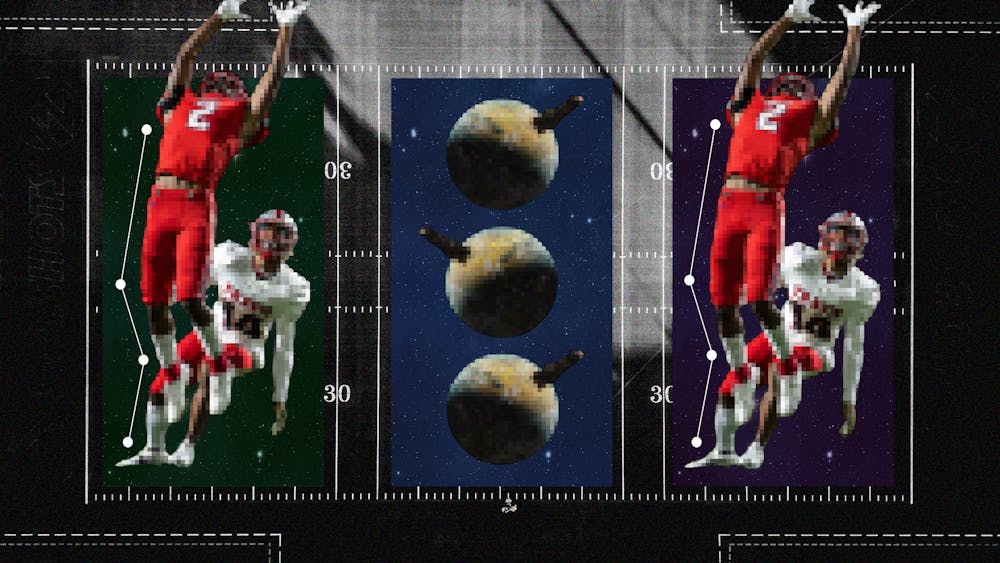
Culture hasn’t moved on, but the rules of football certainly have. A play might last years. A game might be stalled permanently by impenetrable geography. One match becomes a crawl through impossible terrain. Another turns into an industrial–scale scavenger hunt. It’s football—but it’s not, because the point is no longer winning in any conventional sense. It’s less of a sport and more of a civilizational hobby—and perhaps that’s what football has always been for America.
Though 17776 was published nearly a decade ago, it is (like all good science fiction) uncannily current. In the traditional sci–fi model, progress is both the plot and the promise. Humans advance to escape scarcity, labor, and our own limitations. But 17776 questions whether striving for a higher purpose actually makes life more tolerable. Bois couldn’t have told us that by 2026, humans would have created large language models that collapse our thoughts into instantaneous answers. But he can tell us exactly why we’ll regret it. “If they advanced too much further technologically, those advances would inevitably intrude on their humanity,” 17776’s supporting satellite, Pioneer 10, says of humanity. “They wanted those precious three minutes between asking a question and knowing the answer.”
Science fiction once meant dreams of flying cars, utopian societies, and social equality. What we actually got was algorithmic feeds, gig economy precarity, and digital exhaustion. Theorist Mark Fisher described the “slow cancellation of the future” as the sense that modern society has stopped producing genuinely new ideas, and nowhere is that clearer than in our generation’s sci–fi. Alien invasions, time travel, and robots were codified long ago by Wells, Verne, Karel Čapek, and Asimov. Today’s sci–fi stories are just variations of these seminal works. Even when they’re brilliant, they’re still only operating inside a language that was built long ago.
17776 isn’t just a sci–fi story with multimedia flourishes—its web–native form is the whole point. The narrative unfolds through embedded videos, Google Earth images, chat logs, fake archives, and nested pages that feel less like chapters than detours. At a moment when online storytelling has been flattened into a standardized grid on a feed, 17776 uses that same environment to make the reader feel disoriented and strangely alive. In doing so, it suggests a path forward for science fiction itself—progress will not come by recycling century–old tropes, but by interrogating the anxieties of our own moment, where stagnation, over–optimization, and the limits of imagination have replaced rockets and robots as the genre’s central concerns.
And at the center of all this is my least–favorite sport: football. Football produces structure out of chaos, ritual out of contact, and narrative out of repetition. It creates artificial stakes, which turns out to be exactly what an immortal civilization needs. The games in 17776 are ridiculous because they have to be. If eternity is the setting, then the game must become enormous enough to hold it.
Bois understands that people will build strange systems around themselves no matter what the future looks like. Innovation is not always about progress. Sometimes, it just comes out of the desperate need to keep wanting. Maybe our own advancement is just an elaborate way of staying entertained.
In the end, 17776 mourns the loss of the classic sci–fi future while exposing what was always hiding inside it—a fantasy of progress concealing a fantasy of relief. Bois’ future isn’t a destination, but a condition. Humanity is stuck with it, and that is what makes the story feel so human. It’s not the immortality, not the satellites, not the absurd field dimensions or the endless football logistics. It’s the refusal to stop making meaning even after meaning has become almost impossible. 17776 imagines a world where humanity has everything except the ability to be finished. In that sense, it’s not really a story about the future at all. It’s a story about the stubborn, ridiculous, deeply familiar fact that people will keep going, inventing, and playing—at least as long as they can still desire.