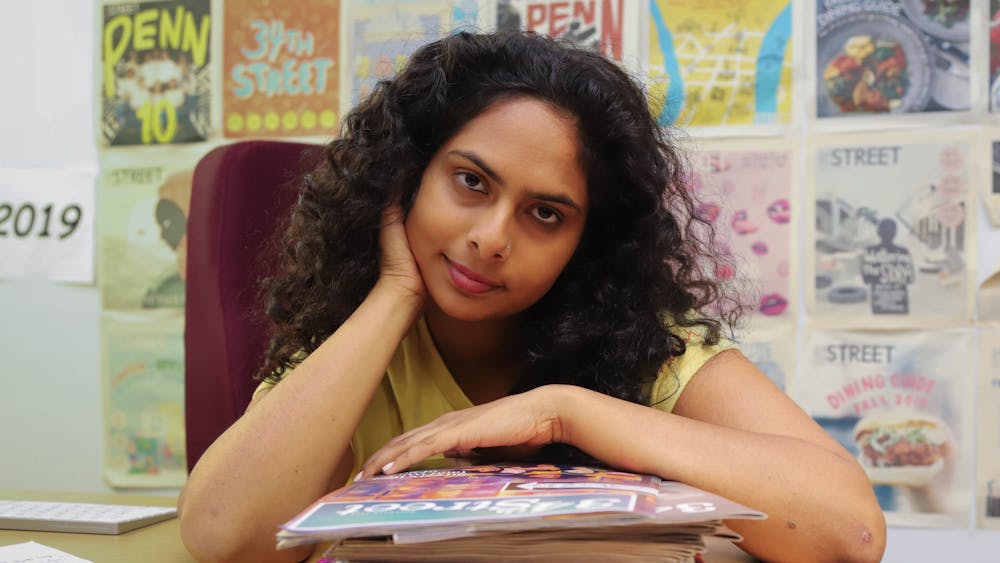
I often say that if I was hit by a laser that turned me into a girl, I would probably become Norah Rami (C ’26). I think she’d concur with that assessment. The two of us grew up in very technology–focused, very Indian suburbs. We both find pleasure in aimless and meandering conversations. And, of course, we both eventually found a home for ourselves at Street.
I first met Norah during my initiation into Penn’s mock trial team, when we traded Spotify usernames and talked about my then–pending application to be a Street Music beat. Countless production nights, edit sessions, and karaoke socials later, the first impression I formed of her still persists in my mind—that of a charismatic firebrand who’s never been afraid to chart her own course. While she’s always embraced spontaneity, Norah now has her next couple of years neatly planned out—she’ll spend a summer in New York as a reporter at Bloomberg, then study at the London School of Economics and the University of Oxford as a Marshall Scholar.
I sat down with Norah intending to discuss her storied career at Penn, and maybe let her wax poetic about how her time at Street shaped her life. We ended up discussing anything—and everything—but.
Hometown: Sugar Land, Texas
Field of Study: Major in political science and English, minor in history
Activities: Street, Friars Senior Society, Pi Sigma Alpha, University Scholars
You’re in your last semester at Penn. What gives your life meaning?
To be honest, I feel like my life has only recently regained meaning. I turned in my thesis on Sunday, and I finally got my documents from Marshall today. Now I have nothing to worry about—and honestly, I was kind of worried about that. What do I do when I don’t have this existential fear of failure driving me? But now I feel like a human being rather than someone who just does stuff. I’ve wanted that feeling for so long, and now I suddenly have it.
Was it difficult to build structure out of this freedom?
Not really. I joke that if I had more time, I would probably just read and write more—which is what I have to do with my time anyway. When I first came into college, I think the lack of structure in my day really threw me off. In high school, I had every one of my hours scheduled, but when I got to Penn, I realized that if I made my life a jungle gym of Google Calendars, I wouldn’t be able to be a person. I barely use my calendar now—so sometimes I forget stuff, or I don’t come to work. But for the most part, it lets me be more free and intentional with what I’m doing.
What’s your most unorthodox conviction?
I think that everything is a choice. Like, yes, you have to work to survive, but you can also choose not to—you just don’t want to live with those consequences. There are certain consequences I don’t want to face, but it’s not that I have to do anything. I’m choosing to do that.
How does that change the way you live your life?
I think that it makes me think a lot about what I do as a person. You know, I chose to spend my whole spring break in Vermont working on my thesis. I didn’t have to do that. And so if I’m unhappy writing in this tiny–ass cabin, that’s not my thesis advisor’s fault. It’s not my thesis’ fault. It’s nobody’s fault but mine, so I might as well enjoy it.
When I was a freshman at Penn, I felt a lot of pressure to make the “right choice.” I sometimes wished that I just had someone telling me what to do. But then I realized that even if I had listened to that person, it would be my choice to listen to them. I think that owning up to everything being my decision has given me a lot more power to move around and make choices—but it’s also made me bear the responsibility for those choices.
You grew up in Sugar Land, Texas—it’s very STEM–heavy, very preprofessional. But you chose to go into the humanities. Do you think you would have been happier if you chose the conventional path?
I imagine this alternate version of myself who was very preprofessional, someone who went to medical school, followed in my father’s footsteps and became a heart surgeon. I think that version of myself could be very happy, but I wouldn’t be friends with her.
My parents really encouraged me to think for myself and do my own thing. In my senior year of high school, I started caring a lot more about classroom drama and social pressures. But one night, my mom came to me after I had been out late and said, “You just wrote all your college apps about how you wanted to change the world. You’re not going to change the world if you keep acting like this.” And I think about that all the time!
I was always a weird kid. Once you lean into your weirdness, you start to liberate yourself from other social pressures. It’s really freeing, especially when it comes to pursuing a less orthodox career in the humanities.
Do you ever get concerned about the precarity of your career path?
I’m allergic to that question—I just have a mentality of presumptive failure. When I was thinking about studying computer science, or considering going to law school, I presumed that everything was going to fail. And if that’s your mindset, then you might as well do what’s unstable anyways, because everything is going to fail at an equal rate. It actually makes you more risk–prone when you think that every plane you board is bound to crash.
You say that you were always a “weird kid.” Is that how you want other people to see you?
When I was on a PennQuest retreat, there was one night where we all talked about how we perceived each other. And everyone else got descriptors like “kind,” or “funny,” or, “someone I want to hang out with on campus.” But when it was my turn, everyone went, "You’re smart. You know a lot about a lot of things.” And you know what, that was my fault—I spent a lot of time on that hike explaining the Madonna–whore complex. But I don’t want the first thing people think about me to be “smart.” The best description I’ve ever gotten was from one of my oldest friends, who called me a “rogue nerd.” And I really like that. Actually, I changed my mind. I like being called smart—whatever—but I like the rogue–nerd aspect of it.
If you had kids, would you raise them the same way you were raised?
I think people often consider having kids when they realize they’re not going to be fulfilled in this life. Having kids is a kind of immortality, because your will continues on through them, right? My family very much believes in reincarnation. And everyone says that I’m a reincarnation of my great–grandma. My great–grandma sort of grew up very much confined by gender norms, and she really wanted to have a career, travel the world and do all those things. She was a wonderful, wonderful person, but she wasn’t able to actually achieve any of the things that she dreamed about. And so, my family often says I’m my great–grandmother’s reincarnation, so what I achieve is her will manifested, her will actualized. And I think people often think about their children as an actualization of their will—at least, that’s my philosophy on children.
Do you think you’d be part of Andy Warhol’s Factory? (Ed. note: Norah asked me this question, but answered it herself).
I don’t think I’d be part of the Warhol Factory. I’m a disorganized person, and I really struggle with organized association.
I agree. If I’m at the Warhol Factory, and some other guy at The Factory sucks, I can’t really get rid of him.
Unless you become a new Warhol.
Yeah, but it sucks to be the guy who has to lead something.
But you’re Street’s editor–in–chief!
I’m not responding to that.
In sixth grade—and this goes back to why I would be bad in the Warhol Factory (Ed. note: it does not.). There was this one teacher who once told me, “Stop being so annoying, Norah, be quiet.” And I just found it to be rude. So then the next day, somehow, I courted everyone in my class to refuse to speak. The teacher is asking questions to this 30–person class, and nobody’s answering. And he asks, “What’s going on?” And nobody’s saying anything. Then, finally, my friend slides a piece of paper to the edge of his desk. The teacher picks it up and goes, “Norah, you made them do this?”
Did you get in trouble?
No. Honestly, I think he admired it.
That’s a pretty good protest. What’s your ideal system of government?
I don’t know. My political science degree was a waste.
What are your favorite ways to spend time on campus?
Well, I discovered this hack my freshman year, which is that if you really need to get work done, you go to one of those cubicles on the third floor of Van Pelt. You go there late at night and you will get done what you need to get done, because you need to leave as soon as possible. You feel like you are being transported into another world. See, I think to actually get work done, your study space should feel like torture—the basement of Gregory College House is another place where I have pulled many all–nighters.
What’s your favorite memory from your time at Penn?
Rephrase the question. Okay, the question is now, “What is a moment at Penn that you realized something new about yourself?”
There was this one time we were all sitting in my kitchen, and Nishanth [Ed. note: that’s me!] and our other friend were discussing who they thought the meanest people they knew were. And they both said I was one of the meanest! I think that really made me realize that I can be quite blunt, sometimes without intending to. I really never intend to be mean—but I guess that’s part of the problem.
If you had to envision the perfect future for yourself, ten years from now, where would you be?
I don’t know.
Lightning Round Questions:
Three people, living or dead, you’d want to get a beer with? Mindy Kailing, Susan Sontag, and former Street Editor–in–chief Walden Green (C ’24)
Favorite movie? Bend it Like Beckham
Least favorite song? “Close to You” by Gracie Abrams
There are two types of people at Penn: People who have a PennCard and people who don’t
And you are? I don’t have a PennCard.