
When you’re a kid, you’re taught to keep moving forward. Don’t hesitate, don’t dwell on things that can’t be changed, don’t look back unless you have to. Forward is progress and progress is everything. Exit 8 turns that idea on its head, and spins forward motion into something closer to a trap than a solution.
The premise of Exit 8 is almost comically simple. A man is trapped in an endless, underground subway corridor. The film never tries to inflate itself beyond the scale of its source material—a popular Japanese indie horror game, first released barely three years ago. It doesn’t turn a simple walking simulator into a sprawling epic or a grand statement. It stays small, and in doing so enables a very precise exploration of its themes.
Director Genki Kawamura’s restraint is what makes Exit 8 work so well. He doesn’t force the material into an overblown spectacle of explanation. Instead, he trusts the premise. He trusts the audience to sit inside the loop, repetition after repetition, without losing interest. The film unfolds almost entirely in real time—or at least in a way that feels close enough to real time to matter. We’re thrown into the loop almost immediately but discover the rules of the game slowly, and that slowness is essential. The movie isn’t interested in rushing toward its own gimmick. We’re meant to feel the deadening rhythm of the loop, falling into despair at the same time as our unnamed protagonist, the lost man (Kazunari Ninomiya).
The mechanic of the game is simple—if you notice an anomaly, turn back. If the hallway is unchanged, keep going. Most players can finish the game in 30 minutes. That leaves a lot of time to fill in a 95 minute film. Instead of changing the rules of the game, the film turns the rules into a way of thinking about life, especially a life structured by routine, delay, and avoidance. It makes the film feel global yet distinctly Japanese in its emotional and cultural logic. It’s not just about getting lost in a subway station, but getting lost in a system, in work, in obligations, and in the endless pressure to continue moving forward without looking back. The pressure to endure without complaint and neglect personal crises in favor of social order feels deeply tied to Japan’s intense work culture.
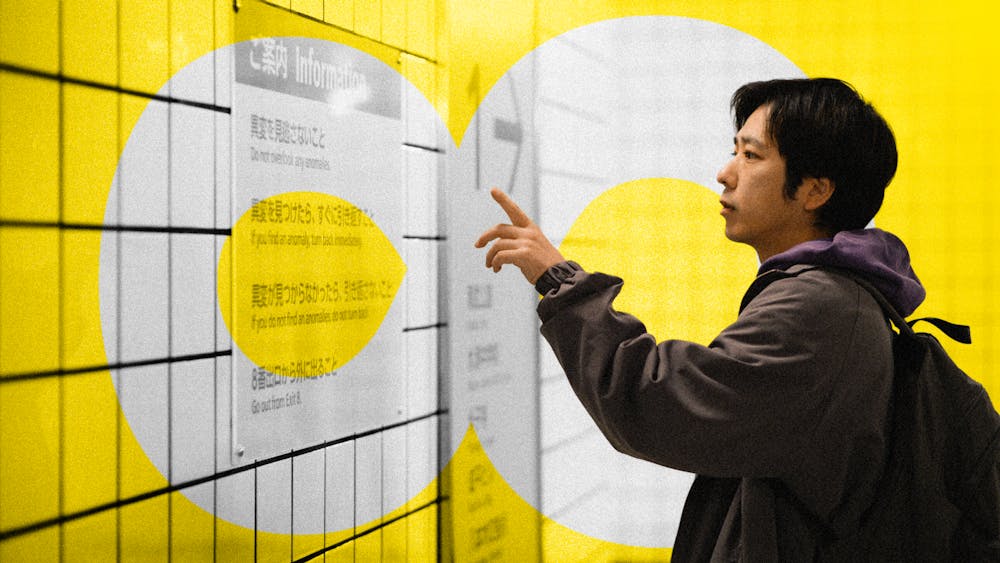
The set is one of the game and the film’s greatest achievements. Liminal spaces are everywhere in contemporary horror now—A24’s Backrooms may be the best example of this—but Exit 8 uses them with unusual discipline. The hallway is sterile, well–lit, ordinary, and almost aggressively unremarkable. It’s not an abandoned furniture store or abandoned hotel. It’s a place designed for transit, for movement, and for passing through without a thought. And yet, the corridor comes to evoke a debilitating sense of dread. Each return to the same white walls and yellow signage deepens the suspense until it’s impossible to remain calm.
The movie is great at making the repetition feel active rather than passive. Exit 8 could easily become monotonous, becoming a film that simply repeats itself until the concept wears thin. But Kawamura keeps finding new ways to make the same space feel unstable. The atmosphere mutates even when the hallway doesn’t. We keep searching every frame for differences, just as the lost man does. We wonder if the camera is pointing us to an anomaly. Every pass down the corridor becomes a test of attention, generating new anxieties. The movie effectively turns the audience into players, even though we can’t interact with anything.
Most of that tension comes from the camerawork, which is easily the best part about the film. Kawamura and cinematographer Keisuke Imamura make the hallway feel bigger than it is through long, sweeping oners that move with smooth confidence. The shots in Exit 8 feel minutes long—which is impressive, considering the average shot length in Hollywood is 2.5 seconds. The camera glides, tracks, pivots, and occasionally lingers just long enough for the frame to feel uncanny. The set starts to seem infinite not because it’s visually extravagant but because the camera just keeps on going. The camera reveals information slowly, and that delayed revelation is crucial. It makes every new detail feel earned, every anomaly feels like an intrusion into something otherwise sealed.
That’s when the movie’s emotional power sneaks up on you. Exit 8 doesn’t provide a huge range of feelings. It’s not a film with sweeping catharsis or constant emotional escalation. For much of its runtime, it remains tight, controlled, and restrained to the point of austerity. But then, it gives certain moments that land with real force because the film has been so careful with what it withholds. Its emotional core has something to do with guilt, something to do with fatherhood, something to do with the fear of becoming someone you’re not ready to become. The story never over-explains these pressures; instead, they hover just beneath the surface of the loop, waiting for the anomaly that will let them break through.
This is especially true of a very specific phone call scene, which occurs around one–third of the way into the film. It’s not just the content of the conversation that hits hard, but the way the scene is framed. The moment stretches just long enough to feel real, and then a rack focus quietly reframes everything. It’s a simple visual gesture, but forces the audience into the shoes of the lost man. The film doesn’t dramatize anything; it just lets you see it, and that’s enough.
Exit 8 doesn’t just recreate the game’s mechanics. It translates those mechanics into a human condition—the desire to proceed without reflecting, the fantasy that if we keep moving long enough, a solution will eventually appear. The film knows exactly how much it needs, and never asks for more. That modesty keeps the adaptation from becoming over–inflated, instead stripping the game down to atmosphere, rhythm, and dread. The subway corridor is not only a space for horror, but a mental space where avoidance turns physical. The lost man isn’t just trying to escape, he’s trying not to confront something, not to go back.
Ultimately, Exit 8 suggests that forward motion, on its own, is meaningless. You can walk forever, follow every rule, reach every checkpoint, and still be trapped if you refuse to actually see what’s behind you. In a society tailored to future–thinking, Exit 8 suggests that a life spent only looking forward is a life that never resolves. The only way out is to stop, turn around, and actually look. It might not guarantee escape, but it’s the only thing that makes movement meaningful at all.