At first glance, fashion and engineering couldn’t be more different. From ancient Mesopotamia to the 21st century, humans have been developing creative garment–making techniques, which successive generations of designers are constantly in conversation with. Engineering, meanwhile, seems to only look forward, focusing on endless progress toward a perfectly optimal solution. But beneath the surface, these fields are closer than they appear. Whether designing haute couture or building an autonomous robot, innovation in both fields stems from human necessity and requires constant collaboration. At their core, both engineering and fashion reveal something vital about what we value as a society through what we create.
Given their curiously similar philosophies, it is no surprise that a growing number of creatives are bridging the gap between fashion and engineering. Take, for example, Italian architect and professor Niccolo Casas, whose avant–garde acceptance of the digital age allows him to work productively in interdisciplinary spaces like fashion technology. Casas’ work spans many mediums and industries, with his long list of collaborators including fashion designers, medical startups, and environmental organizations. “My work is fundamentally driven by an interest in the notion of the limit—understood not as a separation, but as a space of simultaneity where two distinct conditions coexist,” Casas says. “These situations may manifest aesthetically and organizationally as patterns, thematically as fields of inquiry or experientially as bodies of knowledge and intellectual stances.”
What draws me to Casas’ art is how I can feel the meticulous intentionality in every single piece. By building dialogues between technology and the human experience into his work, every piece invites the audience to search for the deeper meaning. Smoke Dress, created in collaboration with Dutch designer Anouk Wipprecht, uses a microcontroller to emit a veil of smoke when a viewer gets too close. It’s an allusion, perhaps, to how technology may be depriving us of human connection and making it easier to hide behind screens.
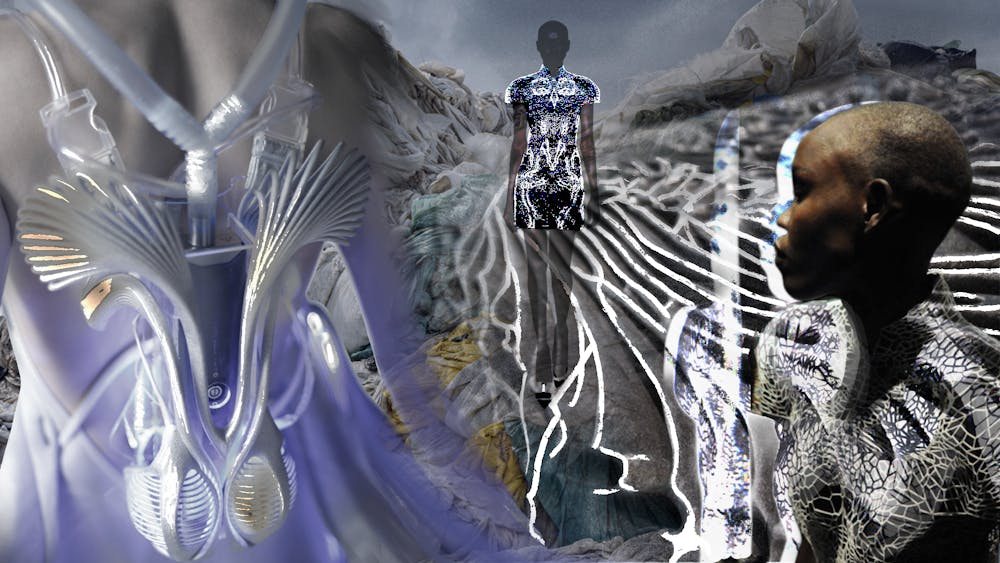
Much of Casas’ work involves 3D printing, a process that requires extensive planning. Aware of the inherent tension between calculation and movement, Casas consciously introduces “small imperfections and unresolved moments” in his work. These small imperfections, arising from using technology in unconventional ways and preserving any accidental irresolutions, allow his patterns to feel organic rather than purely algorithmic. Casas uses this purposeful ambiguity as a tool when crafting a narrative within his piece: “Two patterns, two systems, two logics can coexist within the same space without being fully reconciled,” Casas says, “and it is precisely this ‘tension’ that keeps the work alive and generative.”
Casas thinks it will be a long time before 3D—printed clothes enter our everyday wardrobes—but that doesn’t diminish the fashion tech’s potential to transform the fashion industry. “Research that originated from purely aesthetic concerns, driven by the demands of haute couture to produce singular, unrepeatable pieces, ultimately evolved into a production methodology with significant ecological potential, should it be democratized across large–scale fashion manufacturing,” he says.
Sustainability is a key driver of the fashion tech industry, and Casas’ work reflects this. To raise awareness about plastic use, he partnered with the environmental awareness organization Parley for the Oceans to build Plasticity—a 3D–printed sculpture made from upcycled plastic waste found on remote islands. Casas believes that interdisciplinary collaboration is essential to solving ecological challenges. “One does not learn from what is already familiar,” he says. “Engaging in multidisciplinary discourse is among the most effective means of generating genuine novelty, particularly in relation to ecological questions.”
A sustainable future is an interdisciplinary one, and Casas thinks artificial intelligence is the technology that will have the most impact in developing interdisciplinary spaces. “[AI] is an instrument for recognizing analogous patterns and discoveries across fields that would otherwise rarely intersect—a tool for dismantling the boundaries between knowledges,” he says.
Another major application of fashion tech is in the creation of sustainable replacements for common textiles. The global fashion industry produces 92 million tons of textile waste annually—with the rise of fast fashion, this number will only increase unless action is taken.
In 2021, Penn's DumoLab—spearheaded by Stuart Weitzman School of Design faculty member Laia Mogas–Soldevila—successfully manufactured a completely biodegradable, leather–like material made with silk protein and chitosan, a material made of shrimp shells. They used this material to create a dress called DERMA, which they unveiled at the Wharton Charity Fashion Show at the Philadelphia Museum of Art. “The cool thing about this fashion piece is that it’s soft and flexible at the hips … and stiff as a corset [above],” Mogas–Soldevila says.
Similar to Casas, DumoLab is experimenting with the use of 3D printing techniques for fashion. Using a retrofitted computer numerical control machine, they built a pneumatic extrusion system that Mogas–Soldevila calls “a two–and–a–half D printer.” Rather than printing layer by layer, the machine prints a hierarchical surface, manipulating the biomaterials’ properties throughout. “You can mediate the material properties of these gels by using a low molecular weight formula in the hips so that it’s more stretchy, and a high molecular weight [to make a] stiffer corset part that stands,” Mogas–Soldevila explains.
These biomaterials also have huge potential in fields beyond fashion—they can be used to manufacture plastic bags, cutlery, packaging, and much more. “The biomaterials revolution is coming,” Mogas–Soldevila says. “There are many consumables [that] can be replaced by biopolymers, I’m certain.”
One major barrier to long–term use of biomaterials is longevity, and DumoLab is currently trying to develop sustainable coatings to address this. “We are looking at ancient waxes, shellacs from bugs, and different types of coatings that can still allow all these leathers and surfaces to biodegrade at the end of life," Mogas–Soldevila says.
Looking further ahead, Mogas–Soldevila points toward food waste as a potential driver of the biomaterials revolution. “[Think of] the leaves, the stems, the shells of shrimp that nobody wants—all that unavoidable waste that we have in our food systems [and] construction systems,” she explains. “If that can become the material that makes buildings, furniture, and fashion, then it’s a win–win situation.”
The fashion–tech space is still young, but the pace of its growth suggests that it has a promising future. Through interdisciplinary work across architecture, engineering, and material science, pioneers such as Casas and Mogas–Soldevila are already pushing the boundaries of fashion and technology. To them, technology is no longer just a means to facilitate art—it’s become a mode of creative expression in its own right, ushering design into a more sustainable future.