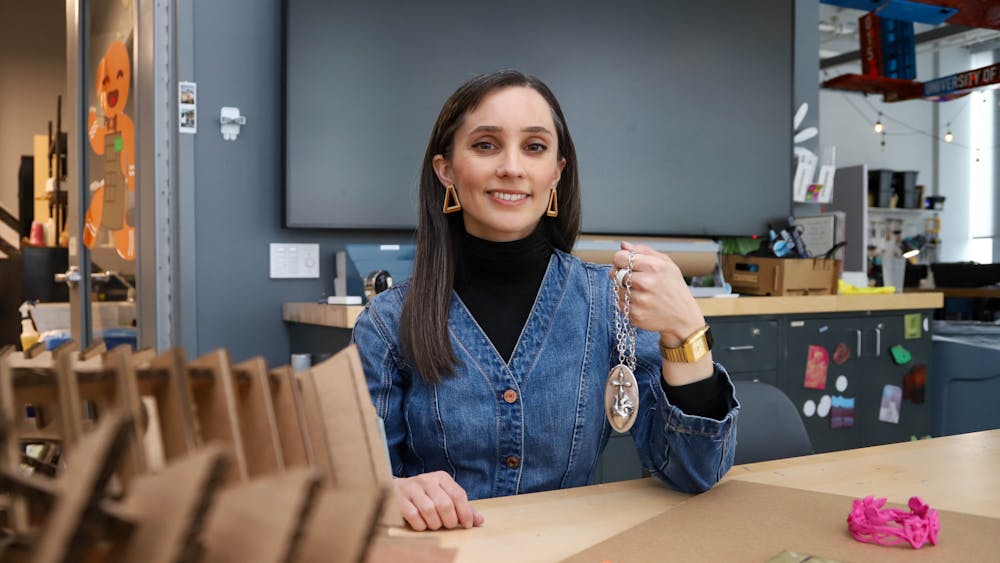
Upon entering Tangen Hall for the first time, one word came to mind: alive. The large workshop hummed with the whir of 3D printers and the chatter of students. As I was led through a tour of the space, careful to not bump into any student projects, all I could focus on was how full of life, passion, and creativity it was. No one embodies the energy of this space like its director, Taylor Caputo.
Caputo oversees all of the work that occurs in the Engineering Studios at Venture Lab, the first–floor makerspace in Tangen Hall. She helped design the space at its inception, using it to both teach students and conduct independent professional projects. She is also a pioneer in the incorporation of artificial intelligence into various artistic fields, most notably in physical product design.
Caputo’s journey to Tangen began at Temple University’s Tyler School of Art and Architecture, where she started off with an interest in ceramics and textiles. She always knew that making art would be a central focus in her life, and she couldn’t see a future in which she wasn’t pursuing a creative career. She was first exposed to digital fabrication, the process of turning digital designs into physical objects, in a jewelry–making class at Temple. “I was just like, ‘This is my jam,’” she says. Another important part of Caputo’s creative practice was the design and production of practical things. “That’s why ceramics and textiles always interested me, because inherently they’re used to create functional objects,” she explains. She discovered her love for education when she was given the opportunity to teach an introduction to metalworking class while in graduatec school at Penn. While showing students how to wield torches and hammers at 8 a.m. was hard work, she found it so rewarding that she chose to return the following semester.
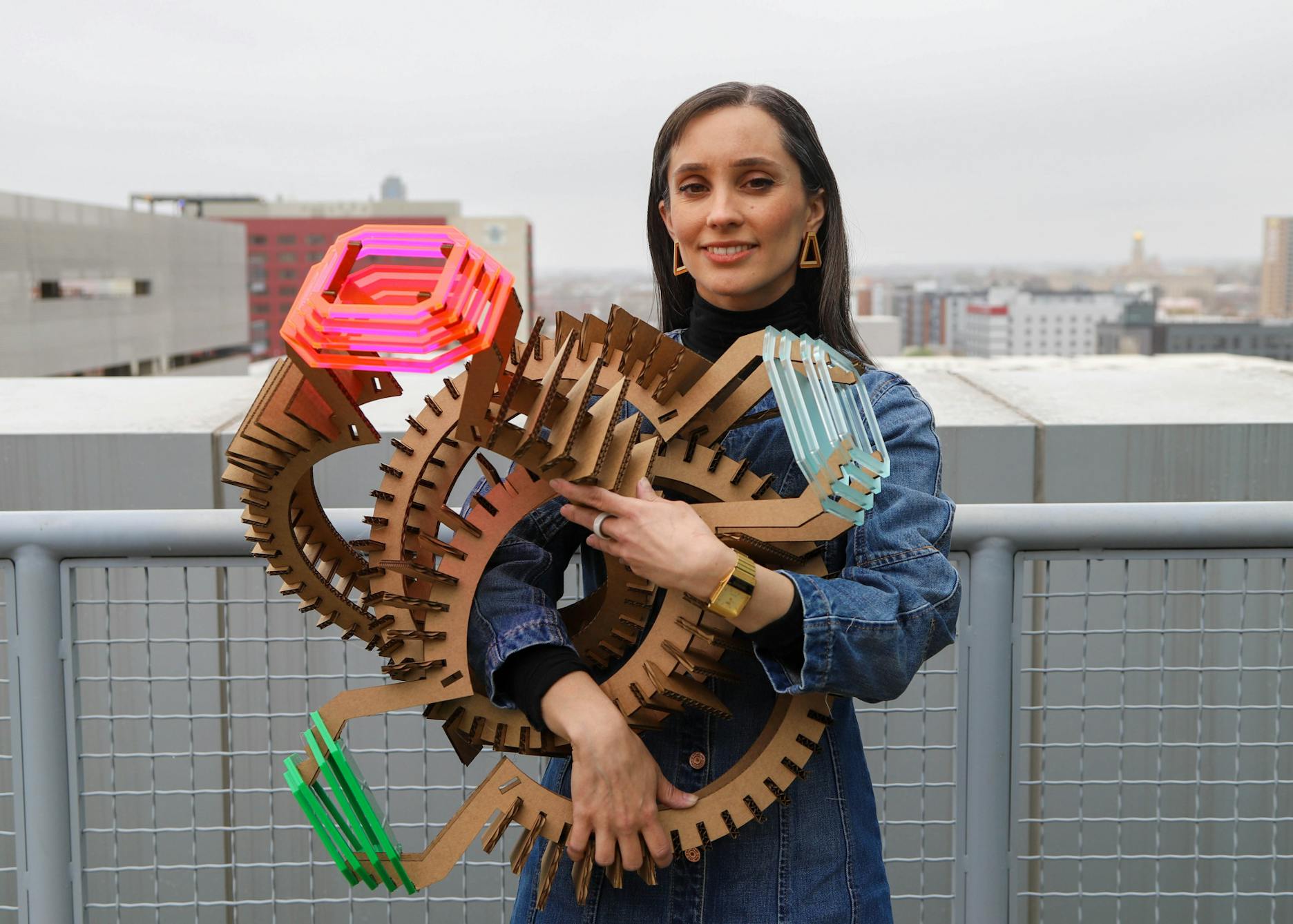
Unlike a traditional campus space like a lecture hall or library, the Engineering Studio is inherently collaborative. Its open floor plan and wide tables easily facilitate group work or parallel projects. And the best part: All of its resources are free for students, no matter the purpose. Building an easily accessible, low–barrier place to create and collaborate was important to Caputo, who wanted the space to mimic a studio in its culture. “That means you come and work in a studio every day, your friends are here, you’re all working on the same stuff,” she says. “It’s a slightly different type of educational experience, and it was such a great sense of community. You learn from everyone else as much as from your classes.”
Caputo believes the foundation of creativity lies in allowing everyone to “make weird stuff.” Two recent graduates of Penn’s Integrated Product Design master’s program were featured on Shark Tank for their product ChompSaw, a kid–safe cardboard cutter. The product was made possible by the resources and community of Venture Lab, and Caputo credits both the makerspace and the program for transforming two students with no business background into successful entrepreneurs.
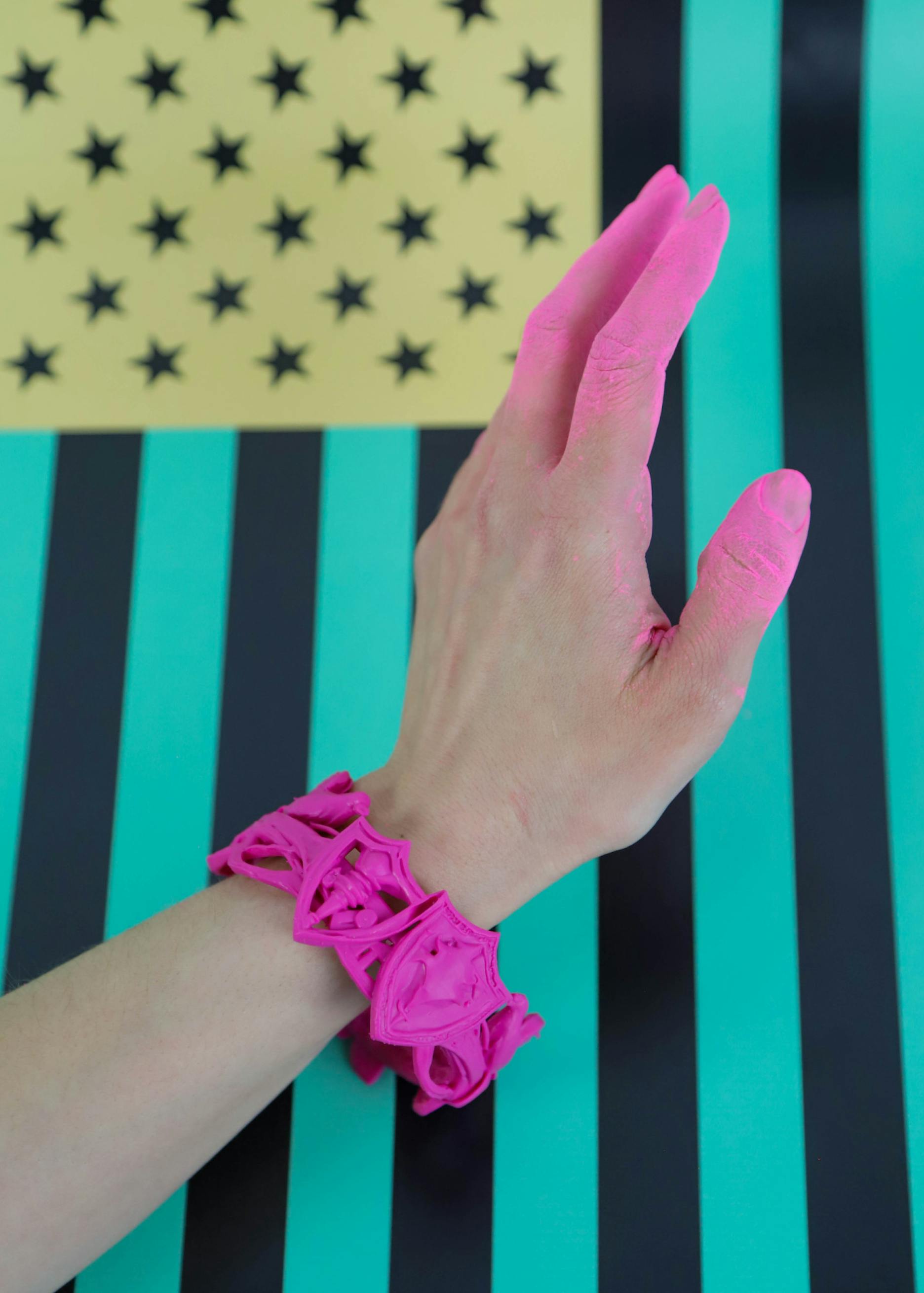
Caputo continues to offer one course, “How to Make Things,” that is designed to build students’ hands–on abilities, helping them create objects that are fully functional while still maintaining aesthetic value. On the table between us, she laid out some examples of past work to better explain how her class works. The first project is a laser–cut jigsaw puzzle, where students learn how to use tools for image creation and curate an experience with their piece. The rest of the semester has students incorporate AI into their design processes. Caputo presents a hot pink resin bow ring, her final product, to explain the second major project. Students use either text–based or image–based prompts to generate a 3D model of a meaningful symbol of their choosing, which gets combined with a ring band, printed, and used to design a mold of the final product. Throughout the class, students combine their design concepts with Meshy, an AI model, to produce pendants and other works.
Caputo’s use of AI in her works is something that sets her apart from many other artists, even those in her own field. While explaining this side of her work, she pulls out some of her more recent pieces as demonstratives. The first one, a small periwinkle heron, was generated through Meshy. Caputo notes that modeling organic materials like feathers is incredibly difficult, even for experienced users, so utilizing AI in that part of the process helps to streamline things. But technology is not just a means to a predetermined creative end—Caputo is also exploring the limits of these new programs by prompting them to visualize abstract concepts. Picking up a white bangle decorated with flora and birds, she explains that it was part of a personal project where she got Meshy to create a piece modeled after the themes of “life, liberty, and the pursuit of happiness.” Upon closer inspection, those themes become clearer in the bangle’s design: leaves and other natural elements encircle a Statue of Liberty–esque torch centerpiece. Though 3D–printed, the bangle has some of the fuzziness we have come to associate with AI–generated work. Caputo doesn’t consider this an inherent flaw, noting that she’s “still exploring the weird mushiness that AI produces,” as well as asking herself questions in the process: “When is that an advantage? Or when do you design around it?”
In creative spaces, AI use remains a hot topic. When it should be tolerated, if at all, is always under contestation—many people consider any application of AI to be an insult to “true art.” As made clear by her projects, Caputo disagrees. “AI is a tool,” Caputo says. “It’s used in tandem with anything else, whether that’s a CAD program or a laser cutter.” She acknowledges that there are limits to using AI—while it’s a valuable source for information or inspiration, using it expressly to generate concepts and recreate them as her own betrays her own identity as a creative.
No one who steps foot in Tangen Hall, which is brimming with Caputo’s creations, could deny that she is an artist. Her jewelry, models, and even the cardboard chairs that sit on the makerspace floor are manifestations of her spirit, put forth by the work of her hands. The incorporation of AI into her process doesn’t take any from that; it merely bolsters it. Like in mediums such as photography, artists are always the first to adopt new technologies, and points of contention arise with every new technological innovation.
“Why would you preclude yourself from using the internet 30 years ago, like a lot of people did, or from using 3D printing in the world of jewelry?” Caputo says. “There were a lot of people that were like, ‘No, this isn’t traditional.’ But like it or not, it’s going to be around.”