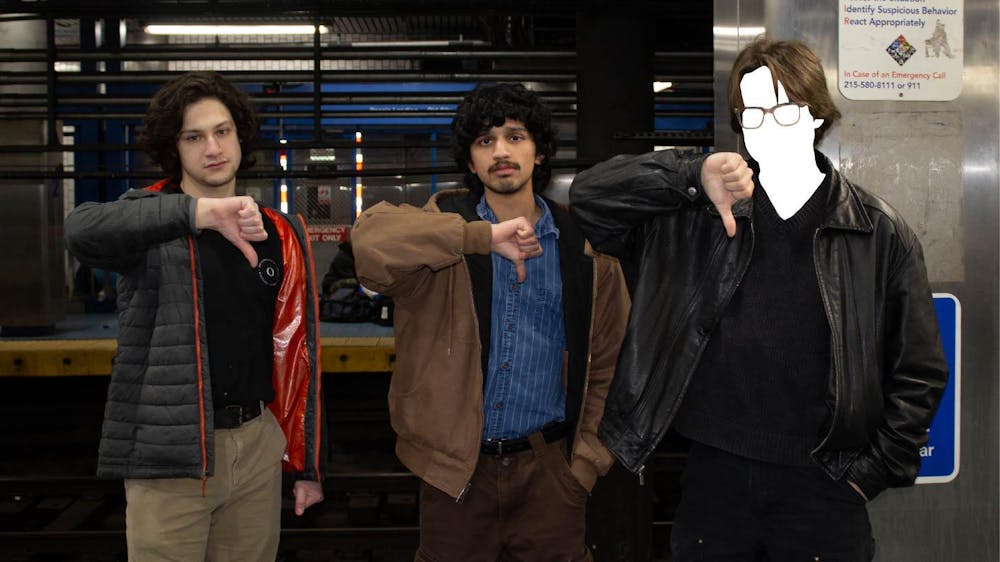
On March 27, Street attended this year’s tour of HUMP!, a 90–minute film festival featuring 23 independent pornographic short films. These adult vignettes ranged from the painfully benign to the faux surreal. As we watched, growing more and more numb to the horror with each “film,” we began to regret our choice of entertainment that night. This wasn’t the “underground,” “fearlessly curated” experience of “communal intimacy” advertised to us—this was yet another attempt to appear subversive, to stick it to the “industry.” In reality, it reinforced all the problems it hopes to solve.
In a room full of 200 people, I have never felt so alone. HUMP!, despite what its curators claim, doesn’t think that sex is about love, vulnerability, or the human experience. HUMP! thinks it’s all one big joke—but we weren’t laughing.
HUMP! 2026 opens with a music video titled “Boobs, Balls & Butts”—can you guess what it’s about? To the rhythm of a song on the title subject, performers slam their testes, breasts, and backsides against each other, smear them against glass shower doors, and adorn them with “cute” accessories. The blurb for “Boobs, Balls & Butts” calls it “a joyful body–affirming short”—but with cheesy lyrics and vocals that sounded AI–generated, there was hardly anything to be affirmed by or laugh about. While this kind of amateur, low effort media presented as self–aware camp or even humor acts as a consistent theme throughout the whole of HUMP! 2026, “Boobs, Balls & Butts” was, shockingly, one of the less offensive films at the festival.
A quarter of the way through the film festival, we encounter “Solidarity with the garbage workers on strike.” In it, lanky, alternatively–dressed gay men, cis and trans alike, raise awareness about a garbage worker strike in Berlin. They even express their willingness to sacrifice their bodies to the cause, after which the camera cuts to a protracted scene of activists performing various sexual acts on muscular, caution vest–clad garbage workers. The premise itself was amusing, but the line delivery, acting, and pacing of the film were so utterly atrocious that the whole thing was painful to sit through.
A later film titled “Outta Cuntroll” was perhaps the worst offender. Following this wannabe–kitschy pattern, “Outta Cuntroll” leverages a juvenile “random–equals–funny” faux absurdism, that disgusts more than it impresses. The film follows a pair of childishly dressed queer individuals playing with “Troll” dolls in a childish pink room. The scene quickly becomes sexual as the two use the toys to penetrate one another, as well as attach dildos to the Trolls to simulate penetration. The scene devolves further into more grotesque uses and abuses of the toys until finally it culminates with one of the two actors “birthing” two Troll figurines as the other actor encourages them to “push.” “Outta Cuntroll” has since been removed from the catalog of films on the HUMP! website—perhaps the curators were so utterly embarrassed by this creation that they wanted to destroy it.
The above shorts, among others, fall into a category of pseudo–intellectual kitsch seeking to haphazardly use the absurd and shocking to evoke a reaction. But how do films like “Outta Cuntroll” affirm anything? What is sex positive about this? Why should we laugh at the “ironic” vulgarity of “Boobs, Balls & Butts” when it sounds like AI–generated slop? Are we to believe that these films are simply random—or are they calculated and imbued with deeper artistic intention? Both of these options are frightening in their own ways. If they are random, then HUMP! has no self–awareness. If they are intentional, then HUMP! is, in a very sinister way, not what it claims to be.
HUMP! claims that it “continues to redefine how intimacy, humor, and art intersect on screen,” but there are three notable exceptions to this so–called “redefining.” The first exception, “Open Mic Night,” has a simple but absolutely confusing premise. An amateur stand–up comedian attending an open mic performs in front of a room that is empty save for one audience member—a young woman in short jean shorts sitting, legs sprawled, on two folding chairs. As he reads off cheesy jokes from his phone, he is interrupted by the woman, who initially boos him before demanding the man “lick [her] clit.” What follows after this excruciating stretch of bad acting is an absolutely uninspired, blandly heterosexual montage of the two characters performing various sexual acts on each other.
Later in the festival, we encounter “Echoes of Water.” This utterly boring film features another scene with two clean–shaven, conventionally attractive straight people making “love” next to a waterfall overlooking a scenic lake vista. Despite cinematic camera angles and big–box color grading, nothing about “Echoes of Water” is noteworthy. This short was so unbearably banal that the woman does not even orgasm—the sex is finished when the man is.
“Sovereign Tool” is also a shocking reinforcement of—even aggressive doubling down on—the norm. Basking in a room lit in red and purple, a muscular, tattooed man narrates how he perceives his partner as a “tool”: how she is his to use, and how he sees her as non–human. These narrations are not dirty talk to his partner, but instead presented as his mental state—his genuine beliefs aimed at the audience. All this is done over B–roll visuals of her suspended by ropes and harnesses, performing various semi–acrobatic sexual acts on the man. The man’s dollar–store Christian Grey intonation, coupled with his confident assertion that his partner possesses no autonomous will other than the desire to be his property, is cringe, unoriginal, and uses “kink” as an excuse to display what would otherwise be rightly dismissed as an obviously sexist rant.
These films represent a sort of slippage, in which the veneer of subversion is temporarily suspended. Behind it, we find the truth: that HUMP! is simply repackaging porn—and in these cases, bad heteronormative and sexist porn—and labeling it as visionary. The “fearless curation” is revealed to be completely devoid of substance. It possesses no means of determining whether or not its projected values are even represented in the media it displays.
HUMP! exploits the queer body to hide its unsavory intentions. “Chulicha” opens with a hunky trans man sensually washing a car. As he does so, another queer individual walks out and begins to admire him. They begin having sex on the hood of the car—there is not much else to this one. However, it is precisely the fact that the film incorporates no unique element other than the presence of queer people that invites a troubling conclusion. HUMP! is not a project to enable queer self–expression; it is instead another way to subjugate the queer body to the dominant pornographic gaze.
The presence of queer bodies does not in and of itself make something inclusive or empowering. I contend that HUMP!’s use of queer bodies is deeply disempowering because it seeks to use queerness as a way to convince its viewers that they should be okay with what they are watching. That “Chulicha” does nothing to set itself apart from a typical straight porno illustrates this point.
Alongside “Chulicha,” “Outta Cuntroll,” and “Solidarity with the garbage workers on strike” have a similar problem. Queerness functions as a shield. By framing HUMP! as a work of empowerment and diversity, the curators dodge the responsibility of filtering out underlying stupidity that permeates throughout these films. In doing so, queerness is equated with amateurishness, kitsch, and unseriousness. This expands beyond queerness to concepts of “underground,” “DIY,” “art,” and even sex in general, trivializing its social texture and turning it into a dull aesthetic object. HUMP!’s curators do not want to normalize diversity in porn, they want to make diversity itself a pornographic object. They want audiences to believe that the porn they are watching is somehow more okay because it is diverse. This presentation sucks all life out of the queer experience, replacing any legitimate expression of autonomy and empowerment with a form of sexual tokenization.
Throughout the entire duration of the film festival, without fail, every single audience member (excluding myself and the group I attended with) laughed. To the audience of around 200, this was hilarious. Bad media can be funny, but bad media that pretends to be avant–garde to cover for its ridiculousness and corrosivity is simply tragic. This is how HUMP! is able to perpetuate itself. When audiences allow themselves to laugh at what should obviously be rejected, they feed HUMP!’s narrative that they are somehow progressive or visionary.
At what is supposedly the “best dirty little film festival in the world,” we are forced to ask: Is this the best you can do?