
What does it mean to be an actor? Some might define acting as reciting lines in front of a camera until the director yells “Cut!” Others take a more serious (and sometimes detrimental) approach and become their characters, blurring the lines between fiction and reality.
Whatever approach an actor takes, there is one thing that many seem to overlook: the role that actors play in shaping culture. Topics wrapped in popular fiction—such as toxic relationships, serial killers, and fatal attractions—work to shape reality in subtle but powerful ways. Actors are thus left with an unspoken, quiet responsibility: that they become direct participants in perpetuating these complex ideas. Should they take responsibility? And if so, how?
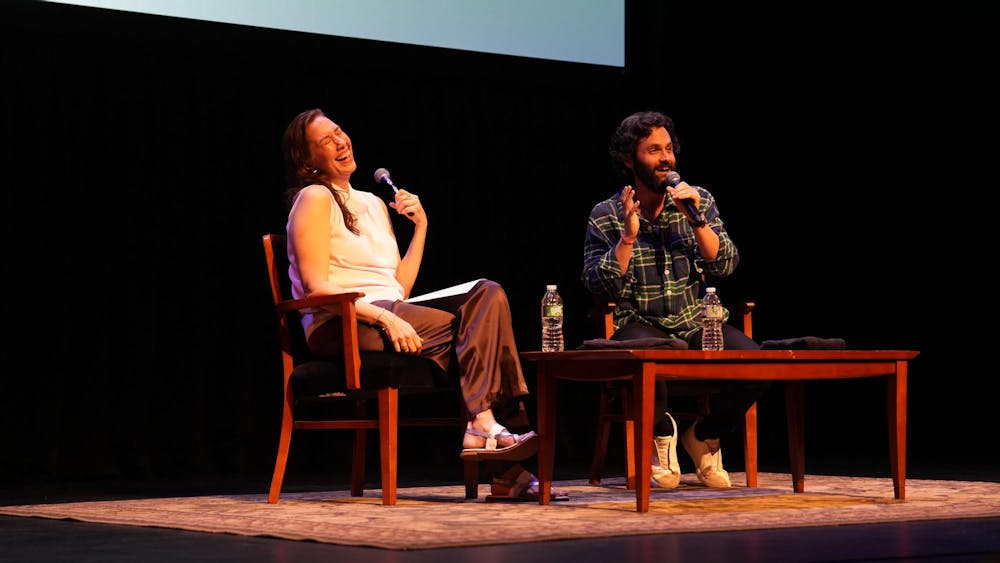
Penn Badgley brings this very idea to attention during a joint event between SPEC Connaissance and SPEC Film moderated by Nura Mowzoon. Badgley speaks to students about the mission behind his podcast Can We Talk and how he reconciles his craft with his ability to influence popular thought through film and television. Though his insights prove to be interesting, his delivery is ultimately confusing, undermining his desire to create space for meaningful conversations about how media shapes culture.
Badgley is known for his breakout role on Gossip Girl as the Upper East Side’s outsider Dan Humphrey. His fame has since grown after he portrayed deranged serial killer Joe Goldberg in the Netflix thriller series You, who uses his talents to pursue the women of his dreams.
Badgley begins by speaking in detail about his character in You and how Joe doesn’t see himself as a clinically insane serial killer, but instead thinks of himself as a romantic who is devotedly pursuing love—even if it means killing for it. However, in portraying this character, Badgley admits that he realized he was perpetuating a way of thinking about love that could be seen as “toxic.” To him, love as depicted in both You and Gossip Girl is abusive, where characters objectify the ones they love. It's a portrayal he finds potentially problematic in terms of shaping young people’s perceptions of relationship norms across media, and he wants to do something about it. While there is weight to these insights, they ultimately come across as vague and general, lacking concrete evidence beyond projects Badgley has directly worked on.
It was through a producing partner that Badgley first connected with moderator Mowzoon, who studies the science of relationships. After reflecting on his ideas, Mowzoon invited Badgley to speak to her students at Arizona State University about relationships, dating, and attraction, as she noticed that her students often had unhealthy or unrealistic expectations about these topics. Feedback was so positive that Badgley and Mowzoon were invited by other schools to address similar topics, working to provide a space for young people to have important conversations about media and cultural norms.
While addressing Penn students about the idea behind Can We Talk, Badgley echoes the importance of pushing back against today’s “polarizing media” by interrogating what Hollywood and media outlets have “programmed” young people to believe. But in doing so, he doesn’t cite any concrete examples to support these claims, and they land instead as confusing generalizations. Still, Badgley echoes these views multiple times during the talk, holding a pessimistic view of the entertainment industry at large and its ability to offer viewers hope and positivity.
When Mowzoon turns things over to student moderators, a voice from the crowd asks Bagley about the proudest moment of his acting career. His answer? Working on Season 4 of You. He explains that, while filming, he injected conversations he grappled with into his portrayal of Joe, exploring how his character misrepresents romantic relationships. He also describes the importance of watching himself act. Where most actors find it awkward to watch themselves on screen, Badgley watches himself to gain insight into how he contributes to the finished product. But this seems to be the only insight Badgley provides into his craft as an industry professional.
Student moderators invite both Mowzoon and Badgley to comment on one thing college students should hear. Surprisingly (though perhaps unsurprisingly, given the meandering nature of the talk), Badgley says very little, while Mowzoon answers the most, acknowledging the importance of building community to overcome rising anxiety. She explains how she's noticed that her students are feeling more anxious, retreating deeper into their phones and themselves instead of building genuine connections in the real world—what she sees as grieving for something you’ve never had. She stresses the importance of being proactive and building community with peers now, because so many people are waiting to connect.
Though Badgley makes interesting statements about the importance of having difficult conversations and interrogating narratives perpetuated by the media, his talk lacks a concrete structure, and his ideas never fully cohere. When students from SPEC ask him additional moderator questions, he often circles around them—or else offers answers so diffuse they barely register as answers at all. When asked which director he would love to work with next. Badgley claims that none of the industry’s current or upcoming projects excite him—a statement that lands as controversial, especially in an audience of aspiring entertainment industry professionals and given rising box office returns, alongside this year’s incredible Oscar wins.
But through the generalized statements tinted with a lack of optimism, there is something we can still take away: that the media is an ocean, and that by looking deeper inside it, we are looking deeper inside ourselves.