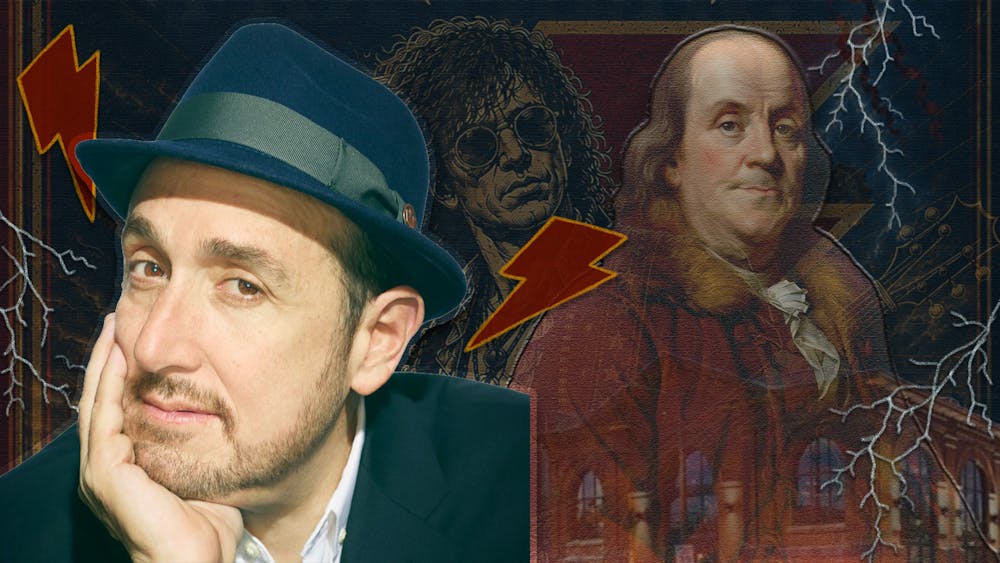
You can’t step foot on Penn’s campus without encountering something Benjamin Franklin themed. Literally—paths of Locust Walk have his wisest words immortalized in stone. Everything is Franklin–ified, from the athletic field bearing his name to the infamous campus bench that bears his likeness, leaving just enough space for the unsuspecting parent or tourist to snag a picture alongside him. To many students, Franklin is just another amorphous figure in Penn’s extensive history. Randall Lane (C’90) disagrees.
For Lane, four years at Penn made him feel like part of the “greater Franklin family.” Majoring in American history and spending his summers working in Philly only strengthened his ties to the figure. Penn was also responsible for introducing him to his other love: writing. In fact, it was years at The Daily Pennsylvanian (and a semester–long stint as a Street editor) that inspired him to pursue journalism and work for Forbes magazine, where he currently resides as editor–in–chief. In the decades of his writing career, he has written numerous articles and books. However, Lane’s newest project is far from the world of financial journalism. He recently finished writing a rock–and–roll musical retelling of Benjamin Franklin’s life titled The Sound of America. It portrays the founding father as a rock star, tackling the downfalls of his new international fame. The Sound of America began its run in Philly’s own FringeArts Theater on July 1st.
Lane’s extensive history knowledge imbued him with a deep fascination with Franklin, whom he sees as ahead of his time. He ran away from home, wrote under a pseudonym, and even had a common law marriage, something practically unheard of in the 1730s. His experiments led to his international renown, and he experienced all the positives and negatives that came with it. Forbes even ranks Franklin #2 in a list of self–made Americans, something Lane swears to me he had no influence in. “People would travel the world to see him and ‘rip his clothes off’ in an intellectual way. He was a man of letters and words and thoughts, and he wrote things that people loved. He had the ego, he had the illegitimate child, but he also did amazing things with his platform in a Bono or a Chris Martin kind of way. He was totally the first rock star in world history.” This idea of the figure greatly contrasts with the image of a fat guy with a kite so often associated with Franklin, but dovetails perfectly with the musical’s rock–and–roll soundtrack, something also quintessentially American.
Lane’s love for rock music was also a driving force in his creative direction. He’s been to countless rock concerts, and listened to artists across various subgenres. His love for it shines through the Zoom screen, as he describes how to him, rock is the “ultimate American art form. It's rebellious, it’s loud, it’s proud, it’s smart, and it’s hugely influential.” Despite this, it’s not very common in musical theatre. The Sound of America seeks to combine the theatre experience with the best parts of rock–and–roll: audience interaction, high energy, allowing people to laugh, dance, and have fun.
The exigence for this soundtrack came from an informal jingle for a Philly racehorse team alongside his high school friend and rock musician Todd Schwartz. Their friends loved it, which inspired the duo to take their songwriting skills to a greater scale. The music was a collaborative process that came very naturally from the two, flip–flopping between taking the lead. Sometimes Schwartz would come in with a killer track that Lane would pair with syllables, or Lane would draft lyrics for Schwartz to compose around. “There’s no such thing as one–platform storytelling. When you start playing with words, lots of good things happen. I’ve had 30–plus years of it, and so writing the script was very easy, because I’ve learned over the years how to tell and pace a story,” Lane reflects. And so, under a poster of The Who in Schwartz’s basement studio, The Sound of America was born.
Lane and Schwartz originally planned to take their musical to Broadway, but an inspirational “lightning strike” led them to open the show at Franklin’s first home and Lane’s second: Philadelphia. They stumbled upon the FringeArts Theater, sitting in the shadow of the Ben Franklin Bridge. Everywhere you turn is marked by Franklin: his print shop, his grave, the fire department he founded. Seeing his influence so strongly in one area solidified their choice, and they committed to making The Sound of America a fully Philly musical. “We realized this was becoming really Philly,” Lane explains, “So why not go all the way?” It started with the crew: the director is Philly’s own Kyle Metzger, and the cast pulls from Philly talent. They even brought Dr. Rosalind Remer, the preeminent Franklin scholar in America, from Drexel University to produce and fact–check. This is the city where Franklin built his legacy, so it’s the natural place to celebrate it.
Franklin isn’t the only cause of celebration in Philadelphia this July. The American Semiquincentennial overlaps with the show’s opening weekend. Philadelphia will be a red, white, and blue explosion of tourists and festivities, including a tour of Old City conducted by The Sound of America’s leading man Kohl Pilgrim. However, not everyone is matching the enthusiasm the city is projecting. The political turmoil that’s characterized the past few years has caused general patriotism to take a hit, as many citizens no longer feel that America and its ideals are something to be celebrated. Considering this background, Lane’s show could not have come at a better time. “Ben Franklin is the kind of person everybody can look to and say, ‘That person was truly a great American.’ The show’s central message is about unity. Without giving too much away, the show’s antagonist and Franklin’s real–life nemesis, Lord Wedderburn, connives to break up Franklin and his band. Lane included this metaphor to remind audiences that “when America’s united, it’s an amazing place, and when other people try to divide us, things can fall apart.”
While The Sound of America’s deep Philadelphia roots, fortuitous timing, and refreshing spin on a classic American figure all enhance the show’s presence, Lane’s focus when creating it was on enjoyment. “No one’s touching this thing because it's an intellectual journey about Ben Franklin. These songs kick rock–and–roll ass,” Lane admits. Of all of Randall Lane’s written works, this is his first published love letter: to Franklin, Philadelphia, and rock–and–roll.