
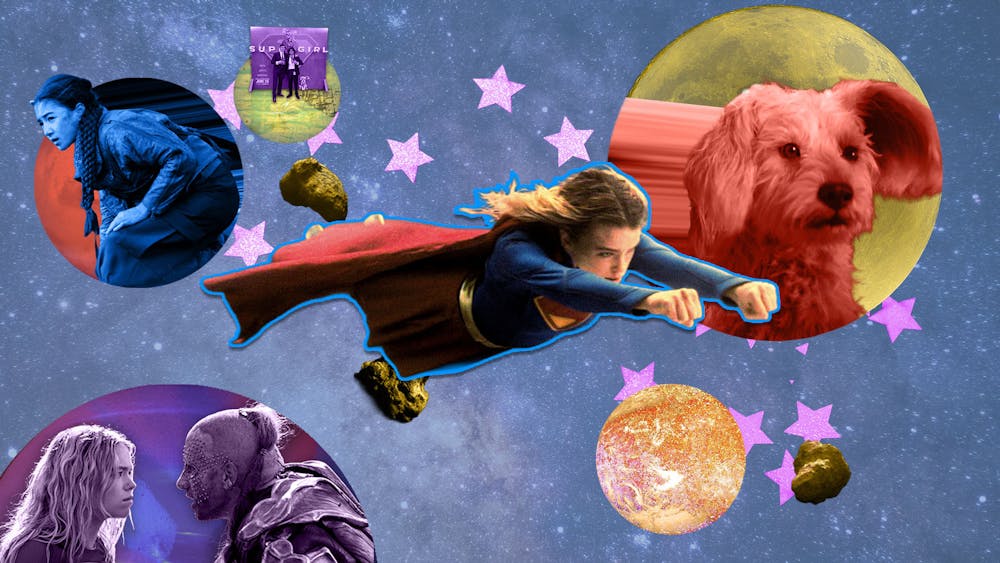
Last week, I had the once–in–a–lifetime pleasure of attending the world premiere of Supergirl.
After looking in the right places, asking the right people, and getting a healthy amount of luck on my side, I ended up in the same room as movie stars, CEOs, creators of all kinds whose work I love, and my plus–one, who couldn’t care less about superhero movies.
An experience like that should, by all accounts, make me like the movie more; it’s hard not to get swept up in the excitement of a premiere. So believe me when I say this: I didn’t care for Supergirl.
I held off on reading Tom King’s Supergirl: Woman of Tomorrow for almost three years. Not because I didn’t want to—quite the opposite. Ever since James Gunn announced a film adaptation from director Craig Gillespie as one of the first projects in his DCU, I wanted to experience the movie on its own terms. I didn’t want to spend two hours comparing every scene to the comic, and I certainly didn’t want to spoil the story for myself.
After seeing the film twice (for some reason), I read the comic. And, strangely enough, I think doing it in that order only strengthened my opinion of the movie. Viewed entirely on its own, Supergirl is fine. That’s probably the best word for it.
It feels like a perfectly acceptable superhero movie from 15 years ago. It doesn’t do anything egregiously wrong, but it also never does anything memorable. I walked away enjoying maybe four individual lines of dialogue, but beyond that, there isn’t anything that lingered in my mind.
The humor rarely lands, the visuals are unfortunately flat, the action lacks any particular inventive choreography, and no one has anything interesting to say. Every emotional beat arrives exactly when and how you expect it to, and almost every plot point feels pulled from a movie you’ve already seen.
Not only have you seen it before, but you’ve seen it done much better.
For almost the whole runtime, I thought I was watching Guardians of the Galaxy–Lite. The constant needle drops, the (somewhat) colorful space outposts, the parade of wacky alien creatures. At one point I forgot the characters weren’t on Knowhere. Supergirl never finds an identity of its own.
Even the story doesn’t create suspense. I never once found myself wondering “What’s going to happen next?” Every major moment feels telegraphed well in advance, turning the plot into little more than a checklist of familiar superhero beats.
Unfortunately, the characters aren’t much more compelling. Milly Alcock is perfectly solid as Kara Zor–El. I don’t think she gives a bad performance, per se, I just didn’t leave the theater desperate to see her in future projects. Jason Momoa’s Lobo, despite dominating much of the marketing, barely factors into the movie at all. Krem (Matthias Schoenaerts), meanwhile, is a villain assembled from generic fantasy parts with a few failed attempts at quirky characterization sprinkled on top.
Even Krypto, somehow, never quite works for me. Maybe this sounds heartless, but throughout the entire movie I never stopped seeing him as a fake, CGI dog standing next to real actors. Because I never fully bought his physical presence, I struggled to emotionally invest in the danger surrounding him.
There’s also one small writing habit that quickly becomes frustrating. Supergirl tells Ruthye (Eve Ridley) to stay put. Ruthye immediately ignores her. Supergirl tells Ruthye to stay put again. Ruthye ignores her again. The movie returns to this dynamic so many times that it just seemed like the screenplay was running out of ideas.
And, perhaps worst of all, the film’s best character ends up being Superman (David Corenswet).
I’m still not the biggest fan of James Gunn’s Superman. It’s one of those movies that’s difficult to explain my problems with because they’re more instinctive than analytical. I know its version of Clark Kent isn’t quite my ideal interpretation of the character, yet every time David Corenswet appears in Supergirl, the movie suddenly gains warmth. More importantly, it made me wish we spent more time exploring the contrast between Clark and Kara. Despite being family, they grew up under radically different circumstances, but the film barely scratches the surface of how differently those experiences shaped them and their outlooks on both life and other people.
With that, the Krypton flashbacks are a prime example of the movie brushing against something interesting without fully committing to it.
Whether placing the extended Krypton sequence midway through the film instead of opening with it was the right structural choice, I’m still undecided. But the sequence itself needed to breathe. I wanted to feel the slow collapse of Kryptonian society. I wanted to spend more time with and actually get emotionally invested in Kara’s parents. I wanted to meet friends she would lose forever. Instead, like much of the film, it rushes from beat to beat before those emotions have time to settle.
Ironically, that same pace also saves the movie. I can’t honestly call Supergirl boring, it moves too quickly for that. Instead, it settles into something arguably worse: generic. You move from one perfectly acceptable scene to another so quickly that none of them linger long enough to become actively frustrating, but none manage to leave a lasting impression either.
Then I read the comic.
All in all, this is about as faithful a comic adaptation as we’ve seen in live action—which is to say, not nearly as faithful as it first appears. The film preserves the broad outline. Ruthye recruits Supergirl after Krem murders her family and wounds Krypto, and together they travel across space hunting him down. Almost everything in between is different, and that’s where the movie loses what makes King’s story so special.
Rather than building each step of the journey into something distinct, the film smooths Woman of Tomorrow into a fairly generic space adventure, filled with interchangeable planets, forgettable action scenes, and merely serviceable world–building. Kara’s moral lesson to Ruthye about revenge and killing feels forced instead of emotionally earned. The comic couldn’t be more different.
For starters, the book spoils its ending within the opening pages. Ruthye tells readers (almost) exactly what happens to Krem and how he dies. Suddenly, “it’s about the journey, not the destination” stops sounding like a corny cliché and becomes the entire point of the story. Thankfully, it’s one fantastic journey.
Each issue introduces a world unlike the last. Oppressed civilizations, dinosaur planets, ancient magical artifacts, tests of will and strength. Every stop along the way expands both the universe and Kara herself. Ruthye’s incredibly well–written narration transforms what could have been a simple revenge story into something funny, heartbreaking, reflective, and both visually and textually beautiful. The movie captures the skeleton of that journey, but the comic gives it a soul.
One quote printed on the back cover from Comics Bookcase describes the series as having “a real sense of exotic cosmic adventure … almost entirely devoid of familiar sci–fi tropes.” If someone said that about the movie, I’d think they had watched an entirely different film.
Supergirl isn’t bad. It’s perfectly watchable, perfectly competent, and perfectly enjoyable to many. But after finally reading the comic that inspired it, I couldn’t shake the feeling that I had watched a surface–level interpretation of a great story rather than seeing what made it so great.
And that’s ultimately my biggest disappointment. The comic made me feel like I was exploring an endlessly strange universe with unforgettable people and places. The movie mostly made me feel like I’d been there before.