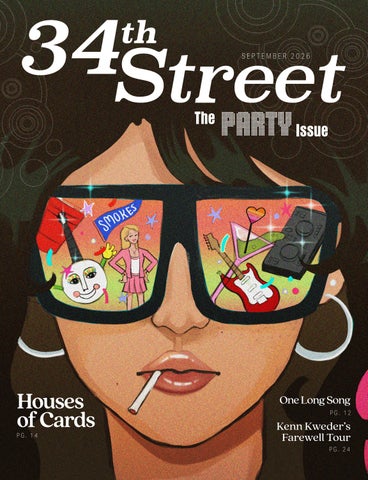
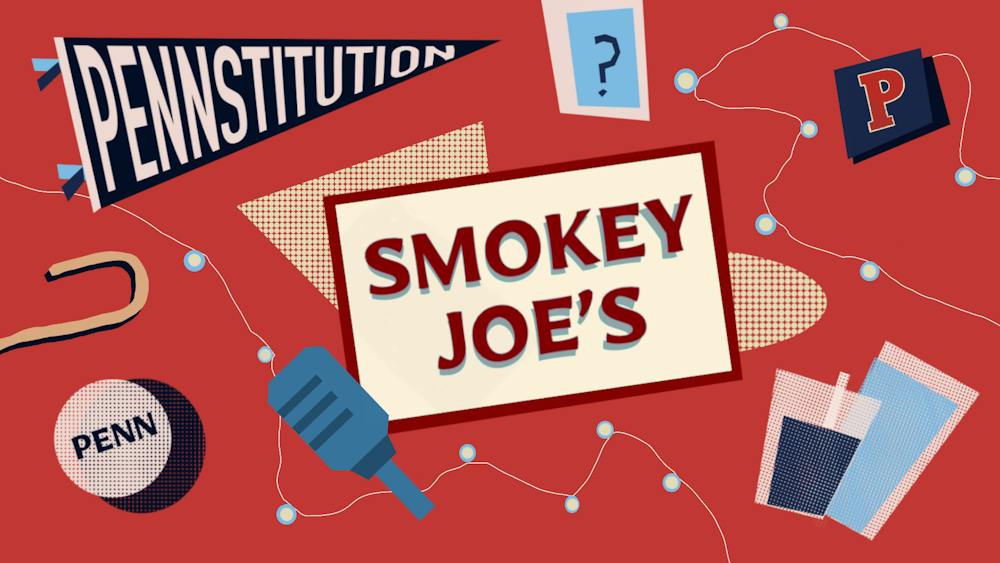
Walk down South 40th Street almost any weekend night and you’ll likely see a growing queue of athletes, fraternity date night post–gamers, and Kenn Kweder fans wrapping around the block. The light at the end of their tunnel is Penn’s infamous watering hole Smokey Joe’s. If you make it through the doors without getting a “Not tonight” from the bouncers, a small wooden staircase brings you up to a small wooden bar, with almost every available surface bearing scratched–in messages and initials left behind by countless generations of Penn students. Smokes’ has cemented itself as part of Penn’s history as much as any on–campus building, learning to change as students do without losing its familiar charm.
Smokes’ opened in 1933, but it was bought by Paul Ryan in 1952 upon his return from World War II. Since then, it’s been kept in the Ryan family. Ryan’s first move was hiring ten Penn football players as staff, a decision that has since grown into a tradition. Smokes’ continues to employ ten Penn students as bouncers and bartenders—a crucial aspect of its culture has become visiting your bartender friend or befriending the bouncers to avoid paying cover. Its close ties to the student body has earned it the nickname “Pennstitution,” and its walls are covered with Penn images and memorabilia.
Penn alum Paul Ryan III has been working there since his freshman move–in day at Penn. Ever since the bar was acquired by his grandfather, working to keep it alive is nothing short of a family tradition. He’s had a bartender’s–eye view of the establishment since the 2000s, making him keenly aware of the era’s social culture. Since then, he’s helped the bar adapt to the ups and downs of the modern age. “It’s a family business, so I’ve been in one way or another since I was a teenager,” Ryan says. “What’s interesting is it’s your neighborhood bar, but the neighborhood changes every four years.”
Smokes’ biggest setback this century was COVID–19, which caused the shutdown of many public spaces, including bars. The Ryans pinched pennies and scraped by, given a slight advantage due to the other local bars they own. But not all of University City’s college bars were so lucky—Cavanaugh’s, Blarney Stone, and City Tap House all closed their doors permanently due to the pandemic, leaving Smokes’ standing solo on South 40th. It would seems natural that Smokes’ would be grateful for the dwindling competition, but according to Ryan, it harms both Smokes’ and the neighborhood.
“When you’re the only bar left, people get really bored of you really quickly, and they’ll go downtown or go to house parties,” Ryan says. “When you have a number of bars in the area, you can walk to different spots and go see people at different places.”
Smokes’ post–pandemic struggles have largely been social. Both new technologies and new regulations have changed Penn nightlife greatly over the years—social media has made it easier to communicate where and when events are happening, but the Office of Fraternity and Sorority Life now turns those groups away to meet the 100–person cap. When asked about those changes, Ryan gives me the verbal equivalent of a shrug. What changed, he says, was not the number or the kind of students going out, but their behavior.
Now bearing the burden of being Penn’s only college bar, Smokes’ has had to adapt as students’ preferences change. The first large shift Ryan noticed was in drinking habits. “Drinking has gone down a lot, and people won’t go out as much during the weeknights,” Ryan says. “National alcohol brands have seen sales dip big time. I think your generation is much more health conscious than past generations, especially in terms of drinking culture.” Recent studies have shown that not only are more college students abstaining from drinking (28%, up from 20% in the 2000s), but those who chose to drink consume less. Binge drinking among college students has decreased from 40% to 20% in that same period. While everyone has a few friends that seem to disprove these trends, this decline spells bad news for a bar. When faced with this issue, Ryan’s solution was to find other reasons to get people in the door. They introduced specials like Quizzo and karaoke nights, which have now become Penn staples, and they also brought in student groups, like Penn’s stand–up comedy club Simply Chaos, to perform some nights. “We’re pushing people to come out for an experience, not just to come out for booze,” Ryan says.
The newest struggle Smokes’ is facing is technological. Having attended Penn in the 2000s, Ryan III is internet–age, getting the first glimpses of how modern–day staples like cell phones and social media affect students’ social lives. The biggest change is that of the “virtual third space,” where people now have a way to see, talk to, and spend time with other people without leaving the comfort of their dorms. “Now you can be in your room, technically alone, but instantly be attached and be a part of anything social going on,” Ryan says. “I gotta make it worth their while to get out of their room and go do something.”
Ryan acknowledges that his statement comes from “the old curmudgeon” in him and accepts that phones do come with social positives. They enable people to connect with others outside of their immediate vicinity, or turn one–off bar conversations into lasting connections. But perhaps the most noticeable consequence of online social culture is the possibility of being recorded.
“I was raised in the age of ‘What happened at the bar, stays at the bar,’ and you never talked about what happened at the bar the night before,” Ryan says. “[If] I were your age, I’d be worried that, at any moment, someone’s gonna take a picture or video of me doing something stupid, and ruin my life.”
While there are no easy answers to these changes, these shifts are also not necessarily things to be “solved.” For now, Smokes’ will simply continue doing what it does best: providing a physical third space where students feel comfortable spending time and making new memories.