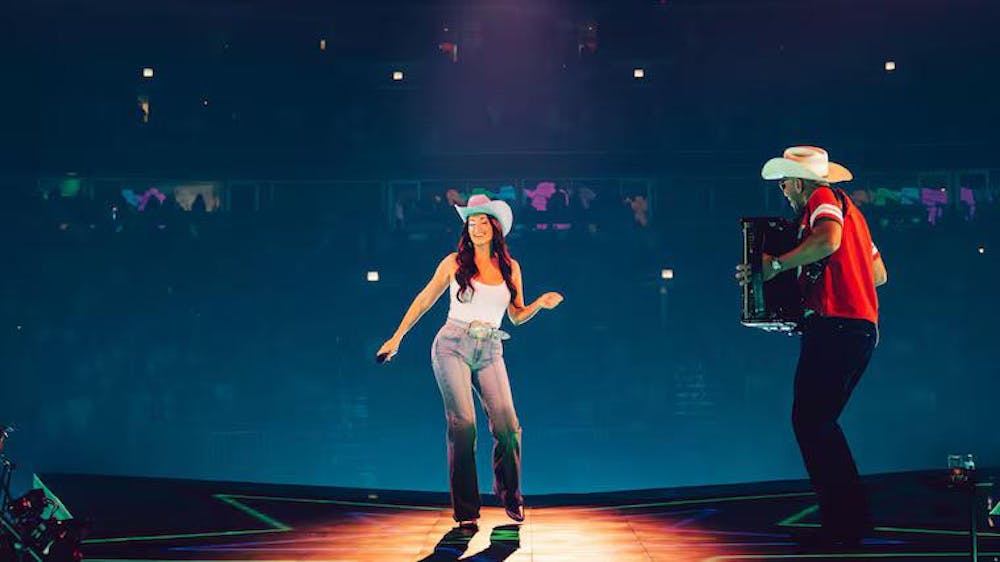
By the time AC/DC’s “Thunderstruck” blasted through the Xfinity Mobile Arena, Kacey Musgraves’ crowd had already spent the better part of the night cosplaying country music.
Pink cowboy hats covered in rhinestones shimmered across the stands. Fresh, still unbroken boots made the audience feel just a bit taller, completing the outfits that seemed assembled for the concert. But as the night wore on, the fashion choices gave way to comfort. Cowboy boots began appearing underneath seats and beside folding chairs, kicked off by concert–goers who soon realized looking the part was considerably easier than walking the way.
Prior to the show, the arena speakers cycled through what I can only describe as “Now That’s What I Call Country Music,” including top hits from Luke Bryan, Taylor Swift, and all the way to Garth Brooks. And then “Thunderstruck” rang out, and Musgraves walked from a faux Roadhouse onto center stage, aptly singing “Everybody Wants to be a Cowboy.”
It would have been easy to mistake the pre–show songs and stage design as an exercise in nostalgia, harkening back to a much simpler time in country music. Instead, over the next hour and forty minutes, Musgraves spent the night making an argument about what country music has been, what it has become, and who gets to decide what comes next.
On the Middle of Nowhere Tour, Musgraves makes one thing clear: she is a country musician, and country music is whatever the hell she wants it to be.
The declaration matters a lot for an artist who has spent much of her career stuck on the border between country and pop. Her 2013 debut, Same Trailer Different Park, garnered national attention. She established herself as a songwriter willing to stretch Nashville’s boundaries from within by discussing topics most musicians steered clear of, but this of course drew criticism from the more conservative side of radio. Five years later, the psychedelic glow of Golden Hour turned her into a crossover star and won the Grammy Album of the Year. Now, with Middle of Nowhere, Musgraves has wandered back towards the sound that first made her, but on her own terms.
Friday night’s show felt more like a homecoming than a retreat.
The setlist moved through her career almost like a survey of the competing definitions of country music that she has existed in. She effortlessly transitioned from her most recent country hits “Everybody Wants to be a Cowboy” and “Dry Spell” to 2013’s witty “Merry Go ‘Round” and back to the psychedelic, dizzy optimism of 2018’s “Butterflies.” Rather than being a chronological telling of her evolution as an artist, the setlist placed its competing versions of country music beside one another. Each version of herself remained on stage singing alongside the others.
That same idea expanded beyond just her career as she leaned further into country music’s broader traditions. Steel guitar and accordion colored the newer songs, and the cover of Texas Tornados’ “(Hey Baby) ¿Que Paso?” brought Tejano into a show that repeatedly pushed against culturally narrow definitions of what country music is enforced by its conservative gatekeepers. She ended the night with a cover of George Strait’s “All My Ex’s Live in Texas.” And amidst this methodical storytelling, she still manages to create moments of looseness. From spontaneously breaking out into the viral TikTok audio “Pink Blush” to leading the audience in singing “Here Come the Sixers” throughout the setlist, she manages to make her story feel a bit more local.
Even the stage design reflected this history. Musgraves performed on a rotating stage, no doubt a nod to George Strait, that spun her through a massive arena, creating a more intimate feel in a production that was otherwise filled with pop–excess and pyrotechnics. At no point does she discard country music’s traditions; she picks through them, keeps the parts she likes, and covers the rest in rhinestones.
Sometimes, quite literally.
During “Rhinestoned,” a pair of enormous, anatomically correct, disco “cojones” descended from the ceiling. Musgraves climbed aboard and hovered above the stage, turning the show into an absurdist spectacle.
The prop, of course, has already irritated some of those self–appointed guardians of country music. Big & Rich’s John Rich criticized the display online, suggesting that relying on such a stunt said something about the quality of her music and called it a “cry for help.” But his criticism inadvertently proved Musgraves’ point. The outrage depended on the assumption that only a select few get to decide what country music ought to look like.
If the spectacle felt new, the argument behind it was not. It is the same one she has been making for over a decade since “Follow Your Arrow.” She insists that people should kiss who they want, smoke what they want, and in general, mind their own damn business. When she sang it towards the end of the set, it did not feel like a relic of her “wild” past that she was obligated to play, but seamlessly woven beside her newer material.
Beneath all of the rhinestones, the continuity may be the show’s most convincing argument. When you take away the massive screens, the rotating stage, fire, and even the disco balls, the songs themselves are built around remarkably simple observations on love, disappointment, loneliness, and figuring out how to cope with it all—just as country music has been doing for a century.
And that is what makes her music so convincing. Country music, to her, is not something that belongs behind museum glass taken care of by only a select few privileged people. It is something that is alive, ever–changing, and worthy of being messed around with. At a time when country music has spent a better part of the decade infighting over what, or more importantly whom, it is supposed to represent, Musgraves provides a much simpler answer. It can have George Strait and rhinestones. Steel guitar and queer fans. Respecting tradition does not have to mean exclusion.
By the time the lights came back on in the arena, boots were taken off, hats laid in seats, rhinestones scattered on the ground, and country music was something bigger, messier, and much harder to define. After spending years between Nashville and pop culture, Kacey Musgraves finally found where she belongs.
For her, it is in the Middle of Nowhere.