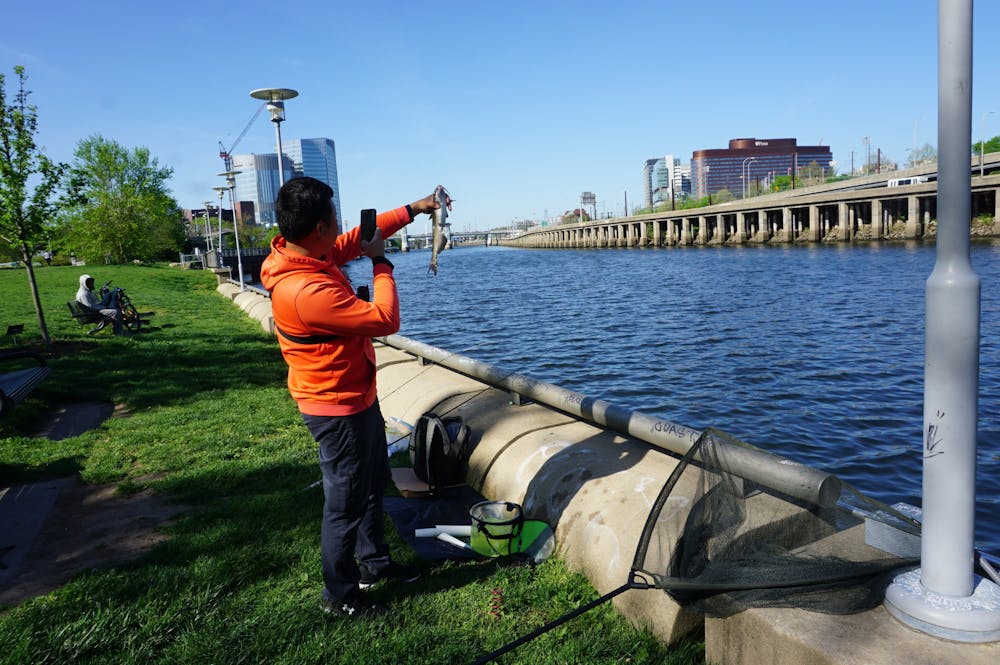
As summer sighs her first warm breath, fishermen take to the banks of Philadelphia’s Schuylkill River. Though many Philadelphians know the river for its reputed pollution and rumors of three–eyed fish, urban anglers have become a fixture of the river’s banks. Curious passersby may be concerned or intrigued, but at the end of the day, this is Philadelphia—it’s not the strangest thing to happen in this city.
Yet, two questions persist: who are these Schuylkill fishermen, and are they eating the fish?
Alfred Jackson Jr. certainly eats the fish. In fact, he’s been fishing in the Schuylkill for 48 years.
I spot Jackson on the banks of the river during one warm April afternoon. He’s sporting a kelly green Eagles–branded jersey and baseball cap with pride—A true Philadelphian. He stands on a concrete landing while his fishing poles slouch lazily against the railing, their translucent lines kissing the water as his trained eyes survey the Schuylkill River. This is his kingdom.
“Right down there where the trees is at, I started fishing there, my uncle was teaching me,” he recalls, “I was about 10 [years old].” Jackson points up the river, toward a coven of trees beneath the Fairmount Dam.
In the 48 years since he first learned to fish, he’s become well accustomed to cooking up his catches. “We catch ‘em and cook ‘em,” he tells me nonchalantly. Of course, he has his preferences. “If we catch the walleyes, we prefer the walleyes, but then we like the catfish [too].”
An inevitable question hangs in the humid Philadelphia air as I examine the river alongside Jackson: Is it safe to eat the fish?
According to the Commonwealth of Pennsylvania, certain categories of fish caught in the Schuylkill River are safe to consume roughly once a month, but other species like eel and carp are inadvisable to consume due to chemicals like PCBs. While adverse effects of consuming these contaminants may not emerge immediately, they can build up in the body, leading to anything ranging from “small changes in health that are hard to detect to birth defects and cancer.”
The river is contaminated with 14 billion gallons of untreated sewage each year, although pollution has actually decreased notably since its time as a primary runoff point for local industrial activities a century or two ago. The Schuylkill River Banks website tells the tales of bygone eras when “the tidal Schuylkill was choked with so much trash and effluent that the river was unable to carry it away from the city.” It was in the 1800s that the Fairmount Water Works, alongside the Fairmount Dam and Fairmount Park, was instituted to protect Philadelphia’s drinking water.
While rumors of mutant fish species are somewhat unfounded, it’s true that these waters haven’t always been a thriving ecosystem. “At one point the river was so polluted it could not sustain aquatic life in some areas,” the Schuylkill Banks website reads. The Schuylkill River Project was initiated in the 1940s to clean up the local waters and make them hospitable to wildlife once again. In 1995, the river was designated a State Heritage Area by the Department of Conservation and Natural Resources, cementing the importance of preserving and conserving the Schuylkill under Pennsylvania law.
So, while the fish in the Schuylkill aren’t really cut out to be high–grade sashimi, they are technically safe to consume if you follow the city’s guidelines.
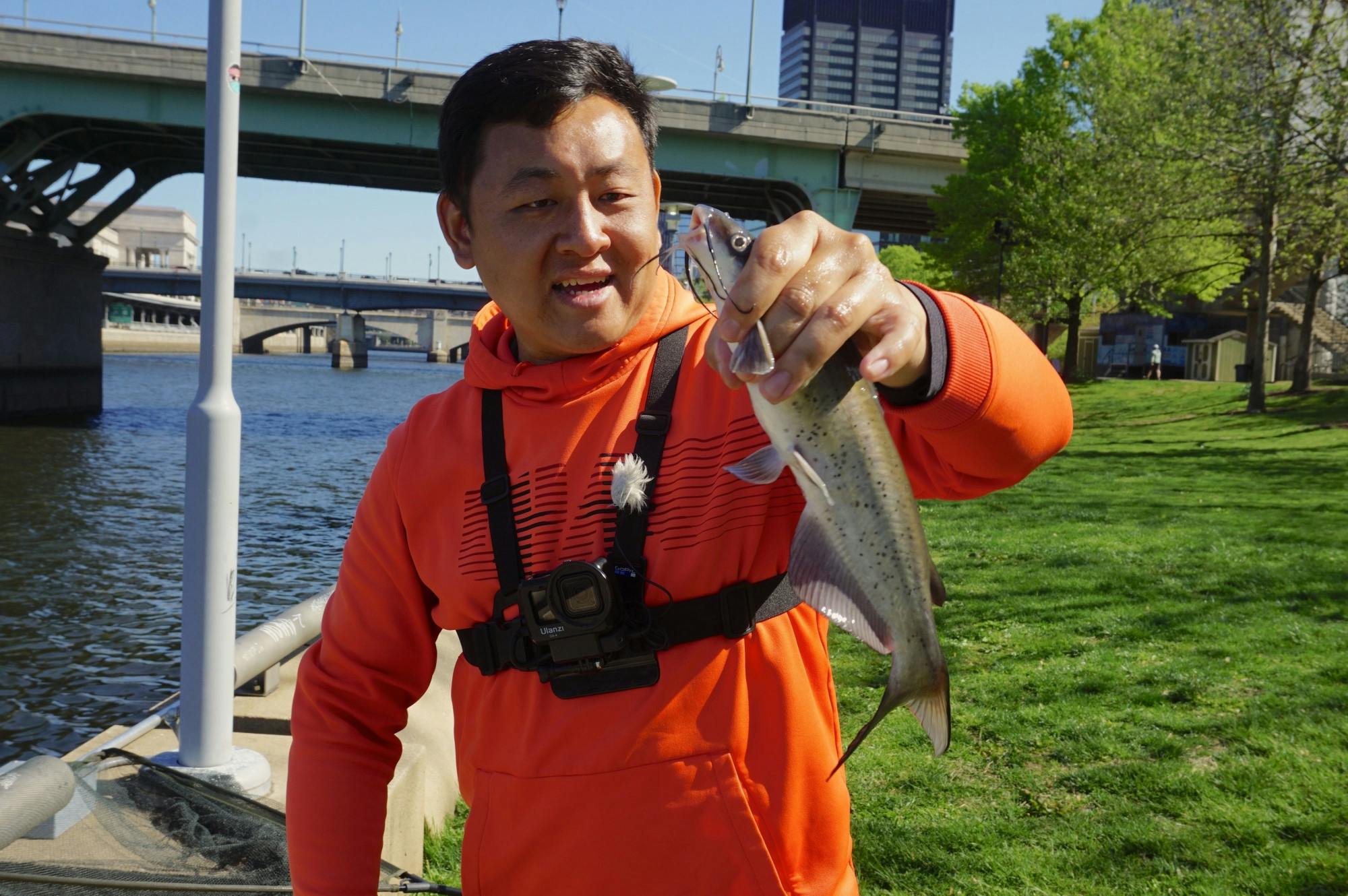
Leo Sheng, an urban angler known on YouTube as Extreme Philly Fishing, poses with a catfish before releasing it back into the Schuylkill River.
According to expert angler and renowned fishing YouTuber Leo Sheng (known to his followers as Extreme Philly Fishing), the saltwater fish that swim through the river are safer to eat than the “native” Schuylkill catfish that are laden with heavy metals.
That being said, Sheng doesn’t eat the fish he catches in the Schuylkill—primarily for health concerns, but also because it’s counter to his values and intentions as a catch–and–release fisherman and conservationist. Instead, Sheng is among the majority of urban Philadelphia fishers who engage in the sport for strictly recreational purposes. He’s what’s known as a “life lister.” “Not only [do] we just fish for fun for the majority of the time and not for food, [but] what we do is, like, we're Pokemon trainers. ... We try to catch as many different species of fish as possible in all different types of environments, in all different places,” Sheng explains.
However, there are other fishermen, like Jackson, who aren’t as interested in cataloging their catches or releasing them back into the water. “We come out to fish for whatever type that we have. Actually, they say that it’s 52 species of fish here. But I haven’t caught all 52. But I have caught quite a bit of fish,” he tells me.
Along with his favored walleyes and catfish, Jackson’s line has also reeled in stripers, American shad, yellow and white perch, bluegills, crappies, and spots (saltwater fish). I mentally catalog the species as he casually rattles them off, but truthfully, I can’t picture the variations he mentions until I search them up later, at home. But to Jackson and his fellow anglers, these fish and the fishing community are everything. Even when the water’s still a bit too cold and their lines get fewer bites, the camaraderie among anglers is enough to sustain these urban fishermen.
Mike Escott and his friend’s kid, James*, are among the recreational anglers who have found friendship while fishing on the Schuylkill.
When I spot the pair on one of my afternoon runs, James stands perched on the low concrete wall at the river’s edge, his hands clasping a fishing pole. A few paces away, a pit bull (whom I later learn is named Coco) keeps watch on a picnic blanket, occasionally making her presence known with a clipped, yet unthreatening bark.
Escott tells me in his lightly–accented Texan voice, “I hadn’t fished at all around here until his mom told me about the fishing tournament that they have.”
I know the one. “Philly Fun Fishing Fest, right?” I say.
“Yes, yes!” he replies in recognition.
Escott’s been frequenting the Schuylkill Banks ever since the 2019 tournament, allowing him to return to the sport he first learned to love during his years back in Texas. While Escott and James strictly participate in catch and release, Escott says, “every now and again, somebody will come up and ask for a fish, so you know, I’ll give ‘em a fish.” In the end, the success of Escott and James’s fishing outings isn’t dependent on the number of fish they catch. “It’s about the environment. I’ve had so many people come up and never think, like I did, about fishing in the Schuylkill,” Escott says.
Among Philadelphia anglers, the pastime of fishing in the Schuylkill seems to be sustained by word of mouth. In fact, that’s how Sheng, our resident urban angler, got his start on the river in the early 2010s. Before gaining a following of over 180,000 YouTube subscribers, he, too, was a student walking the banks of the Schuylkill to escape the stress of college life. Sheng had just moved from Brazil to Philadelphia for college, following in his sister’s footsteps.
“I saw this elderly gentleman fishing around Spring Garden Street. There’s a bridge over there. He was fishing right under it to the left side,” Sheng recalls. That man was one of the first people he saw fishing in the Schuylkill. Like most others, Sheng had no idea that it was possible—or that there were fish in the river.
The gentleman, like a wise and kind apparition, told Sheng everything he needed to know to start fishing in the river. After that fateful interaction, Sheng secured a fishing license and went to Dick’s Sporting Goods to get geared up. “I bought a fishing rod, you know, a very cheap one. I bought a spinning gear, a Daiwa Samurai, for $15 at the time,” he recalls. “I just hit the river and started catching everything,” he smiles, reminiscing.
Soon, Sheng branched out beyond the Schuylkill to other popular fishing areas like Pennypack Creek and Franklin Delano Roosevelt Park. By 2011, a few years before he began recording videos for his YouTube channel, Sheng started a fishing blog, which is still up and running.
In the years since launching his YouTube channel, Sheng has become a recognizable face in the fishing community. His videos are both comedic and educational, serving as an entertaining watch for fishers and laymen alike while also providing important information about safe and conservation–forward fishing practices. Nowadays, he says locals recognize him in the streets, while some followers have pursued degrees in environmental conservation because of him, and others have gone on to amass their own online fishing communities.
The impact of Sheng’s work is tangible. In fact, on one of my many outings searching for Schuylkill fishers, I met one of his subscribers, Hartley Walker Money.
Walker Money’s a lone fisher, perched on the edge of the cinderblock bank, sporting nothing but a backpack as he balances a pole in his hands. It’s a serendipitous meeting, and it’s only his second time out on the Schuylkill since moving to Philadelphia, he tells me.
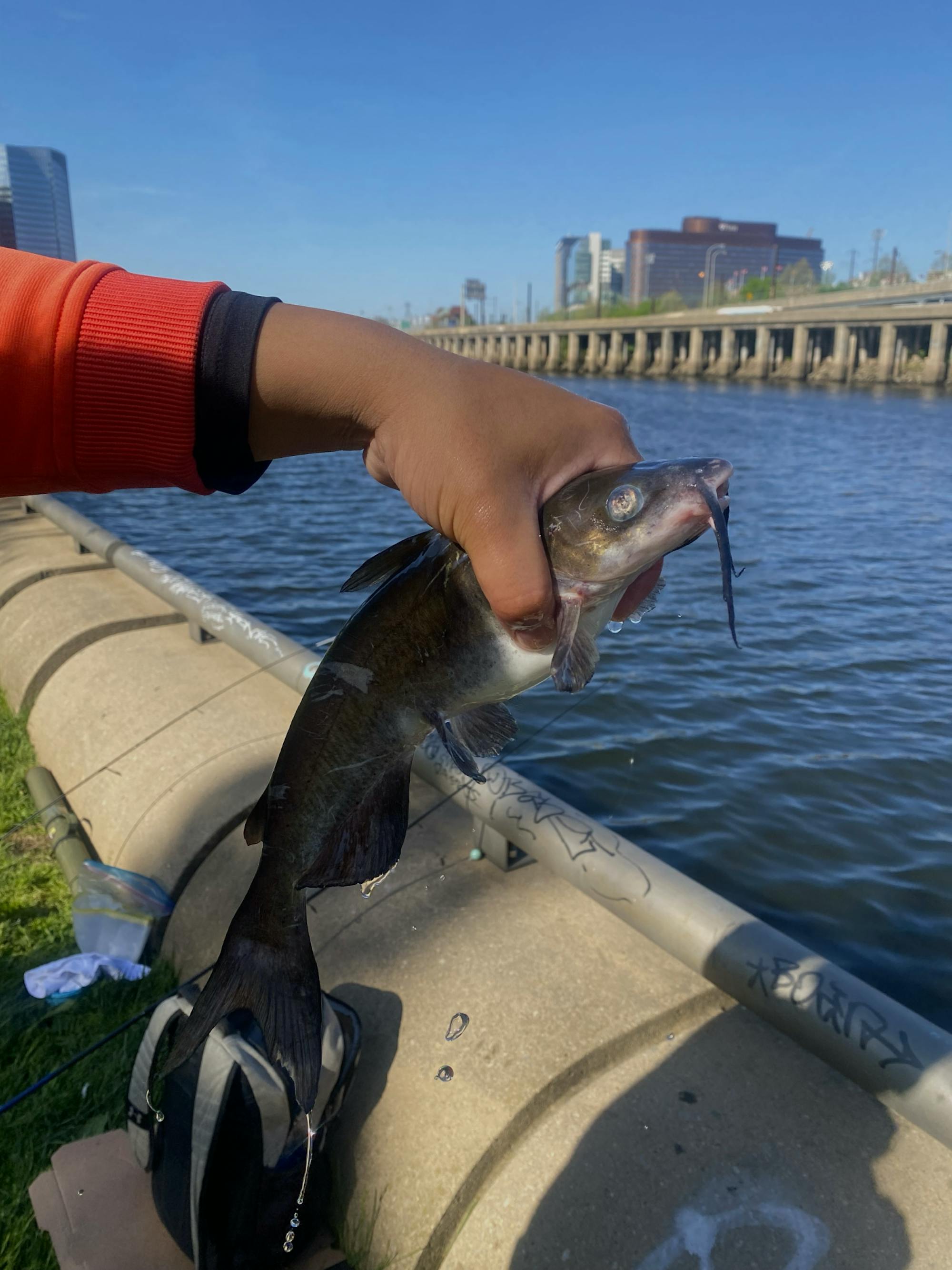
A catfish missing an eye, caught by Leo Sheng known as YouTuber Extreme Philly Fishing.
In fact, he learned about Philadelphia urban fishing through Sheng’s Extreme Philly Fishing channel while researching fishing spots during his move from Vermont to Philadelphia. “Basically everything I know about the Schuylkill is from that guy, just from watching his videos.” Like many other anglers, Walker Money’s been fishing for as long as he can remember. “I first picked up a fishing rod when I was probably six or seven years old,” he says. By the age of 12, he was sort of a pro: “I fished every chance I could get. [I] fish[ed] with my grandparents, fished with some family friends, and I fished both saltwater and freshwater.”
Lifelong anglers like Walker Money have found fisheries wherever they go—Escott and Sheng too, carried their love for fishing across miles of land and water. For Sheng, his lifelong identity as a fisherman seemed inevitable, taking root long before he was even born.
From the banks of Qingdao—China’s coastal Shandong province—to Brazil and eventually the waters of Philadelphia’s Schuylkill River, fishing has been in Sheng’s family for decades. Born to Chinese immigrants living in Brazil, Sheng’s upbringing was steeped in a complex history. His grandparents had their wealth and belongings seized during the period of political upheaval under Mao Zedong due to their association with the Chinese Nationalist Party. Consequently, his parents were born into abject poverty. It was then that fishing became a means of survival for Sheng’s father in China. “When my father was a kid, with my grandfather in Shandong, being a city that is pretty much by the coast, they would go saltwater fishing all the time. And my father, he would be able to catch different species of fish to bring home a stable fare for eating,” Sheng says.
By their mid–20s, Sheng’s parents had immigrated to Bolivia from China in hopes of more abundant opportunities, settling with a relative of his mother’s. In their early years in Bolivia, Sheng’s parents opened a restaurant, established themselves financially, and soon decided they wanted to try their luck in Brazil.
In Brazil, fishing for sustenance was soon no longer a necessity for Sheng and his family, but it remained a cherished pastime and an occasional delicacy. By the time Sheng arrived in Philadelphia for college, he was somewhat of a seasoned professional at catch–and–release practices. Since his foray into urban fishing in the Schuylkill, his life–listing pursuits have taken him across state lines and international waters on numerous fishing trips—all of which he eagerly documents on his YouTube channel. For Sheng, fishing is, and has always been, a cornerstone of his life.
As Sheng knows all too well, the camaraderie brought by fishing requires an eye toward conservation.
Without sustainable practices and comprehensive environmental conservation, these fisheries could soon become few and far between. Sheng is now determined to share what he’s learned from his father and fellow anglers about safe and sustainable fishing practices over the years with his online fishing community. A good angler always has more to learn.
Sheng emphasizes, as he often reminds his audience, that every state has a dedicated page for fish consumption advisories and guidelines. Personally, he’s pretty skeptical about consuming fish from the Schuylkill and advises against it. He’s also interested in promoting catch–and–release for conservation purposes. “There’s like a 50 fish mixed bag regulation in Pennsylvania [where] you can catch any of those species combined for a maximum of 50 a day,” he explains. “There’s absolutely no necessity for you to take 50 back home, because you will not be able to consume all of that in one meal.”
As he says this, I recall Jackson admitting to me, “Me and [my wife], we caught like 50 fish in one day.” Whether they ate all 50 remains a mystery, but Sheng acknowledges that there’s a sort of cosmic balance between the Schuylkill fishermen who eat their catch versus the life listers like himself. In theory, those catching fish to cook are safer eating the smaller fish, with lower concentrations of heavy metals, and leaving the older, larger fish with higher concentrations for the life listers to catch and release.
However, the scale tips when fishermen come out on the waters, disrupting this balance by catching excessive quantities of fish for clout. Some fishermen, Sheng says, “go on social media, post a photo of 50 fish because they want to get the likes from the people.”
The impact of overfishing doesn’t go unnoticed by Sheng. He notes, “Since I began doing my YouTube channel, I have seen certain bodies of water around my area that have died over the years, just because people went there and they harvested way too much fish. Again, not illegally—within the legality of the law. But that doesn’t mean that it is the morally accepted thing to do. Then the whole fishery just died off, you know, because it takes way longer for the fish to just reproduce.”
He also notes, importantly, that these fisheries aren’t just vulnerable due to overfishing—there are other threats afoot, namely rollbacks of environmental protections altogether.
Schuylkill anglers are patient: they wait under the impression that the fish will eventually come. So, what will happen if, once again, the waters become inhospitable for the rich biodiversity that makes life–listing worthwhile? These are the concerns (among many others) that Sheng and fellow fishers face.
While the Schuylkill isn’t as dirty as it used to be, that could soon change due to changes in environmental protections under Donald Trump’s (W ‘68) administration.
In March, the Environmental Protection Agency Administrator Lee Zeldin announced 31 deregulation actions, marking one of the most comprehensive attacks on environmental protections in the United States. These rollbacks include reduced regulations on wastewater, impacting waterways across the country. Though legal battles have emerged as an attempt to push back on these directives, investments in pollution regulations and conservation efforts are certainly on the chopping block. Prior to Trump’s rollback of regional efforts and federal action like the Clean Water Act, environmental protections were largely on a steady track toward progress. Sheng recalls, “when Obama came in, he actually worked a lot on the Clean Water Act, which was extremely good for us anglers because it reinforced more protection towards Native lands, native waters.”
Sheng’s life–lister status further incentivizes him to care about these protections, “I care a lot, not only about the bigger species of fish, but also the endemic native little shiners and darters and minnows. It was extremely important to me, because those are the species that are usually finding wetlands around the area, you know, areas that really need protection.”
He laments the recent administrative changes: “They started scratching off, little by little, those environmental policies that other presidents worked [on] in the past,” he explains. Changes to the Clean Water Act removed protections for ephemeral streams—those that emerge as a result of rainfall. Sheng says, without those protections, “run–off water usually can carry a lot of chemicals and other pollutants to our local ponds and lakes,” eventually decreasing oxygen levels and killing off fish.
Sheng isn’t the only angler with these concerns. Though Walker Money, one of Sheng’s subscriber, is new to the Philadelphia fishing scene, he’s been in the industry for many years prior. He remarks, “The rollbacks are incredibly concerning to me as an outdoors person and environmentalist.” Others, like Escott, have a less optimistic view of the possibility of cleaner waters in the Schuylkill. “It would certainly be nice to be able to eat the fish that you catch, but that’s just not something that’s realistic at this point, in this part of the Schuylkill.” From his perspective, the detritus on the surface of the waters is reflective of a deeper–rooted issue that may be too late to solve. “It’s not unusual to see masses of trash floating down. There’s just a syringe over there on the ground. Some kinds of, [I] won’t say oil slick, but you know, other chemicals floating in the water now and again.”
Even so, Escott, like Sheng, does see awareness as a first step toward getting people back in touch with nature and what it has to offer.
Sheng agrees, believing all anglers can be more conservation–oriented.
“In order for our fishing community to advance ... in terms of environmental conservation and aquatic sustainability, ... we really need to educate anglers about the laws, the rules, and regulations. What is the morally correct thing to do? How you can be a role model for your neighborhood, so that you’re doing wise decisions—the right decisions—when it comes to fishing? This is when we teach people about the conservation, catch and release, selective harvest.”
Sheng says frankly, “I am 100% worried about the future when it comes to environmental conservation and aquatic sustainability.” But his bottom line as an angler and educator is clear: “[I] always emphasize, ‘listen, we are surrounded by nature. We love nature, so it is extremely important that you protect nature.’”
At its core, fishing is and continues to be a beloved pastime for amateur and professional anglers alike. Fishermen like Jackson have been casting lines in this urban river since they could walk. Others, like young James and his family friend Escott have built tradition and camaraderie around the sport. Sheng, too, behind his YouTube persona, is just like these other Schuylkill fishermen. He’s another angler on the water, searching for serenity amid a busy city and busier life.
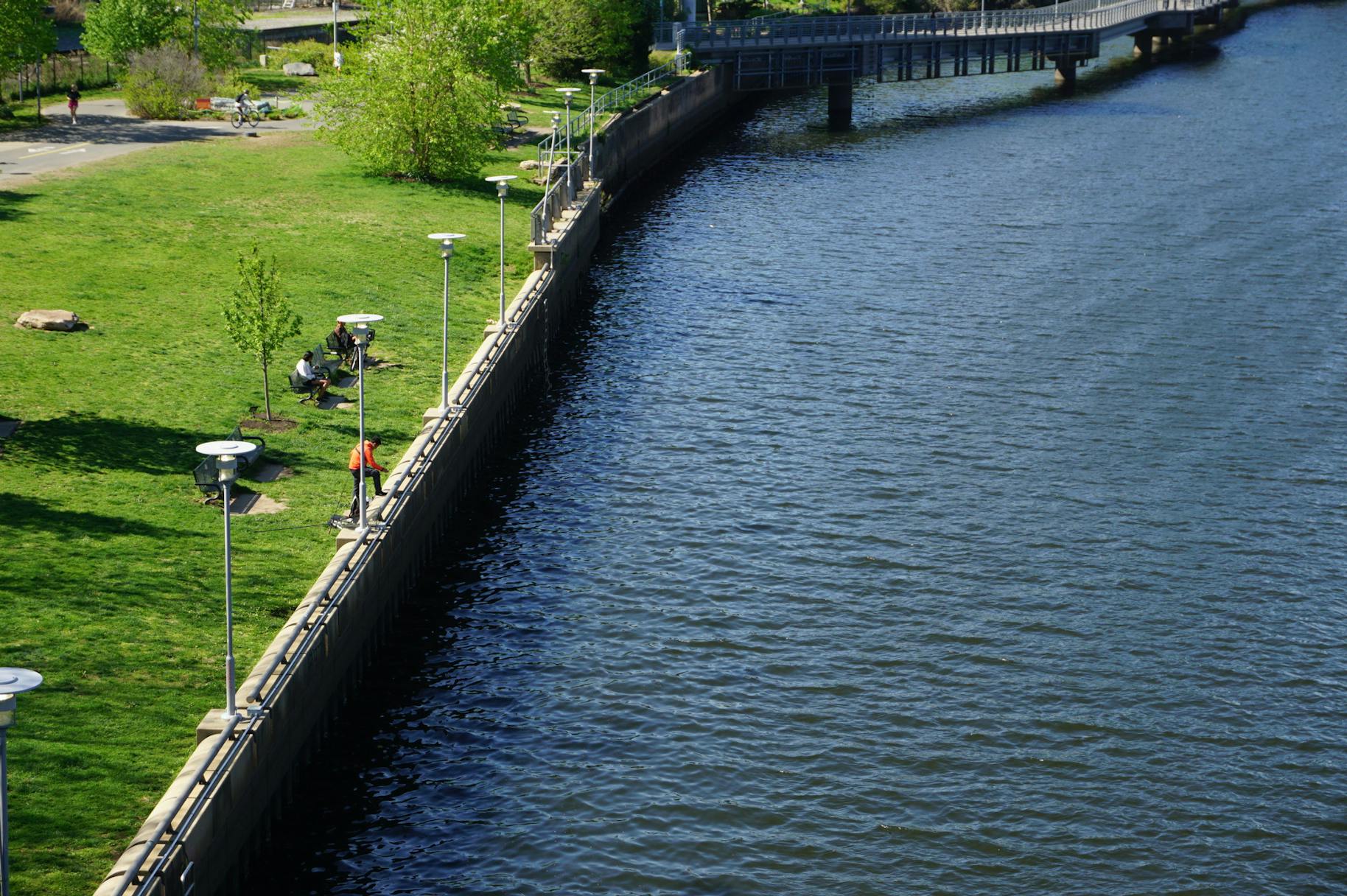
Sheng peers over the concrete bank into the river, waiting for a fish to take the bait.
A year ago, Sheng took time away from his social media pursuits to return to Brazil and help take care of his father after an unexpected heart attack. While his father has since recovered, Sheng’s recently returned from a stint in Brazil when I met him in person for the first time between Locust and Walnut streets for an early morning fish. There’s nary a gray cloud in the sky, and Sheng, in his signature bright orange sweatshirt, stands by the water with his simple GoPro set up. His rods peer over the railing, waiting for a bite.
As the morning sun settles in the sky, Sheng cracks jokes and snaps photos of his first catch of the day—a catfish, of course. But between filming clips, his elevated YouTube persona scales down, replaced with serenity settling on his tanned complexion. Though he’s only back in town for a short time, he tells me how pleased he is to be back on the waters before he returns to Brazil. The water is a world away from the tumult of personal life and politics.
He is just where he began over ten years ago, fishing on the Schuylkill, looking for his next catch, all while hoping to do a little bit of good on his side of the internet and river.
This is the bread and butter of the Schuylkill fishermen—with nothing more than a rod, a line, and some bait, the chaos of the surrounding world quiets to a hum. Anything seems possible on the shore of these banks. For those with an eye to the future, however, the inevitable question lingers beneath the surface: Will these waters survive the onslaught of environmental protection rollbacks?
Perhaps only the tides of time will tell.
*Indicates name has been changed.