I’ve never seen Game of Thrones. Not because I recoiled from the gory massacres or incestuous politics, but simply because I missed the moment. Medieval armor and knights on horseback never called to me the way lightsabers and spaceships did.
Sometimes, I wish I had been swept up in the hype—after all, Game of Thrones may be one of the last true pieces of TV monoculture we’ll see for decades. Unfortunately, by the time it entered my orbit, it was through whispers of an absolutely catastrophic ending. As a fan of Supernatural, The Umbrella Academy, and Sherlock, I’m intimately familiar with finales that collapse under the weight of their own ambition. Game of Thrones, from what I heard, was just another casualty of writers making narrative choices that betrayed the story’s core themes.
That’s the danger of scale. The bigger a franchise becomes, the more it feels compelled to top itself—more twists, more battles, and more spectacle. Spinoffs, especially, operate under the assumption that more is better, that escalating the story is necessary to justify its existence.
When I first saw a clip of A Knight of the Seven Kingdoms, I thought it was a fan film. Not because it seemed low–quality or poorly acted, but because it was the opposite. The scene was simple: One character cooks a fantastical bacon and egg sandwich in a worn iron pot. There was care in the texture—from the roughspun tunics, creased and sun–faded as if they’d actually been worn on the road, to the way the camera lingered on ordinary moments of sizzling oil and joy. The scene certainly didn’t exist to advance the plot, but instead, to let the viewer sit with these characters. The sweet yet restrained production felt like the work of people who love this world enough to slow down inside of it.
And now, having binge–watched the whole season in a weekend, I can say that’s exactly why it works. Instead of trying to outdo its predecessors—an impossible feat—A Knight of the Seven Kingdoms shrinks the world into something easy to step into. It’s not as threatening to an outsider as the cultural revelation that Game of Thrones was.
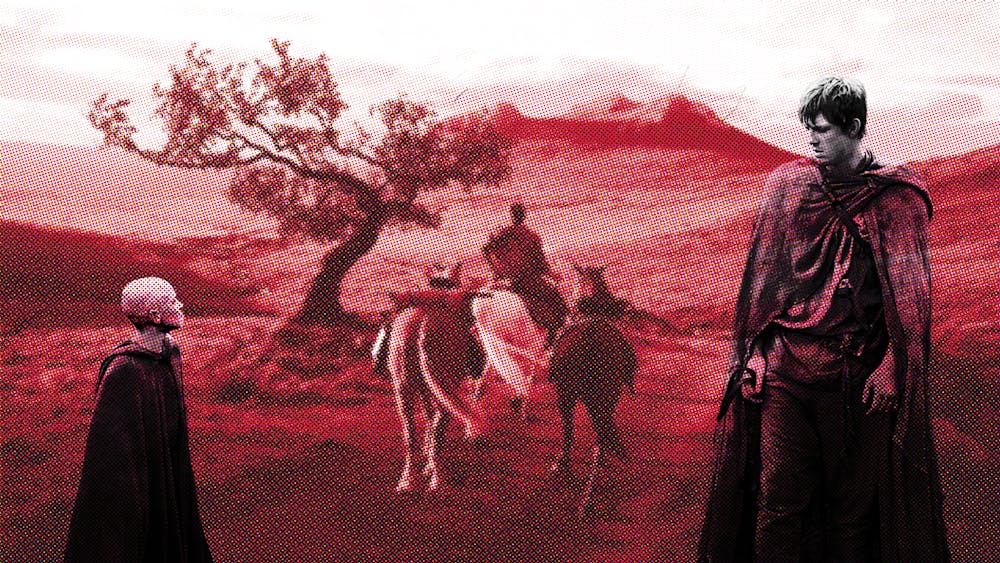
Forget the sweeping setpieces, CGI dragons, and uncountable ensemble cast. A Knight of the Seven Kingdoms focuses on one of the smallfolk—Dunk of Flea Bottom, who quickly renames himself Ser Duncan the Tall (Peter Claffey). The first season unfolds almost entirely in the small town of Ashford, where Dunk enters a tournament hoping to gain acknowledgement as a proper knight. On the road, Dunk meets a bald–headed child called Egg (Dexter Sol Ansell) with suspiciously polished speech. After some convincing, Dunk takes Egg on as his squire.
To understand what’s happening, there’s no need to study complicated family trees, learn the difference between Rhaena, Rhaenys, and Rhaenyra, or keep a Wikipedia page of all the noble houses handy. The series is delightfully small–scale, with a batch of interesting and distinct characters to fill the world. Longtime fans will surely spot Easter eggs and foreshadowing, but even without encyclopedic knowledge of Westeros, the series stands confidently on its own.
That accessibility isn’t just amazing for a newcomer like me, but represents a different kind of philosophy. Showrunner Ira Parker seems to understand that worldbuilding is best when it feels lived–in rather than explained. By focusing on these individuals rather than political dynasties, the seven kingdoms feel expansive without having to actually widen the frame.
Most impressive is the production’s meticulous care. Now that casting is officially recognized by the Academy, perhaps we’re finally ready to acknowledge how essential the right faces are to building a believable world in genre fiction. Despite (or perhaps because) having never seen these faces before, I was instantly convinced I was watching fully formed characters who belonged to this world.
Daniel Ings imbues Ser Lyonel Baratheon aka “The Laughing Storm” with easy charisma—and dare I say, a flicker of unrequited pining for Dunk. Tanzyn Crawford plays the sweet puppeteer Tanselle Too–Tall with warmth and charm, and Shaun Thomas stands his ground as Dunk’s first and most loyal ally, Raymun Fossoway.
When the royals arrive, the performances just get better. Bertie Carvel comes in wise and confident as Prince Baelor Targaryen—perhaps the only man I would ever call king. Sam Spruell plays Prince Maekar Targaryen with rigid severity, but beneath it lies a weary father with some interesting ideas of masculinity he should unpack before he ruins his children’s lives. Finn Bennett plays the spoiled Prince Aerion Targaryen with coiled menace, and Oscar Morgan’s Prince Valarr Targaryen devastates the audience with only three lines of dialogue.
Yet, at the end of the day, the show belongs to Claffey and Ansell. Claffey embodies Dunk’s physical enormity without sacrificing his gentleness. Every line reading and subtle posture adjustment communicates his earnest decency. Ansell is observant, snarky, and disquietingly vulnerable. Their chemistry is effortless, grounding the show in genuine friendship. The investment in that intimacy goes to prove that the emotional core of a fandom has never truly lied in a franchise’s lore, but in its relationships.
If there’s one thing the Game of Thrones franchise has consistently excelled at, it’s elevating lesser–known actors by testing their mettle on dialogue that can easily become trite. And it’s not just the cast—the crew are also giving it their all. From the intricately weathered costumes to the nimble POV camerawork that places us in the knights’ helm, every technical choice deepens the sense of place and reinforces the story’s intimacy rather than overwhelming it with action.
Genre fiction and sweeping franchises have always been easier to forgive when it comes to shallow storytelling. Audiences have grown accustomed to the relentless churn, to Hollywood’s refusal to let intellectual property rest. But worlds like Star Wars and Game of Thrones shouldn’t have to beg for attention. With their built–in mythologies and global fanbases, they can and should be prioritizing substance over scale. The real opportunity of a spin–off isn’t to go bigger, but deeper.
Take Andor. A prequel series about a secondary protagonist in a spin–off movie was never destined for insane hype, but it was the most artistically confident entry into Star Wars in decades. Both Andor and A Knight of the Seven Kingdoms demonstrate that the path forward for sprawling universes isn’t escalation—it’s excavating beneath the spectacle to find the human stories that made the spectacle matter in the first place. By narrowing the focus and rediscovering the heart that made these worlds compelling, they don’t just revive their franchises, model what franchise storytelling should look like in our era of excess. They help remind us why we cared at all.