
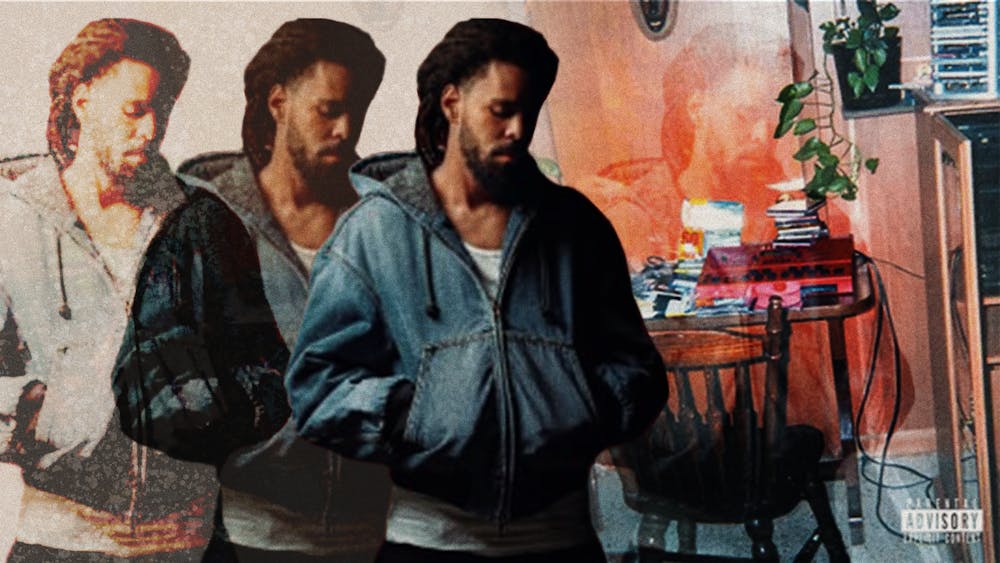
Legacy. In the hip hop scene, most fans and critics agree that’s pretty much all that matters–your music and your memory are all that survive you, and death is likely much closer to your favorite rapper than the average citizen. Jermaine Lamar Cole—J.Cole to the world—has been wrestling with this reality for 39 years and intends to be survived by one final album.
The highly anticipated The Fall–Off, after being in production for almost a decade, is ultimately an album about home. For Cole, this is Fayetteville, N.C. In an attempt to allude to a pre–Spotify world, the album is split into two “discs.” The first, Disc 29, centers him at 29 years old during his first trip home since “coming up” in New York. The second follows a similar trip, where he is older and more mature, for Disc 39. This album marks Cole’s departure and struggle towards reconciliation with his two simultaneous homes: Fayetteville and his legacy in the rap scene, as his presence at the top of the trends begins to fade into history.
The album opens with a skit overlaying an interpolation of James Taylor’s “Carolina in My Mind.” A friendly, vaguely southern ambiance plays in the background until abruptly—“Oh shit, oh shit, oh shit”—gunshots ring out to snap the listener out of their southern hospitality–induced reverie. For a majority of Americans, the South represents a quiet, slow, peaceful life—think sweet tea, biscuits, and gazebos—but for Black Americans like Cole, this has never been the case. Throughout both discs, Cole wrestles with the violence and poverty he grew up with and out of, as well as the effects this still has on the people he left behind.
Tracks three and four on the first disc, “SAFETY” and “Run A Train,” magnify this struggle. “SAFETY”–a standout song both lyrically and musically—unfolds across three verses that read like transcripts of voicemails from a close childhood friend of Cole's: understanding, but hurt by his silence. Each one of these hybrid verse–voice messages touches on death, in that all–too–common, casual way it emerges. The track follows Cole’s typical perspective–switching style, where it’s never entirely clear if he’s telling a factual or fictional story.
Death is a constant threat in Fayetteville, no matter your age, and for his whole career, Cole’s been trying to change that—to make some kind of difference through his music. In “SAFETY”, we see Cole’s friend put their daughter to sleep to his voice, and because homeboys who died of various causes' funerals are soon, the friend extends an invite to Cole, who most likely never accepts due to his fame. In the song, he’s begging him to physically come and reconnect with his real home: the people he grew up with, but his passion for music and for “helping” his people is keeping him away.
“Run A Train” shows this same 29–year–old Cole grappling with the feeling that one gets him. When he’s outside of the “ville,” he represents the place he came from like a badge of honor. But distance makes the heart grow fonder, and Fayetteville is a lot harder to love up close. Cole sees his hometown as a broken place, especially compared to the glamour of New York. Many more people scream his government name in the Fayetteville streets than supported him when he was coming up. During “Run A Train,” Cole notes, “Remember when they ain't respond when you holla? / Funny how a few dollars can change minds.” Whether he acknowledges it or not, an underlying thread runs through the song: If nothing about Fayetteville fundamentally changed, then maybe the discomfort he feels isn’t about the city at all—maybe it’s the money that changed him.
His final note on this broken home, “Fuck the world, let's run a train,” takes place in the ending chorus, shared with the Dionysus of our time, Future, suggesting a kind of hopeless hedonism as a recourse for the harshness of reality. As we grow and evolve, sometimes our connections to our home change as well. There are always things to worry and stress over—change and growth are facts of this world, however uncomfortable. Yet, Cole continues to “fuck the world,” moving forward towards his goals and his intentions in spite of, and sometimes because of, all of the change it might bring him and his home.
Between the discs we find a key tie: The Ville is a blueprint of a home that’s both a place of strife and a sanctuary. Just like he moved out and from Fayetteville, but kept feeling the ties back on that trip when he was 29, he now is struggling to find his belonging in this genre that he loves so much, but is broken in similar ways to those North Carolina streets.
On Disc 39, Cole focuses more closely on his other home: his legacy in hip–hop. Taking both sides in history’s biggest rap conflict—second only to Drake versus Kendrick Lamar (and the entire music industry)—he raps from both Biggie and 2Pac’s perspectives.
Since the infamous events of 2024, mainstream rap has been irreparably altered, and Cole is smack in the middle. As the third member of the “Big Three,” Cole faced backlash after choosing to be the bigger man and retract his diss track on Kendrick Lamar. Within the hip–hop battleground, this was a tactical misstep—interpreted by many as a sign of weakness. The result: a tarnished legacy and a rapidly deteriorating claim to being “one of the greatest” rappers to ever do it. He failed to defend his legacy, his home. His only weapon is words, and when it counted, he chose peace and respect over grit and lyrical violence. If anything, Cole is consistent. His altruism had the whole world begging the question: If his home in the Big Three wasn’t worth defending, what was?
The second disc holds his response. “What If” has Cole rapping as Biggie to 2Pac in an apology–style–letter, regretting his inability to visit Pac in jail and explaining that it wasn’t him that organized the early attempt on 2Pac’s life.
In the real world, Biggie never wrote this letter, and 2Pac ignited a conflict with a mega–viral song representing the “west coast” against Biggie, the man he believed tried to kill him. “What If” imagines a world where Biggie’s letter finds Pac while he’s on the way to Las Vegas. It moves Pac to inspire and decide to reroute to New York and reconcile. It’s quite a what–if, but it hopes for a world where Pac never went to Las Vegas while beefing with Biggie—he wouldn’t have been assassinated, believing that his friend betrayed him.
Cole blames the whole conflict on ego and “venomous voices” that instigate violence for the sake of entertainment—a familiar pattern for Cole. The parallels are plentiful: a rapper from the West Coast wrongfully writing an inflammatory diss track spurred on by industry pressure (Universal Music Group—Drake’s label—was a major reason for the beef due to contract issues).
Though that violence remained lyrical, the extremely declamatory statements used cancel culture to create a kind of social homicide that ultimately failed. While some kind of reference to this beef is expected in Drake’s much–anticipated album Iceman, Cole’s stance is clear:
“This for everybody out there that ever / Fell out with somebody you love / Fame is a motherfucker / Just to look back and be like (Yeah) / “Damn, it didn't have to go like that.” / … What if the bullshit never got in the way? / You'd still be my n**** to this day.”
Cole shares Rap as a second home with the other greats: his brothers, Drake, and Kendrick. Just like ego and pride tear apart Fayetteville through gang violence, it tears apart relationships between great artists. Songs like “Poetic Justice” and “First Person Shooter” are just two examples of when the “Big Three” came together, something that’s unlikely to happen ever again. As humans, we often find home in other people, and like Cole has said and continues to say on The Fall–Off that pride is the devil, tearing these homes and these relationships apart.
His storytelling and lyrical craft dominate this album, which is not a surprise to his listeners. Triple entendres are plentiful, and entire songs span metaphor. “I Love Her Again” can be reinterpreted as chasing a girl he’s in love with (from Fayetteville to New York to Atlanta) or the literal rap game personified: “As long as she's alive, I know I'll always have a friend / Thank God, I think I'm fallin' back in love with her again.” From a purely critical perspective, it’s safe to say Cole is one of—if not the—greatest lyricists of the 21st century. The album is heir to his pre–planned series of albums that started with The Come–Up, and as most Cole albums are, it’s pretty lengthy: Each disc has around 12 songs. Nevertheless, he maintains consistent quality, meaning, and lyrical ingenuity on every track. The production is standard for Cole: good, but allowing the lyrics to breathe their way into the listener’s active mind. Cole has always made songs that you have to read, and this album is no different. Let the casual listener beware. If this is, as he said on his instagram post, his final album, then his legacy and position in hip–hop’s “Big Three” that he so worries about is safe between the stanzas.
Cole’s life has been a record of ego–driven violence and strife, and he’s turned to hip–hop to make a difference with his talent. On “The Fall–Off is Inevitable,” Cole comes much closer to the savior that Kendrick LARPs as, and it's all due to the place he calls home, both on the global stage and in his heart. If you haven’t cried in a while, open up the Genius lyrics, put on The Fall–Off and follow the journey of a Sisyphean Atlas—trekking with his home and his legacy on his back endlessly up the mountain of greatness.
Falling off is normally an artist’s biggest fear in today’s fast-paced industry. Cole planned his. He planned this exit from the only two homes he’s ever known, and he’s choosing one home over the shifting streets of Fayetteville and the shaky podium of hip-hop’s public opinion. On this album, Cole is ultimately saying that his home isn’t a location or a legacy; it’s a deeper peace with others and with himself that only he can choose, and one that he’s still trying to find.




