
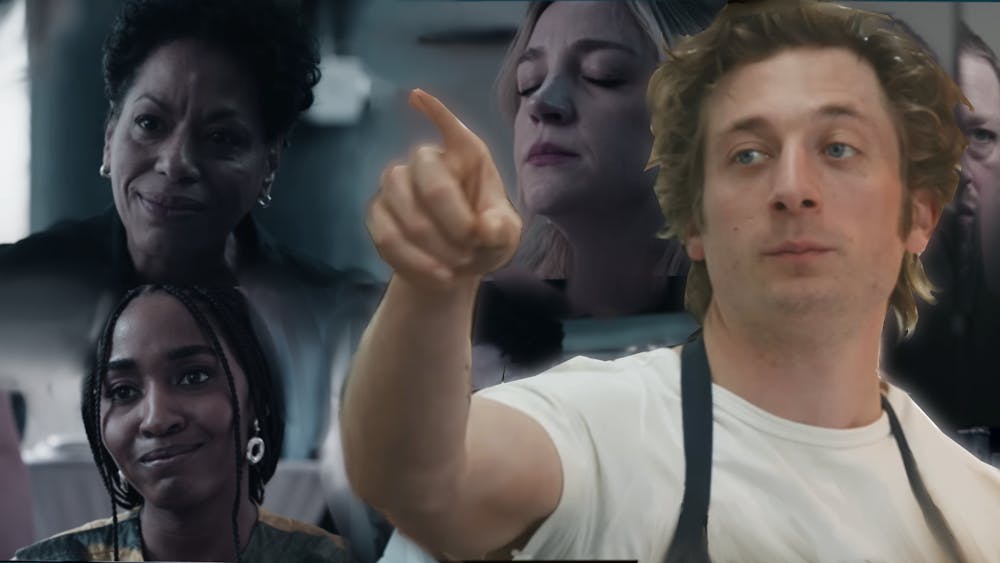
The term “prestige television” used to mean big ambition and slow rhythm, as if each episode was a movie. The Sopranos, Mad Men, Breaking Bad—these were dramas about institutions, morality, and power, all told through the highest cinematic craft. Having cable access to such art felt too good to be true.
But while the visual language of prestige TV—handheld realism, long silences, and anxious scores—is still alive, the scale of stories has collapsed. Nowhere is that more apparent than with FX comedy–drama The Bear, which feels like the last gasp of the HBO–dominated prestige era. Its crises aren’t political or criminal; instead, they’re domestic and relentlessly small. The show’s tension lies in whether someone can function under pressure, not whether they’ll survive the story. Carmy (Jeremy Allen White) doesn’t represent moral decay or institutional rot, he represents exhaustion. Instead of mob hierarchies or corporate empires, systems that shape nations and collapse tragically, it’s a show about competence, burnout, and caring about your job to a violent degree. In an industry driven by shorter seasons, tighter budgets, and algorithm–tested audiences, interior struggle is safer than systemic critique.
This isn’t a knock on The Bear. It’s an observation of what modern TV has become. What started as a revolution has calcified into an aesthetic. HBO used to chase grandeur, now it chases mood. Apple TV, FX, and Netflix all compete to produce “serious” shows about personal damage, framed with the same solemn tone that once belonged to organized crime or high finance. Adolescence, The Morning Show, Station Eleven, True Detective—each borrows the visual grammar of prestige but applies it to smaller, more contained stakes. The camera still lingers, the music still aches, but the urgency is gone. The form has become shorthand for importance—a promise of depth via visuals even if the story no longer reaches for it.
The original wave of legendary prestige dramas came from writers trying to prove that television could rival cinema. The Sopranos followed Tony Soprano (James Gandolfini) for years, not hours. Viewers didn’t see a single crisis, they saw relapse, stalled growth, and therapy sessions where insight didn’t fix behavior. Across six seasons, Tony shifts in small increments—his panic attacks, resentment toward his mother, guilt over violence—and all of his change feels realistically uneven because of the time it took to get there.
Game of Thrones applied the same logic on a massive scale. The series tracked noble houses across continents; alliances formed, fractured, and reformed over eight seasons. Characters like Daenerys Targaryen (Emilia Clarke) moved from victim to liberator to tyrant. That shift only carries weight because the audience spent years watching each compromise and loss build toward it, and those years of investment explain why a rushed finale didn’t feel like one bad episode—it was a decade of emotional capital wiped out in a single night. The power of these shows didn’t come from constant intensity but from duration, repetition, and consequences that compounded across seasons, allowing meaning to emerge gradually through accumulation.
While the first generation of prestige dramas came from television writers trying to prove the medium could rival film, the current generation feels like the inverse: film directors and screenwriters bringing cinematic style to television because the theatrical market no longer supports mid–budget adult drama. In theaters, intellectual property dominates and franchise logic rules. Character–driven stories about grief, work, or moral erosion—the kind of films that once won Oscars—now migrate to streaming platforms. Television hasn’t outgrown cinema, it has absorbed what cinema left behind.
The Bear succeeds by refusing what grand television once required: scale. Consider its second–season finale. Carmy gets stuck in the freezer on the opening night of the new restaurant, and everyone else has to figure out how to operate without him. His girlfriend, Claire (Molly Gordon), ends their relationship while he freaks out. The damage is embarrassment and a breakup.
Compare that to the Season 2 finale of Breaking Bad. Walter White’s (Bryan Cranston) letting Jane Margolis (Krysten Ritter) die creates a ripple effect, causing two planes to crash into each other over Albuquerque. Hundreds die. Meanwhile, Walt’s wife, Skyler (Anna Gunn), leaves him and takes the kids after uncovering Walt’s double life. One character’s private moral failure ripples outward into mass death, public catastrophe, and irreversible damage for all surrounding him.
Both episodes are shot with equal seriousness: long silences, intentional scores, and panic–infused close–ups. But only one expands outward, while the other collapses inward. “Prestige” used to mean escalation and consequence, but now it allows intensity without expansion.
And funnily enough, the obsession The Bear’s characters have with perfection and process mirrors the neuroticism of modern television itself.
Richie (Ebon Moss–Bachrach) trains at Ever, a three–starred Michelin restaurant, and learns to fold napkins with exact symmetry. Sydney (Ayo Edebiri) plates ultra–refined dishes as if her life depends on it. The camera isolates everyone’s hands, the plating, and the micro–adjustments. The emphasis is not on what the dish means in a larger system, but on whether it achieves technical perfection. That fixation on refinement is the show’s subject—and its method.
The Bear is about people who believe that if they execute the minutiae perfectly, they will earn redemption. Television now operates under the same belief. If the lighting is controlled, the performances restrained (with room for outbursts, of course), and the score swelling at the right moments, the work will register as important. Craft substitutes for scale.
The industry knows this. Many of HBO’s recent releases—Succession, The White Lotus, The Last of Us—generate emotional claustrophobia rather than tell an expansive story. The most striking scenes aren’t climaxes or turning points but personal breakdowns: a son imploding at a funeral, a marriage detonating over dinner, a survivor confessing guilt in close–up. The frame tightens, and the world outside the characters recedes.
The Bear takes that logic to its absolute endpoint. It traps its characters in a kitchen and treats their professional competence as the most important thing in the world. A burnt meal in The Bear may feel as tragic and consequential as a death in The Sopranos. It’s pure anxiety as entertainment, an endless loop of people trying to reach grace through work. Nothing changes the world, let alone the city of Chicago. Everything intensifies inside the room.
The show mirrors the conditions under which it was made. Shorter seasons, constrained budgets, fragmented audiences, an industry wary of grand and divisive political statements yet eager for high craft—all of it results in television that manages risk instead of confronting it.
Maybe that’s why it resonates. We’re watching a culture that replaced meaning with effort. Prestige TV once asked, “What does power do to people?” Now it asks, “What does pressure do?” Both questions matter, but only one survives in an industry afraid of big (and expensive) ideas. The Bear isn’t ending high–end television, it’s showing what’s left of it: all form, no grandeur.
That change tracks a broader shift in American life. Institutions feel distant and immovable, while individual performance feels constant and measurable. In an economy organized around productivity, metrics, and self–optimization, the central drama is no longer seizing or corrupting power but proving you deserve to remain in the room. So our stories have shrunk accordingly; the stakes become professional competence, emotional regulation, and endurance.
Reduced in scale but amplified in intensity, this is what prestige looks like after the fact. A single kitchen. A room full of talent and panic. A camera that won’t look away.




