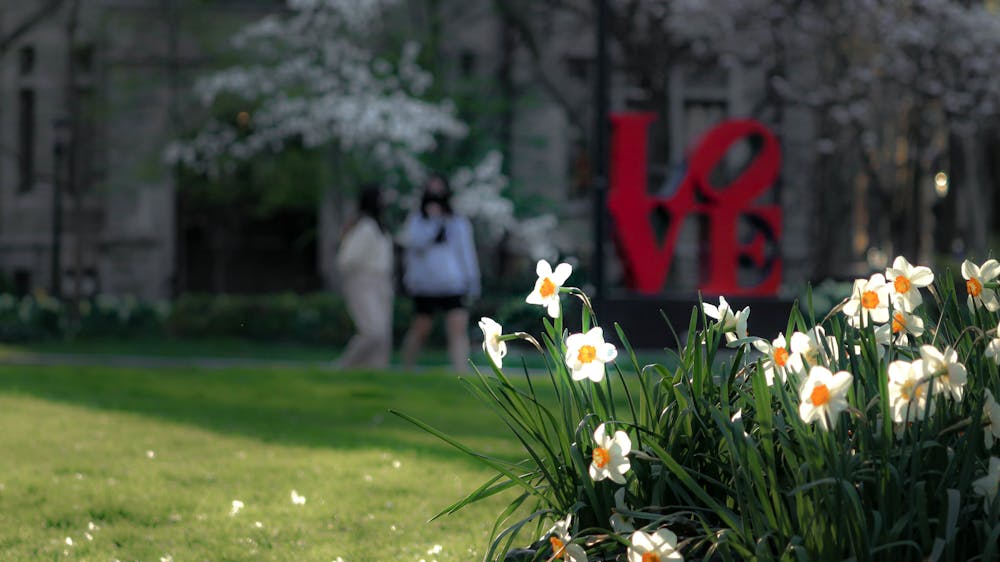
When the LOVE statue was unveiled on College Green in summer 1999, the student body hated it. “It’s a copy of what’s downtown, and I think it’s disgusting,” Josh Croll (C ’00) told The Daily Pennsylvanian at the time. Jon Sell (C ’01) echoed the frustration: “I think they should set it on fire and put it on top of the high rises.” Pop art had always had its share of dissidents, with many art critics (or non–art critics, like Josh and Jon) finding it a crass, tasteless, bottom–of–the–barrel, watered–down version of fine arts. “I can imagine they might’ve been thinking, it’s embarrassing taste in some ways,” says History of Art professor Michael Leja. “It’s like, the campus is too classy to have a tacky sculpture like that on it.”
But times have changed. Today, whether it’s a place of protest when Russia invaded Ukraine, or a go–to climbing spot for Hey Day photos, the statue has evolved into a central, and dare I say, beloved, part of campus life. “One of my favorite things is seeing the line of people who are there waiting to have their pictures taken during commencement,” says Lynn Smith Dolby, director of the Penn Art Collection. “And not just with their friends, but when their families come to celebrate with them. I think it just becomes part of what they remember about being at Penn, and that is so special for me.” Despite the image’s popular use as a commodified, corporate symbol of love, Penn students have reimagined it into a place of genuine connection and political action. “It's just wild to see how much that has changed over 25 years,” Lynn says.
The LOVE statue has seen many creative uses from Penn students throughout the years. In fall 2023, the Signal Society launched a campaign titled Confessions on Locust. Penn students handwrote anonymous, at times deeply personal reflections about their time at Penn and taped them to the front surface of the statue on sticky notes. For a few weeks, walking down Locust Walk meant seeing neon squares in highlighter colors dotting the familiar red of the four letters. Confessions detailed the ups and downs of Penn life, including struggles with queer identity, course selections that parents didn’t approve of, and even a student’s release of a rap song.
When ten people died in a 2022 fire in Ürümqi, China, over 100 Penn students gathered around the LOVE statue, bringing candlelights, flowers, and hand–painted protest signs in Chinese. After the start of the war in Gaza, Penn community members held a vigil at the statue to commemorate the Palestinian lives lost in the armed conflict.
When Russia invaded Ukraine, students wrapped the statue in yellow and blue, the colors of the Ukrainian flag. The next day, when the Penn Art Collection team went outside, they noticed that the tape had ripped off some of the pigment of the statue because the adhesive was so strong. “It was not just a visual change, but also, like a physical change to the sculpture,” Lynn says. “So we did go ahead and do a major renovation of our conservation of that in the spring.”
The statue was fenced off for a few days while repainted, which wasn’t too difficult, as Penn Art Collection works with object conservators who have the exact formulation for each one of the pigments that Robert Indiana originally used.
Lynn emphasizes that it was a deliberate choice to have the statue so close to the ground, even if at the cost of more renovations. “There’s a sense of ownership I see that you guys have with the piece, because it’s so accessible,” she says. “When I look at the work downtown that’s on a really high pedestal, it is completely out of reach, and it is pristine. But the student body would have a very different relationship with it if it were up on a pedestal.”
Ellie Bergstein (C ’26), who is an art history major at Penn, says that the statues on campus are “points for discourse or protests.” Last semester, she researched the LOVE statue for her course “American Art Seminar.” “LOVE is very interesting because there were vigils there for Ukraine, there were gatherings there after October 7,” she says. On the other hand, the Peace Symbol statue, located next to Van Pelt–Dietrich Library, has a drastically different history: In 1996, activist Kathy Change committed suicide by burning herself with gasoline. Next to the metal peace sign, 50 students looked on as fire rose ten feet into the air.
“Something we focused on a lot in our class is how the works on campus, especially the works on College Green, talk to one another,” Ellie says. The conversation between the two statues is further exemplified when considering their contrasting origins. The Peace Symbol was created in 1967 by eight fine arts students, supervised by professor Robert Engman, to protest the Vietnam War. The LOVE icon, on the other hand, may have been created to criticize the corporate commodification of love.
To explore this, we turn to Leja. Up until last year, Leja taught about artist Robert Indiana’s work in his survey of art in the United States from 1750–2000. Indiana, alongside artists like Andy Warhol and Roy Lichtenstein, was part of the pop art movement in the 1960s.
Leja explains that LOVE was a departure from Indiana’s usual work, which were often paintings of road signs. One of these paintings depicts a sign with the word “EAT.” “If you see that, it’s a command from the nearby establishment to stop and buy some food,” he says. “So, in that comparison, you can think of the sculpture as a command, like, ‘Get out there and love.’ Is there some kind of pressure to love in a certain way that is part of our politics, our society, our economy, the way commercial eateries function in our world?”
The statue, with its perfect two–by–two grid of letters, feels quite reminiscent of a corporate logo. “It makes you wonder,” Leja says, “if Indiana was thinking about what happens to human connection in such a corporatized, capitalist, commercial world.” All of our relationships, romantic or not, are commodified in some way—whether it’s “be mine” sour candies on Valentine’s Day, or TikToks of perfect girls on week–long Cuba trips.
And there’s no better story of the commodification of love than the artwork’s own history. LOVE was originally designed for a Museum of Modern Art Christmas card in 1965 as an oil painting on a 12–by–12–inch square canvas. The original 2D design consisted of the letters in LOVE stacked in a square in a serif font, with the characteristic tilt of the letter O. The Christmas card sold incredibly well, launching the image into a global pop sensation. Indiana subsequently reproduced the image in many more media, including a much bigger 72–by–72–inch oil painting in 1966 and a postage stamp in 1973, which sold 425 million copies in two years.
With millions of postcards, keychains, and Valentine’s Day cards sold every year donning the symbol, Indiana’s work has become what it critiqued. “Everywhere I went, I started seeing it,” Ellie says. “I was walking on 40th Street to get a coffee from Knockbox, and I saw a pumpkin that was carved with the LOVE sign in it. I was a studio technician in the Venture Lab, and I saw literally 100 laser–cut little LOVE signs from acrylic.”
“It’s everywhere,” Ellie says. “It’s on the back of people’s shirts. It’s just such an emblem.”