
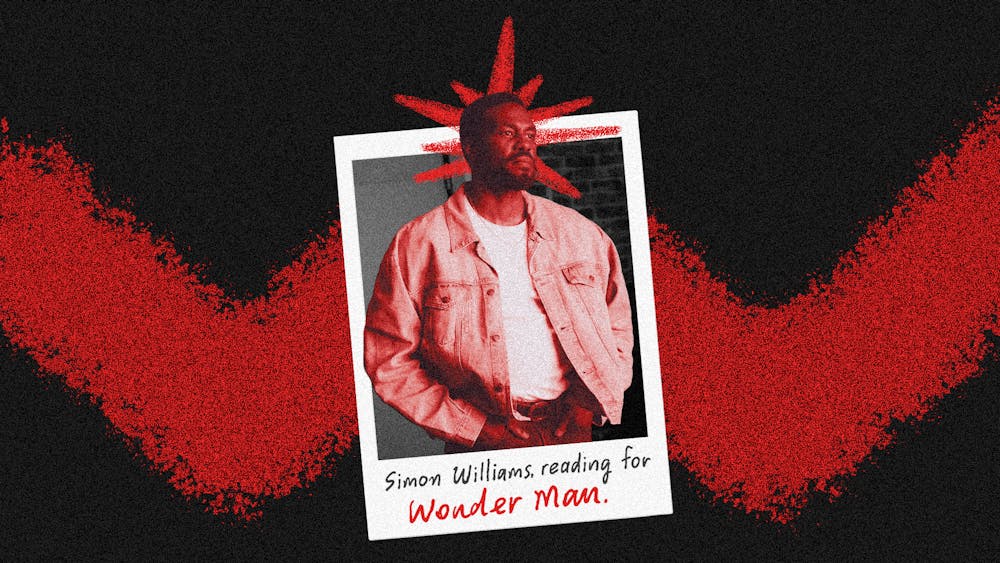
To avoid wasting your time, I’ll answer that question upfront: Wonder Man was made for me.
For those unaware—which is most, considering Marvel appears to have made no attempt to market this show—the first (of many) MCU projects slated for 2026 quietly arrived this week. All eight episodes of Wonder Man, starring Yahya Abdul–Mateen II as Simon Williams, dropped at once on a random Tuesday in January on Disney+. After already being pushed back from its original December 2025 release date and shuffled into an arbitrary weekday slot, the early signs weren’t exactly promising.
Simon Williams is a struggling actor in the heart of Hollywood, auditioning for the titular role in the upcoming remake of one of his favorite films: Wonder Man. In this world, the original Wonder Man is a campy 1980s sci–fi/fantasy cult classic that Simon’s father showed to him when he was young. For Simon, starring in a modern reimagining of the film, directed by (fictional) Oscar–winning auteur Von Kovak (Zlatko Buric), feels like the chance he has been waiting for his entire life.
Oh—and Simon has superpowers.
Does that sound small? Insular? Low stakes? Inconsequential to the larger MCU?
It should. Because it is. And that’s exactly why it works.
Wonder Man barely registers on the MCU’s sprawling narrative radar. Yet somehow it’s one of the most enjoyable things Marvel has released in years. It’s funny, warm, and the side characters are great. Above all, it feels genuinely unconcerned with being “important”: it’s more of a grounded, four–hour character study than anything else.
Ben Kingsley reprises his role as Trevor Slattery, the washed–up actor who once posed as the ruthless Mandarin in Iron Man 3. Post–Iron Man 3, he was broken out of prison by the real Mandarin and had a small supporting role in Shang–Chi. Kingsley is magnetic here, serving as the show’s co–lead and bringing a delightfully loose and comedic energy that contrasts perfectly with Abdul–Mateen’s quiet, stoic performance. Simon isn’t the typical quippy MCU protagonist—I’m not sure he tells a single joke across the entire runtime.
Simon is a loner. He struggles with relationships of every kind and finds unexpected comfort in Slattery’s companionship. Their dynamic forms the backbone of the show and quickly became one of my favorite MCU pairings.
And yes, I keep forgetting to elaborate on Simon’s superpowers—mostly because the show does, too. Strangely, that isn’t a problem. Wonder Man isn’t a traditional superhero show. Don’t expect Simon Williams to suit up or punch villains in any episode, nor get anywhere near the Avengers anytime soon.
In this version of Hollywood, superpowered individuals are barred from working on film sets after a catastrophic incident. That incident involved—you’d never guess—Olaf himself, Josh Gad. And not Josh Gad playing a character—Josh Gad playing Josh Gad. Add in extended cameos from Joe Pantoliano as Joe Pantoliano and a flood of real–world name drops, and the show starts to feel less like an MCU entry and more like a lightly superpowered cousin of The Studio.
Simon’s secret—that he has powers—functions as an allegory that’s easy to read but handled with restraint. It mirrors the way many are quietly excluded from industries not because of what they’ve done, but because of what others fear they might do. The show doesn’t spell this out explicitly, and it doesn’t need to. The tension lives in Simon’s constant self–monitoring, his fear of being discovered, and the way opportunity is always just one stroke of bad luck away from vanishing.
There’s nothing really wrong with Wonder Man. It can be laugh–out–loud funny, thanks to Slattery’s wit and the pure wholesomeness of Simon’s mother (Shola Adewusi). The dialogue is sharp. The Hollywood satire is affectionate without being toothless. Eight tight, 30–minute episodes give the show a breezy sense of “oh this is fun”—which, admittedly, may also be its biggest weakness.
Why? Because every possible complaint about the show could be met with the same response.
“I wish there was more action.”
But it’s not that kind of show.
“I wish it tied into the MCU more directly, especially this close to Avengers: Doomsday.”
But it’s not that kind of show.
“I wish the stakes were higher.”
But it’s not that kind of show.
Which leads to the only real question worth asking: Why was this show made?
Beyond the obvious answer—to entertain—it’s difficult to justify on paper.
Wonder Man isn’t a popular comic character. He doesn’t have haters so much as he lacks fans. In the comics, he’s absurdly powerful, trades blows with Thor and the Hulk, and eventually helps form the West Coast Avengers. But he doesn’t have a deep, complicated mythology. Unlike his comic book counterpart, the show’s Simon Williams seems actively uninterested in heroism. He spends the entire season trying to hide his abilities, not use them.
This is easily the most obscure MCU protagonist to be put to screen. When most of the Marvel fandom was asking “Who?” at the announcement, I assumed the show was doomed, especially because not everyone keeps their eyes out for Marvel press releases.
Of course, character obscurity alone doesn’t doom a project. Guardians of the Galaxy turned complete nobodies into household names. But Guardians had something Wonder Man doesn’t: a hook. A pitch you can’t ignore. “You’re telling me the cosmic–space team is a talking raccoon, a tree, a green lady, a WWE wrestler, and the fat guy from Parks and Recration?” That sells itself. “An actor with superpowers wants to play a superhero in a movie” does not.
Even prestige behind the scenes isn’t enough anymore. Ironheart was marketed relentlessly around Ryan Coogler’s involvement and vanished within weeks. Marvel’s belief in Destin Daniel Cretton—who co–created Wonder Man, directed its first two episodes, helmed Shang–Chi, was briefly attached to (the now scrapped) Avengers: The Kang Dynasty, and is now directing Spider–Man: Brand New Day—doesn’t translate to audience attention. It never has. But Marvel’s trust in Cretton, paired with the idea “What if Marvel made a genuinely good superhero show about superhero movies?”, was clearly enough to get the ball rolling for corporate.
Taken together—an unknown character, a low–concept premise, Disney+ fatigue, minimal MCU relevance, and zero marketing—Wonder Man feels engineered to fail. Which makes it all the more tragic that it doesn’t.
It’s thoughtful. It’s funny. It’s confident in its smallness. And in a franchise addicted to scale, Wonder Man succeeds by refusing to matter too much.
So, who is Wonder Man for?
Me, of course. But it’s also for people who prefer character over consequence, viewers tired of homework television, and anyone who wants Marvel to remember that not everything needs to build towards the end of the world.
Wonder Man is Marvel’s best show since Loki. And unfortunately, almost no one will hear about it.