I arrived at the early screening of Emerald Fennell’s Wuthering Heights ten whole minutes before it began, yet nearly every seat was already taken. With only the front row available, I had to crane my neck to see the screen. Despite this less than ideal viewing circumstance, the long–awaited film swept me away into a world of love, yearning, and, of course, desire. Despite oftentimes straying from the source material, the emotion infused in every moment of the film made it well worth the neck pain. And the reactions of the crowd, filled with readers and movie buffs alike, seemed to agree with me. Wuthering Heights is an exceptional reimagination of the classic tragedy, using raw emotion and a distinctive aesthetic style to enthral all audience members alike, regardless of whether they’ve read the book.
If you go to the theaters expecting a truthful adaptation of Emily Bronte’s novel, you will sorely be disappointed. Fennell’s retelling is an outlandish, hyper–stylized melodrama of the book’s first half. There is no screentime for the plot of young Cathy, Hareton, or Linton, who occupy 200 pages of unused material. The absence of Nelly Dean’s recounting the story of Catherine and Heathcliff to a new tenant not only reduces her role, but removes the character of Lockwood entirely. Despite this, these decisions likely strengthen the film, allowing it to concentrate on a single focus and fit comfortably within a two–hour runtime without feeling rushed.
Beyond its literary inaccuracies, the film establishes its vision through a bold and highly stylized visual world. This is especially apparent with the wardrobe and set, which scarcely adhere to late 18th century style, in which the novel is set. However, it’s not a blatant disregard for research—these stylistic shifts represent the angsty feel of the novel rather than the fashion of the time period. The dreary monotone grounds of Wuthering Heights resemble a decaying graveyard; Thrushcross Grange gives the impression of a psychiatric hospital with its stark colors and open spaces.
Though costume designer Jacqueline Durran also chose to forego 18th century style, the clothing serves a more elevated purpose than just costuming; it acts as a mode of characterization. Catherine (Margot Robbie) is vividly dressed, mostly in red, marking her desire for attention. Heathcliff (Jacob Elordi) wears darker colors, mirroring his brooding, obsessive character. Isabella (Allison Oliver) is decked out in frivolous ribbons and frills while Edgar (Shazad Latif) dresses polished and plain, representing their absurdity and banality, respectively.
The soundtrack by Charli XCX is surprisingly effective as well. The blend of strings, synth, and the echo of her voice feels uncanny and epic, adding immeasurable drama. The music encapsulates the feeling of yearning that is so central to this story. At times, the score swells almost to the point of excess, reflecting the characters’ inability to contain their emotions. But rather than feeling unnatural, the modern sound deepens the film’s intensity, translating nineteenth–century longing into something timeless.
Fennell also directed the disturbingly sex–filled film Saltburn (2023), so the inclusion of several intimate scenes should not be surprising. However, these moments are not unjustified—they shape the film’s entire rhythm. Physical closeness and charged exchanges dominate the narrative, and even the quietest moments feel deliberately suggestive. The camera lingers on small details, turning seemingly ordinary objects into symbols of desire. A scrapbook filled with cut–outs becomes phallic. The slow, deliberate kneading of dough is overtly sensual. Nearly every interaction between the leads is framed through attraction; pauses, glances, and proximity do as much storytelling as dialogue. Casting Robbie and Elordi only adds to this atmosphere; both bring modern star personas rooted in glamour and sex appeal, which the film fully embraces. Their presence shifts attention toward their chemistry and animal magnetism instead of the plot, making desire feel central to the film’s identity rather than incidental to its plot.
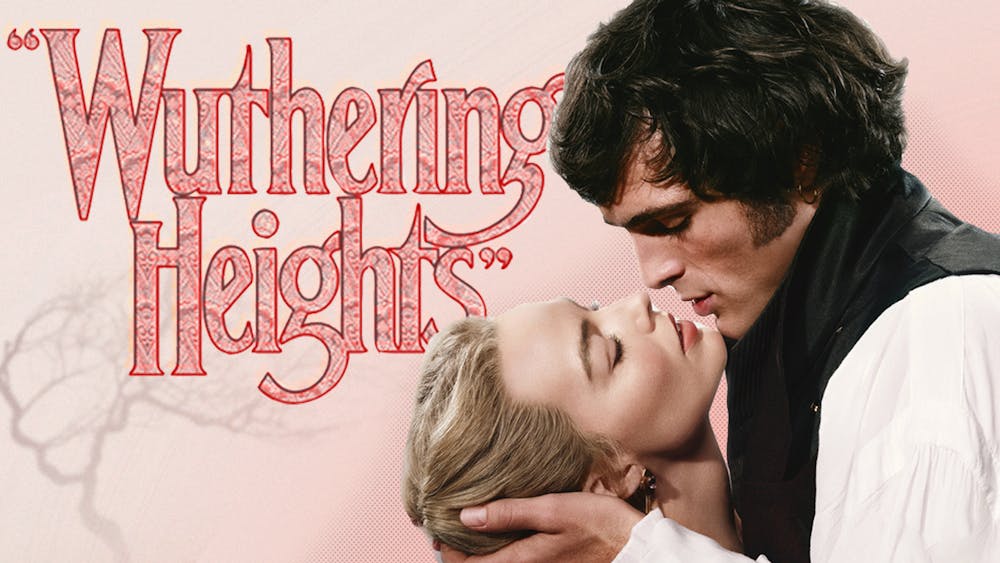
Fennell describes her work as “an emotional response” to the original Wuthering Heights novel, which she read when she was 14 years old. She, in fact, places the title of the film intentionally in quotation marks on the poster as it is not meant to be an exact replica of the novel. In an interview with The Guardian, she explains that creating the film relied heavily on her own sado–masochism: “I love it so much, and it can’t love me back.” The viewer can feel this frustration permeating throughout the character dynamics, which incidentally draws on the theme of miscommunication and unrequited love in the book.
In terms of tone, the novel is significantly darker. Its themes of obsession and revenge are replaced with romance and eroticism. There’s plenty of lust in the source material, but it’s framed through a twisted, darker lens. In the film, the lust between Heathcliff and Catherine is less obsessive and more romantic.
Additionally, character features differ from the book in their choice of casting. I would push back on the casting of Elordi as Heathcliff, who, in the novel, is described as “a dark–skinned g*psy.” However, perhaps in their minds, this whitewash is justified by casting Latif as Edgar, who physically differs from the novel’s description of his blue eyes and fair complexion. Still, it seems like a cop–out and denies audiences the interracial romance that could’ve been.
To a book lover, this adaptation may seem superficial as compared to the intricate details of the novel. However, there’s only so much two hours of screen time can include. The film capitalizes on the passion and yearning in Catherine and Heathcliff’s tale and makes full use of its duration in the best way. Through her film, Fennell emphasizes the importance of emotion and message over precise accuracy. She prioritizes making the audience feel something. And it works. By foregrounding longing, chemistry, and passion, she reframes the story less as a bleak tragedy and more as an intense romance. Only a robot could watch this film and remain unaffected. Its romance is undeniable, making it a fitting Valentine’s Day watch—if you don’t mind a touch of tragedy.