Pencils down, robes on. During the break of a life drawing session, Danny Ramirez—a freelance model based in Philadelphia—walks around the studio looking at versions of themself. They’ve been modeling for seven years—long enough to know what to look for in a drawing.
The premise of life drawing is simple: A model takes off their clothes, stands on a platform, and holds still while artists attempt to capture their form. It is a cornerstone of art training or classic painting, but nothing about bodies, nakedness, or looking is ever actually simple.
Ramirez tells me that when you look at a drawing of yourself, you can tell whether an artist is frustrated with their work or if they enjoyed themselves while making it. And then, of course, you can “get one where you’re like, God, I think that person’s just, like, really into butts.”
The naked body invites projection. That’s what makes nakedness such a vulnerable state. But therein lie the questions of whether the artist is conscious of what they're projecting and whether they believe they’re drawing someone or drawing on top of someone.
Ramirez is nonbinary and likes to embrace their androgyny even when modeling nude. But they rarely see that reflected back, instead seeing hyper–feminized versions—curves exaggerated, head round like a baby’s—or angular, masculinized interpretations. Neither feels true. Both are attempts, whether intentionally or unconsciously, to make Ramirez legible within the gender binary that structures how we have been socialized to see bodies.
Unfortunately, this experience isn’t unique to Ramirez, nor the social structures surrounding gender. Ian Pugh, junior at Massachusetts College of Art and Design, tells me about a session with a model in her late twenties who had what he describes as having “a pear–shaped figure, very wide–set hips, very healthy, hearty weight.” He watched many new artists struggle to draw what was in front of them, drawing the model thinner, lighter, more “floaty” than she was.
And this is the inheritance of living digitally. What they drew was shaped more by years of scrolling than by the naked body actually on the platform.
“Some people weren’t used to a body type that wasn’t standard anime twink, for lack of a better term,” Ian explains. The artist’s influence wasn’t just represented through the stability of their hand, but through their digitally involved nature. The new generation of artists has grown up with unlimited access to bodies, albeit filtered through Facetune, idealized in video games, or standardized in porn. Each online platform has its own body logic of the slim–thick Instagram body, the petite “anime twink,” or the hyperreal porn body. None of these figments of normative beauty standards look like the woman on the platform, but social media and porn have shaped both aesthetics and our perception of what is expected or possible. Even though the phone was not in the room, its power of distortion was still in every drawn line.
Whether it’s forcing Ramirez into masculine or feminine, or thinning a plus–size model to match Instagram standards, the impulse is the same: to force conformity onto bodies, rather than honor them as they are, in the context of their person.
Ian, even as an animation major, finds the same issue in the classrooms of his art school gen eds. As we talk about his studies, he remembers his first life drawing session with the kind of visceral clarity usually reserved for first kisses or car accidents. He was a freshman, standing in a circle marked by canvases and classmates who would soon be confronted with the reality of a naked stranger. “The first time doing it, it was a little awkward,” he tells me. “But after the heebie jeebies wears off in the first ten minutes, you’re just so focused on ‘oh shit, I have to draw this.’”
The class curriculum lets students graduate from pure study to interpretation only after they master the rules of form. The trap they often fall in, though, is thinking that anatomical accuracy is the final goal. This is what he sees in what he calls “Instagram reels artwork”—hyper–realistic drawings made purely to showcase technical skill. As an example, he references “that dumbass colored pencil drawing of the snarling lips with the lime in it.” With palpable disdain, he declares that “it lacks depth.”
What Ian is naming is art that thinks it has perfected the mechanics of realism, but has forgotten why we draw in the first place. You see this all over social media, where commercialized art prioritizes virality over meaning. It tokenizes one quality to market itself deep in the algorithm. When technical skill becomes the end rather than the means, human subjects become, themselves, props for demonstrating mastery. Queer bodies, plus–size bodies, bodies of color get rendered with that same slick, Instagram–ready precision, packaged for consumption.
“There have been times where I’ve been like, oh my god, you drew me how I feel like I am,” Ramirez explains. “That’s a really special moment where I feel seen.”
One artist they work with stands out as an example: He has a habit of talking the entire time while drawing, getting to know Ramirez as a person, not just a form. He draws them in a cold room, with the smell of charcoal filling the air just as much as conversation. But when he turns around the canvas to show Ramirez the drawing, it resonates with them on a different level. “It’s just extra fulfilling,” they tell me, “when you get that person who is putting some of you, that they actually got to know, in their work.”
The artist’s influence is already inherently present—their hand, their eye, their particular way of seeing. But the question is whether the model’s presence makes it onto the page too, or whether they are left replaceable with any other body that could hold that pose. “I feel like [that artist sees] my soul,” Ramirez says. “I feel like I’m looking at me … not just the way that my body is painted.”
This is what collaboration looks like. The drawing doesn’t pretend to be objective—it can’t be, it never was. It’s instead honest about what it brings: One person’s attempt to see another person clearly and for who they are.
“The model is not truly just an object,” Ramirez tells me. “Their presence as a human being is palpable. You really can’t separate that.”
Tension is reflected in the shoulders or in the softness of the hands. The drawing becomes a kind of testimony. For Ramirez, this matters in a particular way. When you’re a nonbinary person standing naked in front of a room of artists, your body becomes a site of interpretation. Artists might see the anatomical facts of sex, and many assume they know how to draw you. But Ramirez's gender isn’t legible through their body alone. True representation, especially for queer subjects, is understanding a person whose identity exists independent of, not in contradiction to, their physical body. The nakedness doesn’t simplify things, but rather it makes the stakes more visible.
Ramirez tells me that it is special when the artist sees their “soul”—but they don’t quite know how to explain what makes it happen. Maybe it’s not something you can pin down. Maybe it only exists in those rooms where an artist talks the whole time, where charcoal smell mixes with conversation, where someone turns around a canvas, and you see yourself the way you feel inside. Not able to be captured, just recognized interpersonally in the moment.
Even Ian, in classes focused on technical precision, recognizes that something more is happening: “There is a not romantic, but rather intimate relationship between the artist and the model that goes unspoken,” he says.
This intimacy is what separates art from documentation—and it’s what the phone destroys.
Heather Phillips, a photography lecturer at Penn, knows this intimately. “A camera is an aggressive tool of violence,” she tells me. In one photo, a million details are packaged into its composition. But that same comprehensiveness can become a tool of care rather than capture. A photo taken secretly will never be the same as one taken collaboratively, which is why Phillips ensures that “everything about [her] practice is collaboration.”
As an example, she tells me about one project she worked on where she took photos of a trans man over the years to document his transition. In isolation, each photo might just seem like a portrait of a man in his underwear. But, in the context of the art, in the project, each pixel of beard hair is laden with personality, trans joy, and self–love.
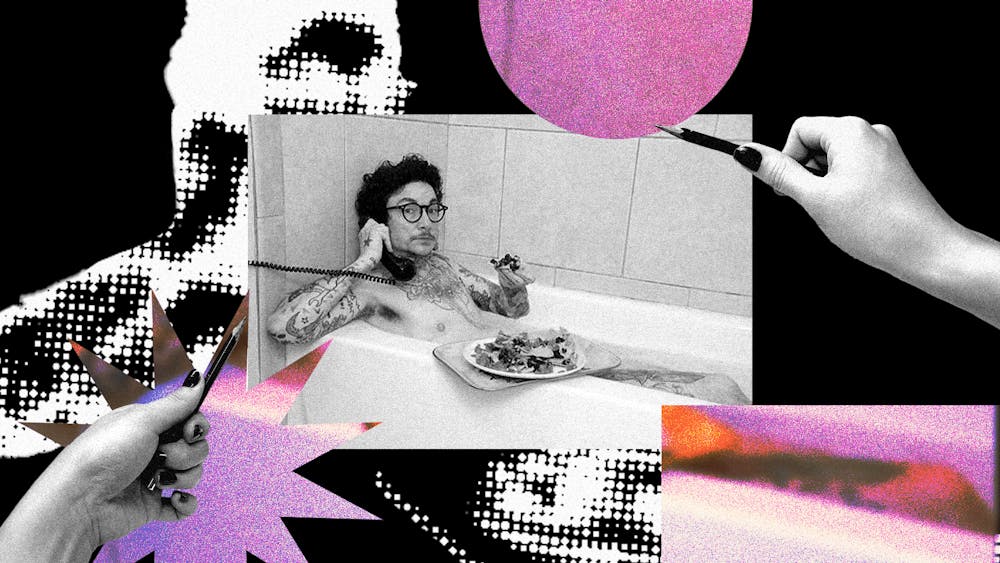
One photo, found first in the slideshow featured on her Penn bio, depicts this model in the bathtub, with a tray on top of him and a phone to his right. She tells me about the collaborative creation of this shoot, depicting her “on the phone with him on his birthday after his wife served nachos in the bathtub, because that's what he wanted for his birthday.” The nudity here isn’t about exposure—since the most clothes he wears are a sailor hat, silk neck scarf, and dampened tighty–whities—but rather it’s about comfort and domesticity. It’s not clinical nudity like a documented transition timeline, nor the sexualization of porn. It’s a trans man, near naked, reenacting an authentic, happy memory of nachos and birthdays.
At one outdoor session with the same model, strangers walked past, watching Heather and him pose in costume. They drew attention, let themselves be perceived, and put their vulnerability forward. But that vulnerability acted as something offered rather than taken. As people walked past, necks twisting to watch and question, the model turned to Heather with what she described as “sheer excitement” and said: “They think we’re acting, but we’re not acting. This is our life!”
It’s not a coincidence that everyone I spoke to for this piece—Ramirez, Phillips, and Ian—is queer. They know what it is like to be read wrong or reduced to what others project onto them. Nakedness for queer people risks documentation instead of being truly seen for oneself. Collaborative visibility isn’t just aesthetically preferable for queer bodies—it’s political. When your naked body has historically been medicalized, criminalized, or fetishized, being drawn or photographed on your own terms is a means of reclamation, survival, and resistance. Not just as a body read as a symbol or as a threat. As a person.
Pencils sharpened, robe off. Ramirez steps back onto the platform. But between poses, their body has already shifted—weight redistributed, breath deepened, mind moved from the joke they just heard to wondering what's for dinner. The artists position themselves around the studio, ready to pick up where they left off.
In a world saturated with images—where bodies are constantly captured, catalogued, and commodified—the practice of sitting with someone, seeing them, and choosing what to represent becomes a survival of the soul.
Ramirez settles into the new pose, and the artists begin to draw. Their body doesn't owe anyone stasis or clarity. And the best art respects that, acknowledging the gap between the fixed image and the living body, then honoring it rather than trying to close it. By the time the work is finished, the person who inspired it will already be someone new.