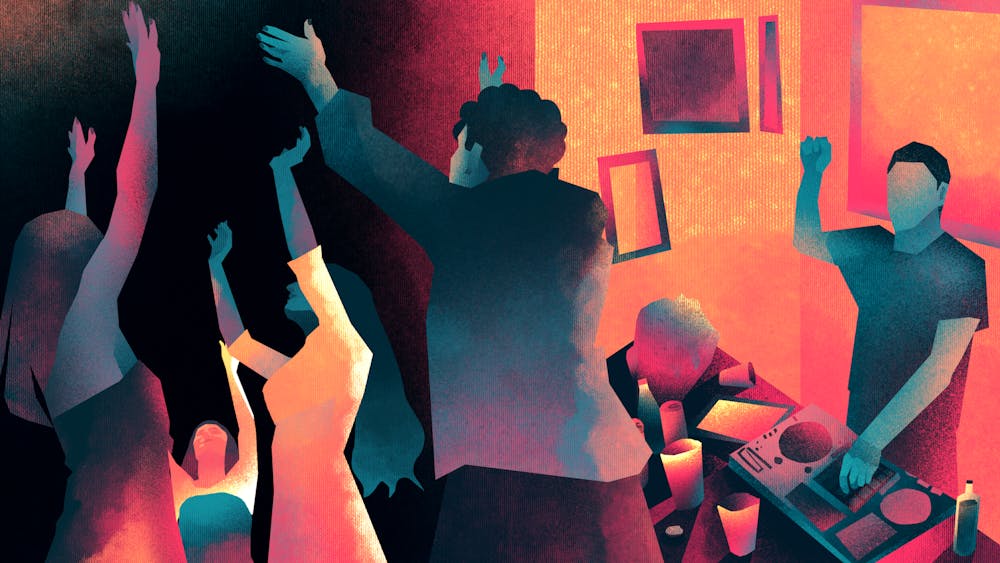
I’m standing in a crowd of moving bodies, eclectic in composition, dancing hardstyle to Takuya Nakamura’s trumpet x jungle performance in the Warehouse on Watts’ Loft. Someone dressed like Rumpelstiltskin stomps and jumps aggressively to the occasional bullshit Nakamura plays—which, every now and then, sounds as if someone’s released a barrel of snakes in a petting zoo.
Most Penn students have likely heard of WOW—despite its underground feel, it remains a mainstream venue. Night after night, it pulls in a mixed crowd of Do–it–Yourself diehards and orthodox partygoers alike. Despite its mass appeal, it maintains the grit one typically expects from a Philly venue. It’s a re–purposed warehouse with a view of Spring Garden and the Divine Lorraine Hotel sign—“KEEP NY OUT OF PHILLY” stickers cover its bathroom stalls, giving newcomers a taste of the city’s expansive musical underground.
Philadelphia was never really a mainstream music city, with its commercially–oriented venues that your frat might rent out struggling to rival those of New York City's. Especially for the under 21 crowd, the mainstream scene often leaves you stranded on the sticky NOTO Philadelphia dancefloor having just about the most uncomfortable night of your life. But having fun at night need not be relegated to the mainstream side of things, especially in a city built on scrappy basement shows and forest raves. On any given Philly weekend, you can find dozens of DIY shows—hosted by people like you and me—in our own homes, basements, or whichever pizza parlor is willing to open their doors to local live bands and sweaty mosh pits. But Penn students aren’t looking.
Though he’s now a professor at Penn, urban ethnographer David Grazian began his career as a sociologist by studying college parties at Rutgers University as a student, and has since focused his research on the “lived experience of popular culture.” As high–density centers of creative production and entertainment, he explains, cities are the place where popular culture is experienced at its best. In 2011, Grazian published On the Make: The Hustle of Urban Nightlife, a study of Philadelphia’s after–hours scene.
In the 1990s, Philly became a hub for art schools, music conservatories, and college students at a time when American cities experienced population growth, declines in crime, gentrification, and deindustrialization, with poor industrial neighborhoods “repopulated by creative people.” In Philly, Grazian explains that most of these creatives moved to Old City. He cites the opening of Stephen Starr’s now closed Continental Martini Bar in 1995 as the start of Philly’s “nightlife renaissance.”
Former factory spaces were converted into apartments, art galleries, and music venues. Of course, Old City quickly grew too expensive for artists to live in, so they moved up to Northern Liberties. Since then, the city’s hubs for underground nightlife have remained in Northern Liberties, West Philly, Temple Town, East Passyunk, and Fishtown—with the mainstream setting up shop in Center City.
At the same time, the national shift away from a collective culture—be it the radio, appointment television, or MTV—fragmented popular culture in big cities across the country. However, unlike New York or Chicago, Philly’s population was never high enough to create thriving genre scenes.
“The problem for cities … is that music venues and other kinds of culture–producing establishments require a critical mass audience in order to survive in an urban economy,” Grazian says.
Rather than stamp out Philly’s nightlife, however, the city’s spare population makes it possible for smaller–genre artists with cult followings to thrive across the city. Many artists came during the mid–aughts, fleeing a second wave of gentrification in Brooklyn and fueling a mass migration of Bushwick–ites to the City of Brotherly Love. They were generally drawn by the city’s thriving arts and music scene and a lower cost of living.
“The people that move to Philadelphia aren’t thinking about the people that are moving to Philly, as well … the one group that I would say does move to Philadelphia specifically for something very particular are artists.”
Producer and former music journalist Nick Sylvester argues that “Philly’s decidedly anti–scene, and that appeals to a lot of musicians that move there. They can actually do their own thing.”
The combination of early 2000s Philly transplants and scene fragmentation transformed the city's music landscape into a cluster of what Grazian calls “microscenes.”
In an article on the matter, Grazian defines microscenes as “locally bounded yet decentralized [DIY] music scenes where participants gather in repurposed urban spaces to perform and enjoy alternative popular music genres … all while relying on digital media tools to build a networked community and sustain participation.”
Microscenes, ultimately, are what Grazian argues dominate Philly’s nightlife.
Lex (C ’26), who requested to be identified solely by their first name, became invested in the DIY scene during their sophomore year at Penn.
“It’ll literally be a show in a pizza place,” they share, where partygoers will move all the chairs out of the way so crowd surfers can ride through.
More commonly, they explain, “there are plenty of basement and house venues that are run by either people that I know, or friends of friends,” where they frequently attend shows. Lex says that they’ve always been a creatively minded person, and they found themselves drawn to “DIY spaces over things that may have been ‘polished.’"
A big portion of the city’s underground scene is fueled by college students, Lex explains, particularly those from the Music Industry Program in Drexel’s Westphal College of Arts and Design. Peter Baran and Alexis Stenella are two such students.
Peter and Alexis, both sophomores, are on the executive board of the Dead Bug Collective, a music collective of MIP students that Peter co–founded last year and which Alexis now manages product coordination for. Dead Bug hosts DIY shows across the city, booking artists who play anything from emo to jazz.
The pair are in a metal band together—called SHARK EAT U!—and explain that they would constantly get put on emo lineups or bills, where they felt like they didn’t belong. “We felt kind of like, these people aren’t really here to see us,” Alexis says. “We knew other bands were probably feeling the same way,” she continues. Dead Bug’s founding philosophy was to avoid “hastily thrown together bills” at all costs, even if that meant putting on fewer shows.
“We want to give people that opportunity to play shows that were not … in some random dude’s dingy ass basement, which I love, but sometimes you want to feel like an artist, you want to feel like what you’re doing kind of matters,” Alexis says. “It kind of made me realize, like, I would prefer things to be more organized.”
And so they—like all DIY collectives—took it into their own hands.
When it comes to booking venues, they focus particularly on the kind of audience they’re trying to attract for the show. Peter shares, for example, that they once threw a hardcore show with DJs under a bridge in the woods, rationalizing that people that go to raves or hardcore gigs would be more than willing to make the hike. A hardcore show in a basement would never be comfortable, Alexis says. But when they threw a “friendsgiving” concert this November, a basement venue was perfect for the cozy vibe they were trying to create.
The audience they pull ranges significantly from show to show. Recently, they threw a benefit for Sudan, and worked closely with a Sudanese friend of theirs who pitched the idea for the bill and then brought a crowd from the Sudanese community. The concert ended up attracting a mixed crowd consisting of DIY–regulars and people who were just coming out for the cause.
“We’re trying to not just limit ourselves to being a college kind of booking collective … we don’t want to just be Drexel, we don’t want to just be Temple,” Alexis says. “We’re trying to find venues where people from different neighborhoods in Philly can go” that is not just some house on a college campus.
“I don’t want to have the 30–year–olds pulling up to a frat house,” she adds.
On the show–goer side of things, Lex emphasizes that “Philly is really nice because there are actually Instagram pages that are dedicated to sharing show flyers … and then you kind of just pick one and go.”
It can feel intimidating at first, but if you bring a friend to your first one—“you start to get to know people, you kind of snowball into it,” they explain. “Generally, people are very willing to make friends and hang out—in between sets, people will go out to the front and smoke and talk to each other.”
Alexis and Peter assess that the scene is sustained by “that Philly kind of energy [that will] obviously trickle into the music scene.”
Sylvester explained the peculiar cultural moment Philly was experiencing in similar terms, where “uncool is the new cool, in which blue–collar scrappiness and a surfeit of fried–meat specialties now seems endearingly kitschy.”
To this day, the grittier–edge of the city remains a key part of its appeal as an escape from high–end nightclubs and $20 martinis.
Despite the mixed audiences of DIY shows, Lex, Peter, and Alexis all say they’ve never seen a Penn student at one. Peter explains that he’s always wondered if Penn had a music scene, having never gotten the chance to interact with Penn students at shows. Alexis says she’d like to believe that Penn students come to their shows, but she’s never spoken to one. After our interview, she now knows a total of two Penn students she likes—though she hopes she’ll find more soon.
Grazian expressed a similar dissatisfaction with Penn students’ disinterest in the outside world. When his son began at Penn, the two of them were surprised that students rarely felt the need to leave campus, let alone go to shows. And while he believes that he attracts the students that do feel that push, he relents that “those students that are interested in really interesting music are not the norm.”
Lex shares that “during the middle part of college, I felt very alone in being a Penn person that was going to stuff … when I would go to stuff, I would see a ton of Drexel, Temple, even [Swarthmore], Haverford, Bryn Mawr people would come in sometimes, but there was a very noticeable lack of Penn people.”
When thinking through why that is, they feel that it’s a conscious decision.
“I do think it’s a big class thing," they say. “I think that there’s a lot of superiority that a large chunk of the Penn population has where they feel like they can’t stoop to make contact or form deep connections with people who are outside of the school or just in the Philly community.”
Even the people that might be “alternative” enough to appreciate the scene “kind of turned [up] their nose toward things that were less polished,” Lex explains. They acknowledge that some students may be uncomfortable going to North Philly shows, but Penn students also rarely frequent venues just two blocks away from campus.
In teaching his pop culture class, Grazian found that “for the most part, most Penn kids are certainly very smart … but I don’t find [them] particularly creative, at least in their cultural consumption,” he says. “I would teach a class of 400 students, and there’d be like three that would show up at my office that wanted to know more about jazz or blues.”
Still, he acknowledges that, though they might be in the minority, “there are funky people that go to Penn.”
The “don’t–go–past–40th–Street” mentality continues to dominate life on Penn’s campus. The DIY shows in West Philly and Temple Town are, according to Peter and Alexis, more than open to Penn students, from the “funky” crowd Grazian cites to those more used to sticking their noses up to the “unpolished.”
Still, these off–campus spaces need frequent support, as many shows are pay–what–you–can and usable venues are few and far between. A variety of work is being done to support the underground and mainstream alike, with the City unveiling a Nighttime Economy Office in the summer of 2022.
While Peter and Alexis contribute to the scene from the bottom up, Michael Fichman does it from the top down.
Fichman is a professor at Penn's Masters of City Planning and Masters of Urban Spatial Analytics programs, and is a city planner by trade. He’s also a DJ, and has taught and produced music since the late ’90s under the name Michael the Lion. He’s toured over 50 cities across North America and Europe, and DJ–ed for a living for much of his career.
“I came to really understand myself as being part of a workforce that wasn’t really represented in a lot of discussions,” he says.
When he got his Masters of City Planning at Penn, Fichman built his focus on the “intersection of arts and culture and nighttime cities.” In the mid–2010s, he began a community organization called 24HRPHL, which functioned as a resource and community building organization for musicians, promoters, DJs, and venue owners.
Fichman helped establish the Creative Footprint Project, a census of urban creative spaces that’s produced reports on nightlife in Copenhagen, New York City, Berlin, Rotterdam, Montreal, Sydney, Stockholm, and Tokyo. His long career in nightlife planning eventually led him to be the nighttime committee chair for Philadelphia in 2020, where he championed the creation of the Nighttime Economy Office, which is directed by Raheem Manning.
“The purpose of the office is to establish the priority of life at night in Philadelphia in the government, but it's also essentially the quarterback,” Fichman says, “to run the playbook of programs and policies that will take years to set up and roll out.”
The office functioned as the shepherd for programs and policies the nighttime committee had already outlined. Much of the committee’s concerns came from the city’s lack of understanding of nighttime economics and standards.
While now defunct, the committee helped cut some of the red tape holding back Philly’s nightlife. Several years ago, for example, a bill was proposed in reaction to a fight outside of a concert venue, requiring that concert promoters and venues compile a list of names and addresses of all performers and provide them to the police.
“It just totally misunderstood how concert promotions function—they don’t have that information on hand,” Fichman says. “That’s not the standard procedure of doing business at all.”
In addition to this, there used to be “council bills about really Draconian fines for posters that were put up on lamp poles.” These issues were what initially gave rise to 24HRPHL, where they would try to organize dialogue between a license and inspections department as laws like these can be “extremely hard for independent small businesses.”
Now, with the Nighttime Economy Office, the city can be put through a “night test, trying to put what’s going on at the city through a specific set of filters and perspectives to think about people whose voices generally tend not to be at the table when these policies are created.”
One bill Manning recently pushed through (after coming up with ten years ago), is the 4:00 a.m. closing times during the World Cup this summer.
Outside of the policy world, Fichman has spent plenty of time in the DIY scene himself. Having toured the world’s stage, he notes that “one of the great things about Philadelphia is that if you don’t find what you like out there, you can make it … You can’t do it that way in Paris, you can’t do it that way in New York, it’s just a different kind of place. But like here, you want to become a famous band? Throw a house show. Get a banquet hall.”
“It's a DIY kind of place, it's an elbow grease kind of place,” he says. “It's very built on personal credibility and no tolerance for bullshit.”
When it comes to planning Philly’s nightlife, Fichman contends that it’s hard to take notes from larger–scale cities like NYC or Berlin. Rather, he finds it reasonable to think about Philadelphia in comparison to Nashville or Atlanta, “and think about what’s come to define those places, and what we like and what we don’t like.”
Although he thinks Philadelphians wouldn’t be fond of Nashville’s bachelorette party–filled lower Broadway stretch, he thinks they’d like to see Philly in a similar position as Nashville, serving as a “major cluster of artistic industries [and] being a place that people decide they want to pick up stakes to try to make it in music.”
He cites various now closed Philly venues, like World Cafe Life and the Mill Creek Tavern, as reminiscent of that.
“There have been things that have come and gone, but there’s also this amazing underground scene in West Philly that is decades old, and really, really vibrant,” he says, “and it tells you that the demand is there. It tells you that the creativity is there.” One of the things he believes would benefit Philadelphia the most “is to have places where people can play and get their community together.”
“I can think of a few really great scene moments in Philadelphia history,” he shares, from DJ Cosmo Baker and Rich Medina at the Fluid nightclub on Monday nights, “doing the most important weekly hip–hop party in the world,” to Diplo’s low–budget shows at the Ukrainian American Citizen’s Association (or the Ukie). But “Philadelphia has always had a too many chefs, not enough diners problem,” he laments.
“We’re an exporter of musical talent,” he says. “A lot of great musicians come from here. But it doesn’t mean that they’re performing three or four nights a week to large crowds.”
Still, there are a lot of people—like Grazian, Lex, Alexis, Peter, and Fichman—who really care about the Philly music scene. The increasing corporatization of live entertainment continues to put pressure on smaller, local–facing businesses, and while the city works to support venues, especially by streamlining the business development and regulatory process, venues gain much of their support from their crowds.
What Fichman defines as a socially healthy nightlife is when people are “invested in the creativity of what’s being presented in nightlife,” and consistently show up to the city’s nightlife programming. “There’s a lot of interest in having some neighborhood level nightlife options,” he says, “that will lower some of the accessibility problems and are appealing to people potentially of a very wide range of ages.”
Grazian echoes this statement, believing that it makes “much more sense to invest in street–level performance,” using urbanist Richard Florida’s definition of small, diverse, and accessible performance spaces that nurture creative innovation.
“I don't think we need these spaces to have one dedicated kind of music, but a consistent music space, it needs to be a place where young people can regularly access music,” he argues. “It means more eyes on the street, it makes our neighborhoods safer. There’s just more people out.”
Both Fichman and Grazian encourage Penn students to join in on the street–level performance that already exists.
“My impression, both from the outside and from the inside, is that oftentimes you feel like Penn is in Philadelphia, but not a part of Philadelphia,” Fichman says. “I would encourage people at Penn to get involved in the scene … Planting their flag in the ground to make something culturally interesting happen.”
Like many of us, Grazian says that, at heart, he’s “still a 22–year–old trying to figure out what music’s all about.” Be it through playing or attending DIY gigs, turning your nose down to the unpolished side of things appears to be the best way to do it. In Philly, at least.