
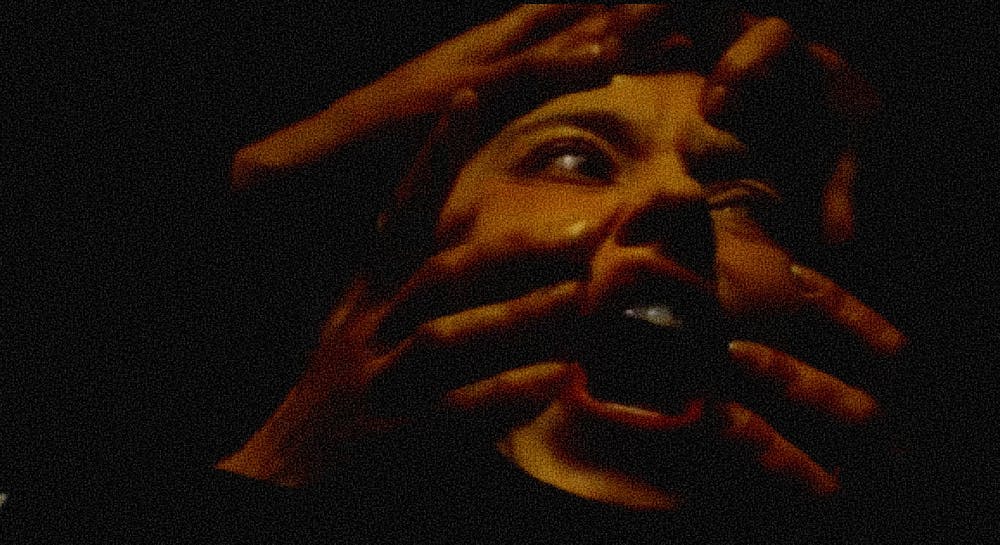
How many films are truly timeless? How many can withstand the test of time without becoming artifacts? How many are interesting, perhaps, but trapped in the anxieties of the moment that produced them? Horror, more than any other genre, almost never achieves that kind of timeliness. Its monsters age, its metaphors calcify, and its fears grow transparent. Its power comes precisely from its responsiveness to contemporary fear. What once terrified people becomes revealing—not necessarily because it was poorly made, but because it was too honest. And yet, that’s what makes horror so culturally valuable. It’s the genre most willing, most suited, and most efficient at presenting our society in visceral forms. If horror rarely ages gracefully, it’s because it’s doing its job too well.
In the late ’70s and throughout the ’80s, that job became increasingly aligned with a conservative backlash to social liberation movements. As feminism, sexual liberation, and reproductive rights gained visibility and legal traction, mainstream American cinema—aimed at the masses—responded with narratives that quietly reasserted traditional values. Nowhere is this clearer than in the rise of the slasher film.
Despite the sex, violence, and bloodshed, slashers were for the conservatives. The formula is familiar to the point of cliché—sex equals death. The sexually active sluts are punished first, and most graphically. The virginal “final girls” survive by virtue of vigilance, caretaking, and abstinence. In Halloween, the first victim is a teenage girl, Judith (Sandy Johnson), older sister of would–be killer Michael Myers (Nick Castle). The film opens with Judith making out with her boyfriend, and when the couple heads upstairs, Myers stabs her to death. She’s not even the only woman in the film to die directly after having sex with her boyfriend. On the other hand, Laurie Strode (Jamie Lee Curtis), is a studious, virginal babysitter. A nurturer to the core, she helps her friends and protects the kids, even when her own life is in danger. She’s the quintessential “final girl,” the one who gets the privilege of being the sole survivor due to her morally superior position of abstinence.
This isn’t an isolated case. In A Nightmare on Elm Street, Tina Gray (Amanda Wyss) dies after sleeping with her boyfriend. But survivor Nancy Thompson (Heather Langenkamp) is wholesome, intellectual, and nurturing, refusing all drugs, alcohol, and sex. The “final girl” does not simply survive; she preserves a social order in which female sexuality is subordinate to protection, reproduction, and moral labor.
In this framework, female sexuality is not frightening because it is powerful or pleasurable, but because it disrupts reproductive order. Sex is punished not for being sex, but for being sex without consequence—or even worse, sex that demands autonomy. The first deaths are almost always women who openly desire, whose bodies are framed as excessive, available, or unruly. Their punishment reassures the audience that desire must be controlled and that reproduction—real or symbolic—belongs to a moral economy overseen by men, institutions, and violence.
The contemporary horror landscape looks quite different, but the body remains central. Since the 2022 overturning of Roe v. Wade, horror films have begun to explicitly reframe reproduction as a site of violence rather than morality. The anxiety is not that women will reject motherhood, but that motherhood will be forced upon them.
The near–simultaneous release of Immaculate and The First Omen in 2024 is no coincidence. Both films center young, devout women whose bodies are commandeered by religious authority figures. Both depict pregnancy not as a divine miracle but as institutional violation. Immaculate goes even further in its unexpectedly transgressive ending: main character Cecilia (Sydney Sweeney) gives birth and, without a second thought, picks up a rock to smash the newborn to death. The film inherently rejects the sentimental lie that motherhood redeems violation. The body revolts because it must.
Fellow Euphoria star Hunter Schafer also starred in a reproductive horror film in 2024. Cuckoo goes one step further by stripping reproduction of any remaining moral framing and rendering it purely extractive. In the film, women staying at an Alpine resort are implanted with nonhuman eggs and coerced into carrying and raising offspring that are not theirs. What makes Cuckoo especially resonant is how little interest it has in sex itself. Desire is irrelevant. There is no transgression to punish, no erotic excess to discipline. Instead, the horror emerges from the complete erasure of consent and the expectation that women will comply, adapt, and nurture regardless. The couples visit the resort for their honeymoon. They leave pregnant—and surely that’s a good thing? Cuckoo presents the idea that motherhood is destiny, then resoundingly rejects it.
The Alien franchise also made its return in 2024 with Alien: Romulus. Though the franchise has always been about bodily violation—with the xenomorph’s forced impregnation and a violent, chest–bursting birth—Alien: Romulus finishes the metaphor off by centering female bodies. The pregnant Kay (Isabela Merced) wants her baby to be born in a place with sunlight. But when she’s injected with an experimental serum, disastrous consequences arise. Her belly rapidly swells, and in a painful labor, Kay gives birth to a hybrid abomination called the Offspring. The Offspring is not simply a monster, but the culmination of a process to which Kay never fully consents and cannot stop once it begins. The scene strips childbirth of intimacy or choice, staging it instead as a grotesque inevitability. Her body accelerates toward an outcome she did not choose, overseen by technology and desperation rather than care. In this way, Alien: Romulus treats pregnancy as a condition to be managed rather than an experience to be guided by the person carrying it.
What unites these recent films is not just their fixation on reproduction, but their insistence that the terror lies in systems that override women’s agency. And yet, there is an unresolved tension at the heart of this so–called feminist turn in horror. Who is telling these stories? More often than not, the answer is still men.
This is not to say these films are insincere or cynical. Many are thoughtful, disturbing, and clearly in conversation with contemporary reproductive politics. But when we talk about power, authorship matters just as much as intention. A horror film can critique bodily control while still reproducing the genre’s exploitative gaze. Graphic depictions of female suffering, even when politically motivated, can easily turn into spectacle. Are these films dismantling horror’s historical fixation on punishing women, or simply updating it with better politics?
Horror has always mirrored social unrest: zombie films after 9/11, home invasion films amid domestic instability, contagion narratives during pandemics. The current surge in reproductive horror is no different. It’s art responding to policy.
Fifty years ago, horror imagined the terror of reproductive freedom. Today, it confronts the terror of its absence. Horror may never be timeless, but it doesn’t need to be. Its value lies in its ability to tell us what we’re afraid of. Right now, that fear is clear—not sex, not desire, not choice, but the loss of control over one’s own body. And if horror continues to listen to that fear rather than exploit it, it might finally become a genre not just of reflection, but of reckoning.