What are the ramifications of unchecked greed? Has rapid technological progression doomed human connectivity? When our shared morality appears under siege, how can we revitalize willingness to cooperate with each other?
Such questions have long encompassed the works of Montreal–based artistic director Virginie Brunelle. Since 2009, this composer has demonstrated the power of storytelling through interpretive dance. Each of her projects symbolizes humankind’s cruelest, darkest nature—through delicate and surreal movement, Brunelle’s troupe, Compagnie Virginie Brunelle, presents narratives of infidelity, greed, and other transgressions. “My works are often conceived as living frescoes of society, a kind of mirror reflecting our actions and behaviors,” Brunelle says. “My hope is that audiences can build bridges between the piece and their own [mental] landscape.”
Similarly, exploration of human duality guides Brunelle’s newest production Fables. Unlike the company’s previous shows, however, this storyline incorporates a broader critique—examining the injustices characterizing dystopianism. Originally, Brunelle’s interest in the historical Monte Verita colony inspired this production: this community offered residents communal resources and forums for expressing new ideas. To the choreographer, this social utopia models artistic freedom, humanism, and coexistence—contrasting the bigotry of America. Correspondingly, Fables depicts a society working towards a utopia: “The choreography and scenography [reflect] a community striving to resist division, imagining instead a collective landscape [of] shared humanity,” Brunelle explains.
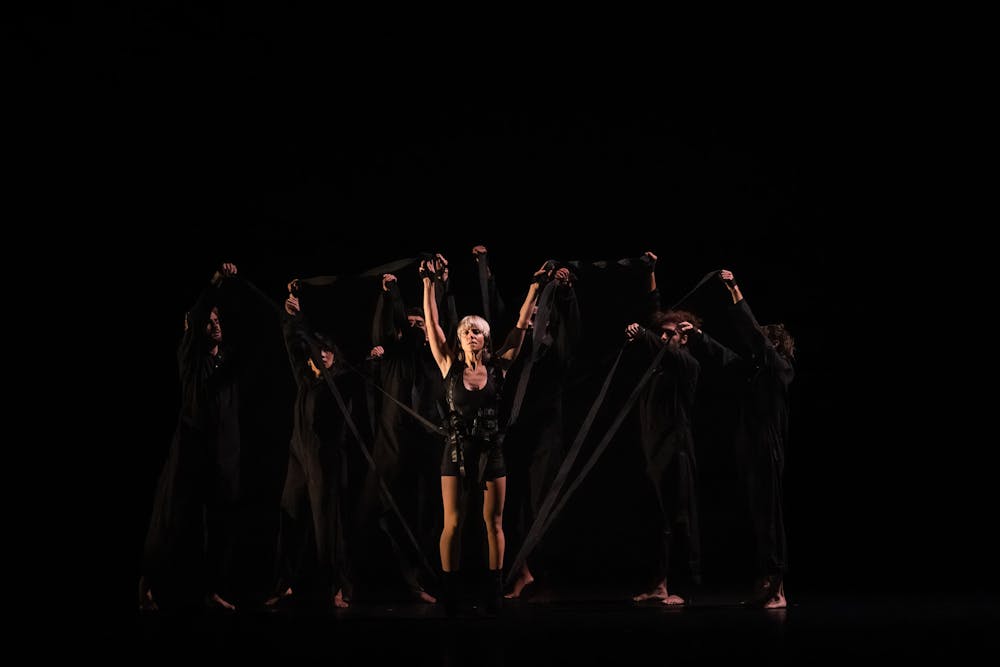
Initially, Fables constructs a society of early industrialization. As the curtain opens, two dancers—each dressed in black—engage in a brawl: Violently gripping each other’s limbs, violence escalates rapidly. As other characters walk onstage, they sport equally dark outfits and hostility towards each other: Subsequently, this fight becomes a societal–level conflict. As one member circles the stage with a microphone, their grunts of pain become audible; eventually, the strongest individual emerges as victorious. Although extreme, this scene grants audience members a space for reflection. Brunelle spurs us to consider how ultramodern technologies have hindered human relationships—fueling self–interest and discooperation among individuals.
Subsequently, the performance encompasses a feminist lens, reverting its focus towards one female cast member. Within multiple vignettes, this woman’s life story unfolds—from birth to marriage to motherhood. Throughout this narrative, however, the woman completely lacks mental and bodily autonomy: In a puppet–like fashion, other troupe members dictate her movement. As a child, she emerges onstage in a white gown as other cast members lift her high. Upon entering adulthood, she remains idle as two others grab her feet, propelling her forward. Even on her wedding day, other dancers place this woman into her bridal gown.
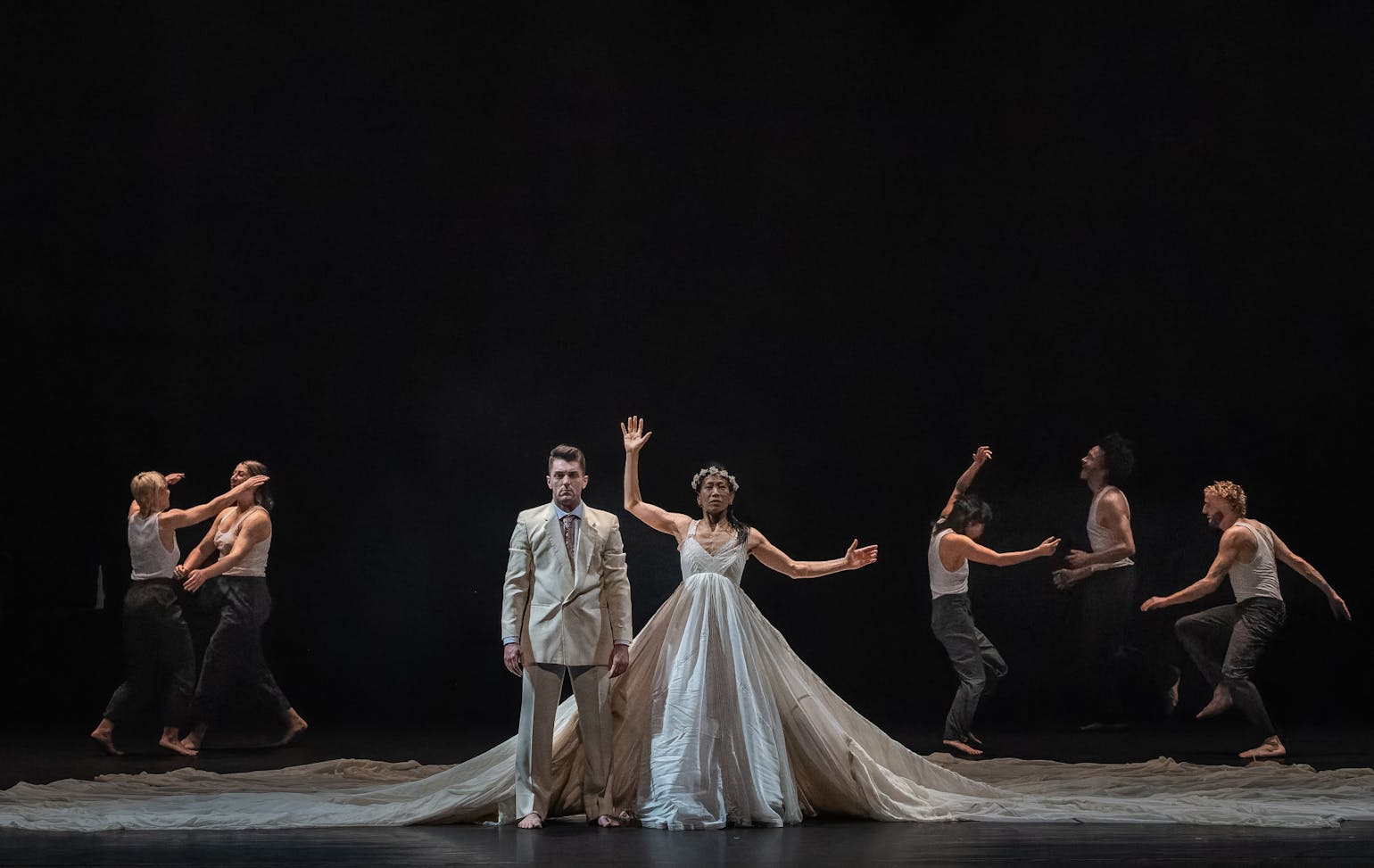
Collectively, this choreography emphasizes womanhood as a journey of strong adversity and the long road ahead to women’s equality. “I also felt a strong desire to pay tribute to our mothers and grandmothers, women who brought humanity into the world,” Brunelle says, “marked by deep resilience and a quiet yet immense strength.”
Later in the show, one woman emerges from backstage with a harness on, crawling forward on the ground as multiple men control her limbs through attached straps. The men yank the woman left and right, carefully coordinating the flow of the straps with one another. Fables carefully incorporates intimate, bodily movements to further showcase the ills of society. “It is an intensely physical piece, with a great deal of partnering,” cast member Sophie Burton says. “We truly feel interdependent as performers, having to be deeply in sync with one another—constantly available, attentive, and adaptive.”
For the final act, the stage lights flare gold as each member flaunts a newly glitter–sequined leotard. For the first time, the entire troupe moves in sync, all performing the same dance together—these characters dismantle their group’s internal divisions, forming a peaceful, attuned community. As we watch dancers perform flips, we are reminded of Monte Verita’s aroma of hope, creativity, and liberation. While granting Fables a pure, colorful ending, this number hones a message of unity—evoking humanity’s need to alleviate our own social ills.
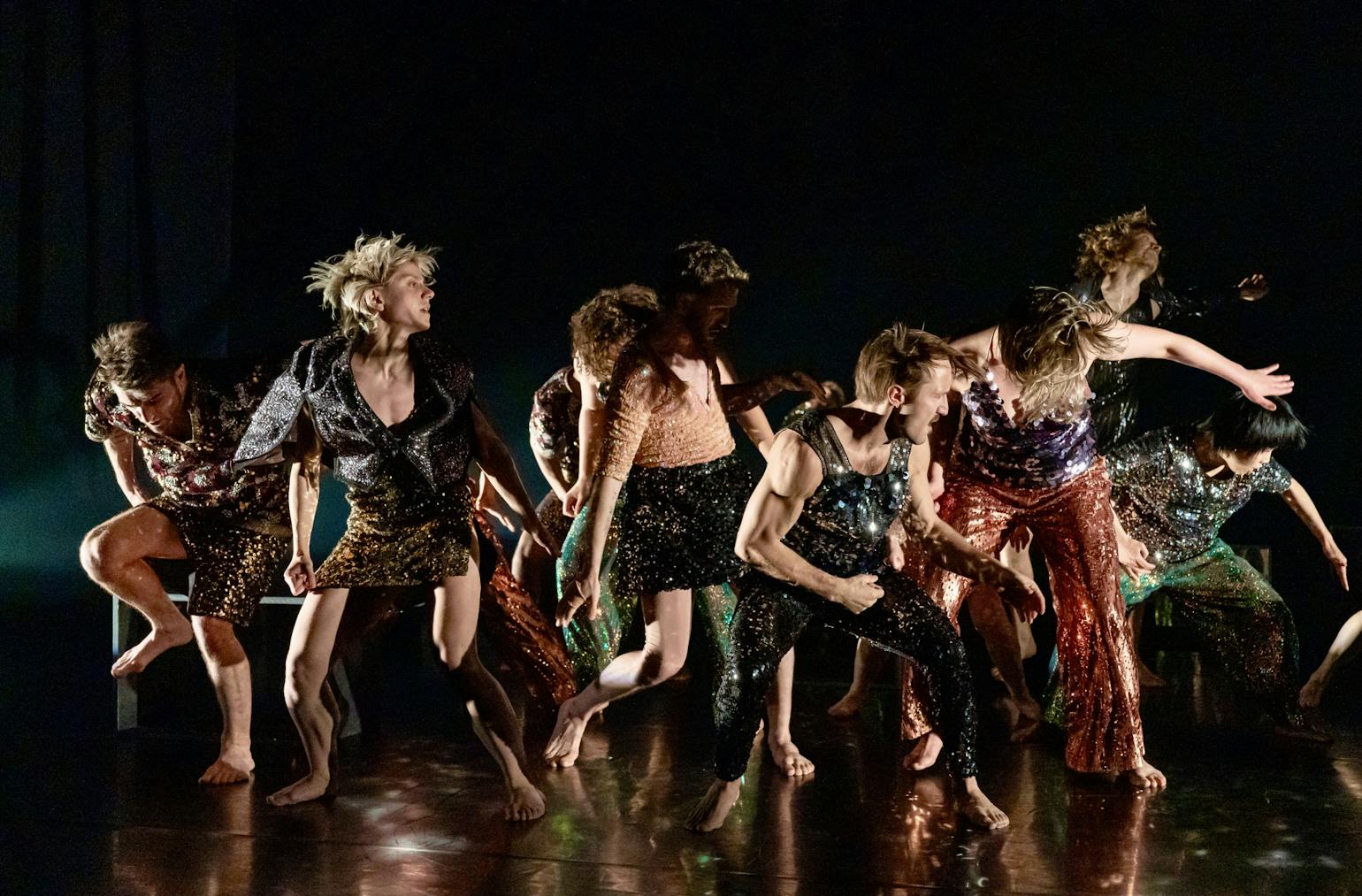
Among Compagnie Virginie Brunelle, Fables sustains a tradition of representing raw human emotions and form. Burton explains, “Each [of our works] seeks to balance physical intensity with poetic imagery, inviting audiences into an experience that is both visceral and deeply human.” As performers, the troupe cultivates a unique gap between the mind and soul—connecting our struggles and hopes wholeheartedly.
Fables showcases the pricelessness of modern dance as a form of art, reminding us how to maintain our common humanity amidst the many social divisions enstrangling us.