How do you revive one of the best superhero shows ever made without suffocating under its legacy?
That’s the question hanging over Daredevil: Born Again, Disney+’s continuation of Netflix’s Daredevil. And after two seasons, the answer seems to be: you can’t.
In brief, Netflix’s Daredevil is incredible. Not only is it easily one of the best superhero shows ever made, but its first and third seasons are some of the strongest television the genre has produced. The show balances brutal action with psychological warfare, as Matt Murdock/Daredevil (Charlie Cox) and Wilson Fisk/Kingpin (Vincent D’Onofrio) try to outmaneuver each other emotionally, legally, politically, and physically. Every conversation is loaded, and every victory costs something. The show feels small, grounded, and intimate in a way superhero television rarely does.
And, putting it lightly, Season 1 of Disney+’s “revival” did not live up to that legacy.
Born Again understands the iconography of Daredevil. It understands that Matt, Fisk, one–take action scenes, and Hell’s Kitchen are things people like seeing. What it doesn’t understand is what made the original show work in the first place.
The first season felt compromised before it aired. Disney reportedly overhauled the project midway through production, firing the original creative team and bringing in new writers and directors after realizing the original version wasn’t working. The final product felt stitched together: Episodes 1 and 8–9 clearly operate on a different wavelength because they quite literally came from different people. The newer material brought sharper action, stronger visuals, and seemingly more competent character writing, including the return of legacy characters the original plan seemed eager to discard. The middle chunk felt flatter, cheaper, and strangely uninterested in the relationships that made Daredevil compelling.
Which is exactly why there was still some optimism going into Season 2. The assumption was that the replacement team finally had a full season to steer the ship themselves. Instead, somehow, Season 2 manages to make the show’s problems even clearer. Because the primary issue with Born Again isn’t really the visuals, or the action, or even the dialogue. The issue is structural. What used to feel like carefully constructed escalation now feels like the plot and characters improvising excuses to keep moving.
Season 1 already hinted at this problem. In one exhausting run–on sentence, this is basically what happens: Foggy Nelson (Elden Henson)—Matt’s best friend—is killed by the assassin Bullseye (Wilson Bethel), love interest Karen Page (Deborah Ann Woll) leaves, Matt gives up being Daredevil, Fisk becomes mayor of New York, Fisk tries to get Matt killed, Matt refuses to be Daredevil, White Tiger (Kamar de los Reyes) gets murdered, Matt refuses to be Daredevil, Punisher (Jon Bernthal) appears to remind everyone the world is awful, Matt refuses to be Daredevil, Matt is taken hostage during a random bank robbery, Matt refuses to be Daredevil, serial killer Muse (Hunter Doohan) starts killing people, Matt anticlimactically says “F*** it” and becomes Daredevil, Muse almost kills his psychiatrist/Matt’s new girlfriend Heather Glenn (Margarita Levieva), Glenn shoots and kills Muse in self–defense, Fisk creates the brutal “Anti–Vigilante Task Force” under his “Safer Streets” act, the task force attempts to kill Matt and Punisher, all the while Fisk tries to acquire a port on the river to smuggle goods through (invigorating, right?), and the season ends with Matt and his new group of charisma–resistant allies deciding they need to stop Fisk.
All of this setup seemingly exists to tee up Season 2, where Matt and Fisk wage a public war against each other across New York. And this is where Born Again loses the plot.
Firstly, every time the show forces viewers to remember the events of Season 1, it drags all of that baggage back with it. Season 1 was so messy and unsatisfying that Born Again spends half its runtime reminding you of a story you already didn’t enjoy thinking about.
Secondly, Netflix’s Daredevil thrived on secrecy. Fisk felt terrifying because he operated like a rumor before he operated like a kingpin. Hell’s Kitchen felt claustrophobic. Violence had consequences because the world was small enough for it to matter. Matt didn’t even know Fisk’s name until Episode 3 of the original series, and the man interrogated into revealing this information was so terrified of the consequences that he killed himself.
Born Again blows that scale open into a city–wide political conflict, and paradoxically makes everything feel less important.
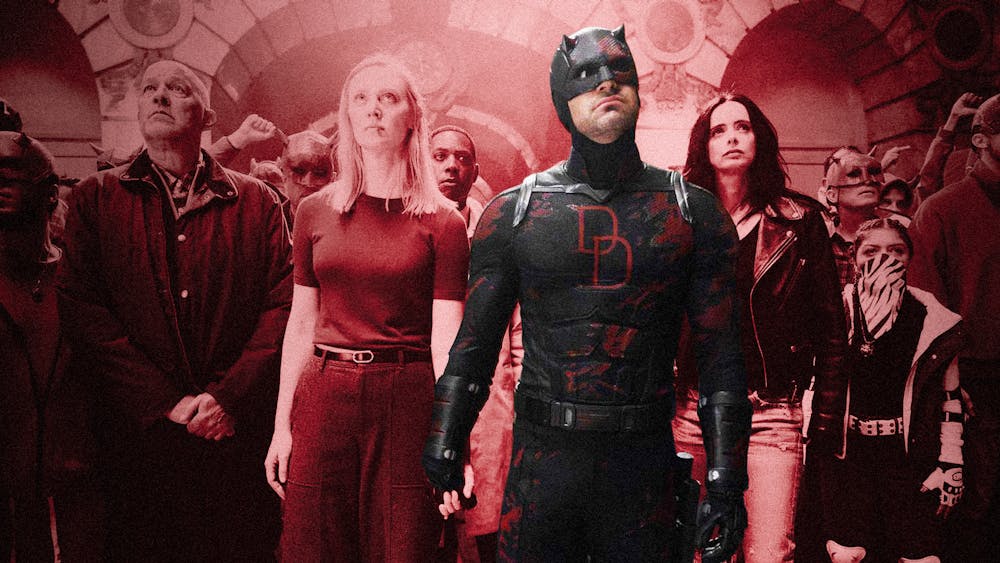
Season 2 revolves around Matt trying to expose Fisk’s corruption while Fisk attempts to frame Daredevil as the real villain. Fisk uses his power as mayor to turn public opinion against vigilantes, while New Yorkers protest in the streets, argue on television, and fight back against Fisk’s anti–vigilante task force. The show constantly reminds viewers that “the city is watching.”
And, to be honest, it’s hard to care.
What used to feel like a tense psychological chess match between two flawed yet compelling men now feels like “The New York City Show.” The cast bloats with reporters, government officials, task force leaders, protesters, advisors, and random civilians whose only real function is repeating variations of “Fisk bad” or “the people will resist.” The original show’s intimacy disappears under the weight of making everything public and politically grandiose.
To be fair, the first half of the season is decent. Early on, the idea of a public–facing war between Daredevil and Kingpin feels promising. Episode 4 especially seems positioned as a turning point after Bullseye kills Fisk’s wife, Vanessa (Ayelet Zurer). It perfectly sets the stage for the brutal escalation the season had been building toward—and so desperately needed.
Then Episode 5 happens, largely filled with flashbacks recreating the original Netflix series. The team recreated the lighting, tone, pacing, and even aspect ratio of the old show to depict events before Season 1 of Daredevil. And unfortunately for Born Again, they did much too good of a job. Not only does the show suddenly look better visually, but it immediately reminds viewers why the original series worked in the first place. Arguably most importantly: Foggy Nelson.
Foggy’s return in these flashbacks clarifies how essential he was to the original series. He grounded Matt, challenged him, and brought warmth, banter, frustration, and perspective into every scene. The dialogue suddenly feels more natural again. The relationships feel lived–in again. And once the episode ends, the emptiness of Born Again’s newer supporting cast becomes impossible to ignore.
Then we’re thrown back to the present timeline, surrounded by characters with motivations and personalities so thin you couldn’t describe most of them with a car door to your head.
The only consistently good part of the show is Bullseye. He drives the best action scenes, and his warped logic about “balancing the scales” after killing Foggy feels perfectly in character. But nearly everything around him feels shapeless. Karen suddenly leads a resistance movement the show never meaningfully develops, and her desire to kill Bullseye is suddenly dropped. Jessica Jones (Krysten Ritter) randomly reappears. Entire subplots involving Fisk’s staff, reporters, black–ops teams, and political maneuvering drift in and out of relevance.
And then we get to the finale, where the show completely loses whatever subtlety it had left.
On a technical level, the finale barely holds together. The timeline surrounding Karen’s arrest and trial feels nonsensical, seemingly unfolding over the span of two days while the show awkwardly cuts back and forth to Daniel (Michael Gandolfini) and BB Urich’s (Genneya Walton) completely uninteresting subplot. The courtroom drama itself feels like it was written by a child—apparently a few wanted criminals (not under oath) saying something happened is enough to prove it beyond a reasonable doubt. Matt publicly outs himself as Daredevil. Fisk, as the city increasingly recognizes him as corrupt, decides his best course of action is to start openly murdering civilians. At that point, the show becomes jaw–dropping, though probably not in the way it intended.
How did we get here? How did a show once defined by restraint and paranoia become this loud?
Defenders of the season could argue that Vanessa’s death pushed Fisk over the edge. But like everything else in Born Again, the emotional payoff never feels earned. The show has explosive events without properly building toward them.
And that ultimately sums up the entire season: the micro is decent, but the macro is a mess.
Individual scenes tend to work. Certain action sequences are excellent. The dialogue occasionally lands. It’s easy to understand what the characters are reacting to in a given moment. But when viewed as a complete story, the season feels hollow. The connective tissue is so weak, and the storytelling so unnatural, that even when the plot logic holds together if you stop and think about it, the actual drama still feels uninteresting.
But even the dialogue starts revealing the show’s larger problems if you listen closely. Born Again relies heavily on swearing, graphic violence, and “look how dark this is” moments to create intensity. That sounds nitpicky on its own, especially for a Daredevil show, but over time it starts to feel symptomatic of a deeper issue: the writers often seem unsure how to create sincerity, tension, or emotional weight without reaching for something loud or shocking.
The pacing is especially strange because Episodes 1–7 largely feel like setup without payoff. Characters talk, investigate, posture, and circle around conflict, but very little fundamentally changes—aside from Vanessa’s death—until the finale suddenly tries to resolve everything at once. Matt is exposed, Fisk snaps, and the show abruptly shifts into overdrive. Instead of escalation, it feels like the writers realized they were out of runway.
Season 3 is already filming, with Luke Cage (Mike Colter) and Iron Fist (Finn Jones) joining the fold. What exactly that season is supposed to look like after this finale, it’s hard to tell—and not in a mysterious or exciting way.
The frustrating part is that Born Again constantly feels like it’s about to turn the corner. It never does. Every strong action sequence or compelling scene briefly suggests the season is finally finding its footing, only for the larger story to collapse back into the same structural problems. Season 2 was supposed to justify the roughness of Season 1; instead, it mostly reinforces it. Born Again may look like a good Daredevil show on the surface, but Netflix’s Daredevil understood why people cared about these characters in the first place.
And nearly 2,000 words later, I worry I’m suffering from the same problem as Born Again: saying so much yet so little.