
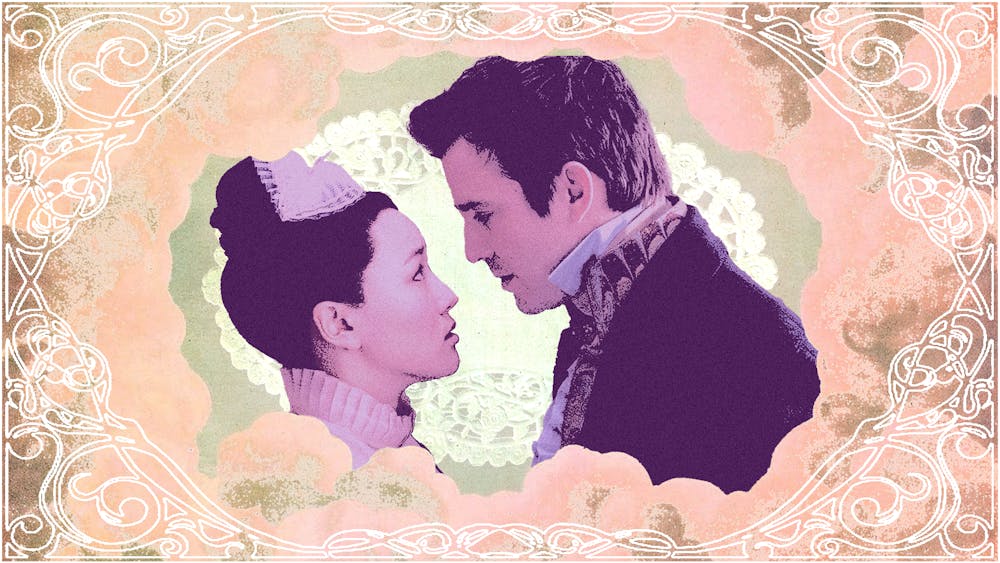
Fake–dating, enemies to lovers, love triangles, friends to lovers—fans of Netflix’s Bridgerton have seen it all. But perhaps the most overused trope that has been incorporated thus far is actually one from a fairytale: Prince Charming, a beautiful ballgown, a hidden identity, and a lonesome slipper.
Bridgerton follows an affluent family during the 19th century in high–society London, with each season detailing a different Bridgerton child’s search for marriage. And the tea is piping hot: scandals run high and spread like wildfire thanks to Lady Whistledown (Nicola Coughlan), a gossip writer who exposes all of the “Ton” drama through widespread pamphlets. The newest season follows second eldest son, Benedict (Luke Thompson) on his search for a debutante he meets at his family’s masquerade ball. The mysterious woman, maid Sophie Baek (Yerin Ha), runs away from the dance at midnight, leaving Benedict with only a glove to show for it. Sound familiar? While this season utilizes a fairly common cliché, it also does something novel for the show—it explores the main romantic relationship primarily through the lens of the historical social commentary that makes Bridgerton distinctive.
As Bridgerton has continued, less focus has been placed on each individual romance. And although including multiple storylines, featuring past couples, and exploring secondary relationships that will be revisited in future seasons keep things interesting and maintains the continuity of the series, it becomes more difficult for audiences to connect with each couple. Simply put, emotional attachment pays off—which can explain why the relationships in Seasons 1 and 2 were so popular amongst audiences. In contrast, Season 3’s main couple, Penelope (Nicola Coughlan) and Colin (Luke Newton), had a story so highly intertwined with other plot points that it made their courtship seem like an afterthought. Other romantic tropes can be more forgiving with a narrative that includes multiple subplots, but when you are essentially retelling a cult favorite fairytale, how can you manage to juggle between different plot lines while also fully dedicating oneself to developing the romance in its entirety? Benedict and Sophie’s season answers this very question.
From the new season’s beginning, it was obvious that showrunners had heard the criticism of wishing to see more of the main couple from viewers of Season 3.
Their solution? A complete focus on Benedict and Sophie. The Cinderella cliché certainly works because the first half of the season feeds into the audience's desires for a yearning, heart wrenching romance. However, it’s also a double–edged sword: incorporating a well–known fairytale means that audiences could already see how the love story would start, its progression, and how it would end. It felt like too simple of a storyline for such a detailed and intricate series, almost as if showrunners and creators were attempting to shy away from the complexities of the Bridgerton world. Of course, the social implications of Sophie and Benedict’s relationship were mentioned—but these were not emphasized or prioritized within the plot. Overall, it felt like an easy escape from jumping into the deep end of integrating romance into an already well–thought out and developed story.
Additionally, Bridgerton is unique because it’s not only a romantic story. It’s one that relies heavily on the historical context of high society London. Sure, there are tons of shows and movies portraying common romance tropes, but nothing does it as well as Bridgerton. It utilizes familiar, modern romance tropes and places them in a historical setting—ultimately creating an entertaining period piece with more complex and unexpected plotlines.
What made Seasons 1 and 2—and even the fan–favorite spinoff Queen Charlotte: A Bridgerton Story—so lovable was not just the chemistry and romantic tension between the two leads, but also how their romances were contextualized into the historical world around them. There are many reasons viewers choose to watch the show beyond a passionate and charming love story; they want to escape into the world of ballroom dances (seen in viral ballroom dance recreations of Charli XCX’s 360), royal gossip, scandals, and pure, unadulterated drama.
This distinctiveness is reflected in the second part of the new season, when tables start to turn: an unexpected death hits the family, lies are debunked, and secrets are uncovered, which ultimately leads to profound commentary surrounding loss, grief, family obligation, love, following one’s heart, and problematic societal expectations. Add in captivating visuals and color grading, perfectly tailored music, and nuanced internal conflicts for the characters, and you create consistently memorable and powerful emotional moments.
These plot points begin to help develop (and complicate) Benedict and Sophie’s relationship further, adding more depth to their partnership in comparison to previous seasons. Their forbidden romance—which they must hide from society, family, and friends—puts everything at risk: Sophie’s reputation, Benedict’s sisters’ debuts into society, and the Bridgerton family’s position within the “Ton.” While the characters have strong chemistry, there is truly nothing like a relationship built on yearning and pining, especially when forces beyond their control keep them apart. It is equally painful and frustrating as it is entertaining and emotionally engaging.
The world and plotbuilding in Bridgerton are not just there to serve as an added bonus to watching the show—they help to build out each couple’s romance by adding obstacles and tension points. The intersection between historical and romantic plotlines is what makes the series special—and Season 4 is a prime example of what happens when showrunners ultimately embrace it, instead of seeking out a more simple solution and running away before the clock strikes midnight.