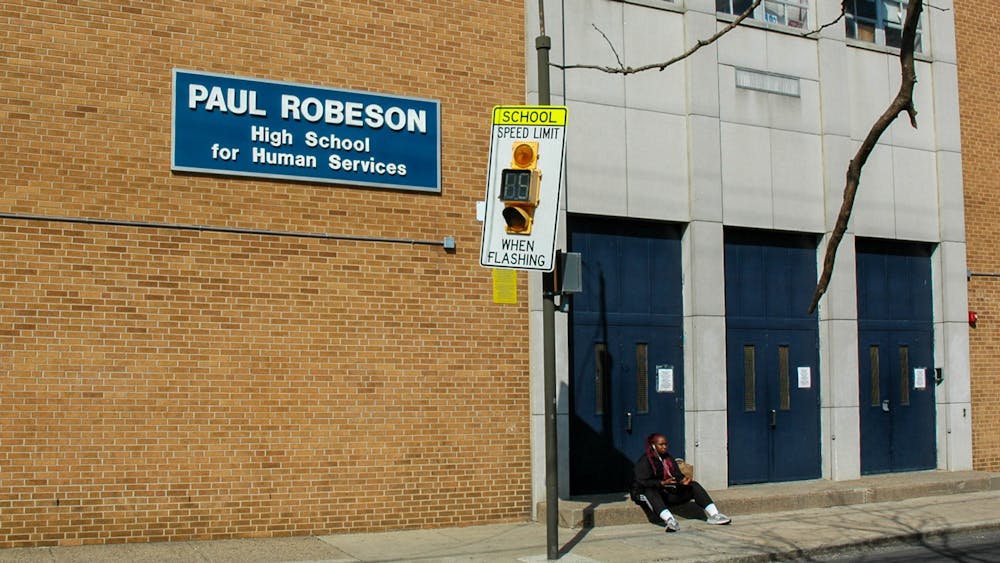
Andrew Saltz, a teacher at Paul Robeson High School, grabs a stool for me and places it in the school’s hallway. He’s substituting for a class, and the door is propped open so he can monitor the students. Sitting down across from me, he points to the ceiling above our heads. “If any of these tiles fall, don’t breathe and run.”
He’s not–so–subtly alluding to the building’s poor condition, one of many factors cited in Superintendent Tony Watlington’s proposal to “reshape” the School District of Philadelphia. On Jan. 22, he released details of his plan to close 20 schools and co–locate six, stating that “moving them into other schools buildings while maintaining their individual structure and identity.” Robeson, one of the schools slated for closure, stands only a few blocks west of Penn’s campus.
Named after Philadelphia–native singer, athlete, and activist Paul Robeson, the school will merge with Motivation High School, after which its building will be demolished. Still, this isn’t news to Saltz, who’s taught at Robeson since 2008 and now serves as its political liaison. He remembers the school district’s attempt to close the school in 2012, giving him a seasoned perspective on its impending closure.
On the surface, concern for the building’s dilapidation isn’t baseless. Saltz recalls the time he taught with a broken leg and realized that Robeson lacked a functioning elevator. Until recently, the school did not have air conditioning.
“We actually had to argue for our own air conditioning,” he says, “And in either 2011 or 2012, I took a kid [on] a ride in an ambulance who had an asthma attack [because] it was 95 degrees in here.”
Given Robeson’s environmental shortcomings, you’d probably assume that the new school it’s merging with would be better off. Yet the opposite is true.
“The school we were supposed to go to first [was] also a failing facility,” Saltz says, referencing Sayre High School, the original school planned to co–locate with Robeson before Motivation. With a school building rating of 54.1%, Sayre only stands five points above Robeson’s 49% rating, suggesting that both are considered to be in poor condition. Motivation isn’t much better. With a 69.5% rating in building quality, the school is simply categorized as “fair.”
“I can be in a garbage building right here, where I’m comfortable, you know,” Saltz says.
However, the root of the closure lies beyond the building’s infrastructural shortcomings. In a statement to The Philadelphia Inquirer, Watlington admits that it’s “not just about old buildings.” While he offers a laundry list of justifications—under– and over–enrollment, improved educational outcomes, among others—he fails to mention the economic incentives driving the shift. It’s less about academic reevaluation and more about the land where the school building lies.
Thus, Saltz claims that these closures can be traced back to monetary gain. In Robeson’s case, he believes the property is “prime real estate,” attracting buyers with its University City location.
Redevelopment has a bad reputation in West Philly, with critics citing the gentrification and displacement it causes.
“I am one of the rare people [who’s] not against the buildings going up. I like that people want to live here,” says Saltz. “I think that’s really good for West Philly, but you can tell people want this land, and the land is going to be given to the mayor. I don’t have a problem with that. I have a problem with build[ing] new apartments and displac[ing] a successful Black school.”
Robeson’s academic strength is tangible: according to The Philadelphia Tribune, the high school was named “Most Improved High School in Philadelphia” in 2017 by the School District of Philadelphia and a “Top High School” in a 2019 U.S. News & World Report. As of 2024, it retains a 93% graduation rate. Robeson’s previous principal Richard Gordon also took the award in 2021 for National Principal of the Year by the National Association of Secondary School Principals.
The school’s accolades raise a broader question: rather than demolish successful community hubs, why not invest in their improvement?
“They’re just closing schools and disrupting whole communities without any real kind of clear plan for the investment of this money,” says Julia McWilliams, the co–director of the Urban Studies Program at Penn and a member of the Stand Up for Philly Schools coalition. “How are all the schools going to benefit? I’m unsure. I don’t see a long term plan. I see this very punctuated moment in the plan of closure. We did not save money last time the building sold, [and] for the ones that did sell, [they] did not sell for much.”
She emphasizes that once the district sells the buildings, they’re no longer owned by the public. Instead, they’re placed on the private market and their status remains hidden from the public.
The lack of maintenance for schools like Robeson is merely one of many examples of how school foreclosures are not instantaneous decisions; most unfold over time, shaped by contentious policy decisions such as expanding charter schools. Statistically, there’s no evidence that these newfound systems work better than existing neighborhood schools.
Consequently, these closures reflect the Philadelphia school system’s long history of injustice, particularly the racial biases leveraged against BIPOC students. In doing so, policymakers make implicit value judgments about whose education is worth “saving.”
“We have seen disinvestment in public education for Black and Brown kids since the beginning of this country,” McWilliams says. “There has never been a golden age where Black children or Brown children have gone to school [with] those buildings … in good shape and [in] something that looks like what white kids [have] always [had].”
Saltz echoes McWilliams’ sentiment—as a long–time teacher at the school, he’s seen how this inequity unfolds firsthand. As a Caucasian man, he knows how nonminorities tend to react.
“There’s some people in University City who see a successful Black high school in the middle of it [who think] it might bring down some values,” he says. “Because those kids get out … running around the streets, being kids, you know, people see that. People who look like me see that. We can be honest about that.”
The fact that these kids are also honor roll students doesn’t occur to them, Saltz suggests. Entrenched stereotypes drive community leaders to neglect students’ academic success; instead, there’s an emphasis on “improvement,” with co–locations displacing communities rather than allowing them to thrive.
Although these closures won’t be in effect until the 2027–28 school year, Watlington already acknowledges that the changes will “roil some communities” and provoke protests. Yet, when McWilliams encounters headlines like these, she reads 26 school closures, refusing to separate co–locations from outright closures.
“A lot of parents have purposely chosen Robeson because it’s small. They’ve chosen particular neighborhood schools because they’re small schools,” says McWilliams. “To me, a colocation means that they are going to slowly bleed that school out, and then eventually just eliminate it from the building that it’s co–located in.”
A key part of school closures is policymakers’ assumptions that parents will agree to send their children to these schools. They presume that parents will follow their plans—that Robeson parents will passively consent to sending their children to Motivation.
Saltz, however, says otherwise: “A lot of the parents are telling us, ‘I’m not sending my kid to Motivation … I’m not gonna do that. I’m gonna homeschool them, or I’m gonna send them to a charter,’ [If]your kid has one year left, you can afford to send [them] to a parochial school if you want.”
He speaks from experience, noting similarities between the attempts in 2012 to close Robeson and now.
“If the kids don’t go, the money doesn’t follow,” he says, countering Watlington’s claim that closures save money. “That’s what our argument was last time, when we were going to go to Sayre.” Calling each parent during the closures in 2012, he found that 90% of families would not send their child to Sayre.
This “push for school choice” by the district is driving the cynicism students feel about the closure. Robeson is a neighborhood school, and students are close, both socially and geographically. When these communities become displaced, there’s no guarantee that students will find their place again.
“A lot of these kids who I love and who deserve an incredible education—they’re not magnet school kids,” Saltz says. “They need a lot more support. How are you going to integrate kids who got kicked out of magnet schools or got denied from magnet schools?”
Another shortcoming in the district’s plan is the lack of intentionality that factors into choosing which school to co–locate Robeson into. They place students according to the district’s best interests, not where students are in the best position for success.
“They won’t be able to get enough kids if that [mindset] stays,” Saltz says. “I bet some of these kids applied to Motivation [and] couldn’t get in. Oh, now you’re in. Well, how are you going to support them to make sure they stay in? Nothing.” With parents and teachers having no say in the matter, students are forced to find a new community in magnet and charter schools.
The reason to do so remains unclear. “There was no evidence that charter schools were better than neighborhood schools,” McWilliams says, “And since then, we have learned that many of them are not. … Some of them are worse, and some of them are very unstable and closed down.”
So where will students go?
Despite the push from the district to co–locate, the skepticism driving both Saltz and Robeson’s students says otherwise. “We could stay in University City and we should stay here. We should be in a small school. There’s plenty of space—we can do it,” he urges. “Black kids belong in University City, not behind a register and working security, right? They should be here as students.”
With the upcoming closures by the district, however, the threat of displacing these students looms over Robeson. In this sense, Robeson’s closure is more than a co–location. It marks a broader shift in the district’s educational priorities, where a school’s property is deemed more valuable than its students.