We hear again and again that streaming killed the water–cooler star (so to speak), but HBO’s commitment to keeping their weekly TV show slots alive may be the only thing saving it. There’s a deeply human sense of community in experiencing and enjoying the same media alongside thousands of other people—making plans with friends to watch the newest episode when it drops, exchanging fan theories and reactions over text or online. Where the aftermath of COVID-19 has made binge culture the accepted norm, this communal delayed gratification turns a show into an event.
This spring, The Pitt has created this experience every Thursday night—the same Must See TV slot that producer and star Noah Wyle’s previous show, ER, also occupied in an age of network television. The Pitt improves upon itself in its second season, elevating many of the themes that it explored in season one to new heights. Although many of these topics are extremely heavy and stressful—each episode leaves you feeling like you’ve just run a marathon—The Pitt is also strangely hopeful. For every moment that shows the worst of humanity, there is a moment that shows the best of it.
The new season opens on a beautiful sunrise scene, and we see Dr. Robby (Wyle) riding his motorcycle over Pittsburgh’s famous Rachel Carson Bridge. It is strangely peaceful for a show that’s so often characterized by high–stress situations, and for a moment, we think that maybe this season will be lower–octane. But upon a closer look, this facade begins to shrivel. Anyone who has watched a medical drama, or even just has common sense, will notice that there’s something very off about an emergency room doctor riding a motorcycle without a helmet. This is simply the first clue to a crisis that seems constantly on the verge of exploding—Dr. Robby is actively suicidal, displaying so many signs of struggle that the viewer begins to question, not if someone will put him on a psych hold, but rather who, and when.
Although several of his colleagues confront him about his suicidal ideation, the hammer never really drops like you think it will. Instead, the season concludes with Dr. Robby monologuing to a baby, à la Sorry, Baby, as he slowly begins to rediscover the joy of living again. This unorthodox choice is strangely comforting after such a stressful season. Instead of ending in a blockbuster–level roar, the season leaves us on a breath of fresh air and the feeling that everything might be okay after all.
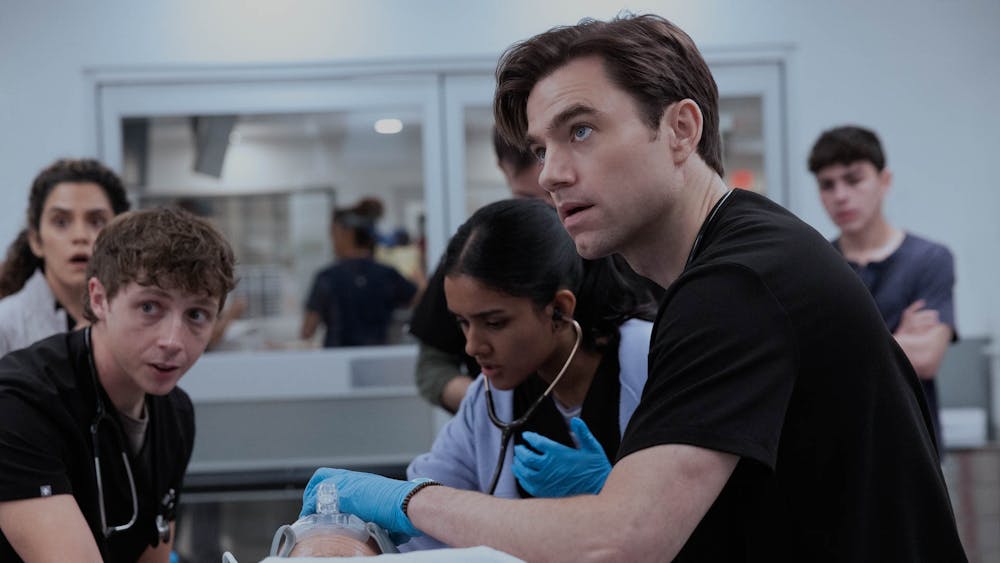
Like in season one, Wyle and the creative team manage to pack an impressive amount of content into the 15 episodes of its second season. Each new episode is the next hour in one 15–hour shift in an underfunded Pittsburgh Emergency Room, following a similarly overworked day shift team of old and new faces. The doctors see between five and ten patients seen each hour, and the mixed episodic format ties up these smaller closed loops inside season–sprawling storylines. This can sometimes feel overwhelming, with so much to pay attention to, so many stories, and an endless barrage of characters; however, the upside is that no topic or issue is off–limits. When an episode has plot lines that span from a girl accidentally gluing her eye shut with lash glue to a woman with stage IV cancer weighing her free will against her imminent death, the show can span a breadth of medical–based issues, but never linger too long on any of them.
Amidst the chaos and high–speed drama, the show still makes a strong effort to focus on topical issues that affect real people, handling them in a way that is both delicate and impactful. The most salient of these is, by far, the incorporation of United States Immigration and Customs Enforcement. One of the ER’s patients is brought in by ICE agents after she “fell” during a raid. The agents, as one could expect, are portrayed as downright awful. Not only do they intimidate people, causing several staff members and some people in the waiting room to leave, but—following a violent scuffle after they attempt to manhandle the patient—the agents arrest the nurse who attempts to defend her.
As we watch situations exactly like these unfold on our social media feeds on a regular basis, seeing it replicated so realistically on a television show—one that ostensibly is supposed to be an escape from reality—can be shocking, if not downright painful. However, the sucker punch of this moment is immediately soothed by the overwhelming care from these fictional physicians and nurses, making us feel that, even though the world does suck, even though people constantly hurt each other and constantly are hurt, there’ll always be someone there to pick up the pieces and nurse us back to health.
The show is also funny, in a way that’s almost unassuming; doctors and nurses crack workplace jokes throughout the day that seem to be more for the other characters than the audience. From an outsider’s perspective, this may seem like it cheapens the heaviness of the themes, but the occasional comedic relief is necessary to sooth the heartache of the most devastating storylines. In addition, with so many different narratives, there is an opportunity to showcase each provider’s abilities and story, which strengthens the hope that many people from different backgrounds can come together to work for the common good.
The Pitt, despite its stressfully realistic plot lines and frequently devastating outcomes, is one of the most hopeful shows on television right now. The thought that there are good people in this world, ones who wake up every day and commit their lives to helping others despite the hellish circumstances we live in, just warms the soul. If we could all be a little bit more like the doctors of The Pitt and show a bit more empathy, the world would be a much better and brighter place.