Congratulations Gen X–ers, there’s a film in theaters just for you. Masters of the Universe is back and on a bigger screen than ever before! I’m sorry, what’s that? You’ve never heard of it?
It’s no surprise that Nicholas Galitzine’s newest film flopped at the box office. He–Man’s pop cultural prominence peaked in the 1980s, when kids gathered in front of their TV sets every weekday to watch the wacky adventures of Prince Adam and his gang of heroes. But even though He–Man is not a fixture in the public’s imaginations, Mattel and Amazon MGM have poured over $200 million into this colorful and fantastical adventure for the entire family.
Masters of the Universe is decently fun and obviously made by people who love the intellectual property, so it’s no surprise that the film is sparking comparisons to the fan–favorite Dungeons & Dragons: Honor Among Thieves. But unlike the D&D film—which wholeheartedly embraces the inherent absurdity of its source material—Masters of the Universe lacks the courage to commit to any of its ideas. The film constantly offers brief morsels of sincerity that are immediately swallowed by the abyss of ironic jokes and self–referential cringe.
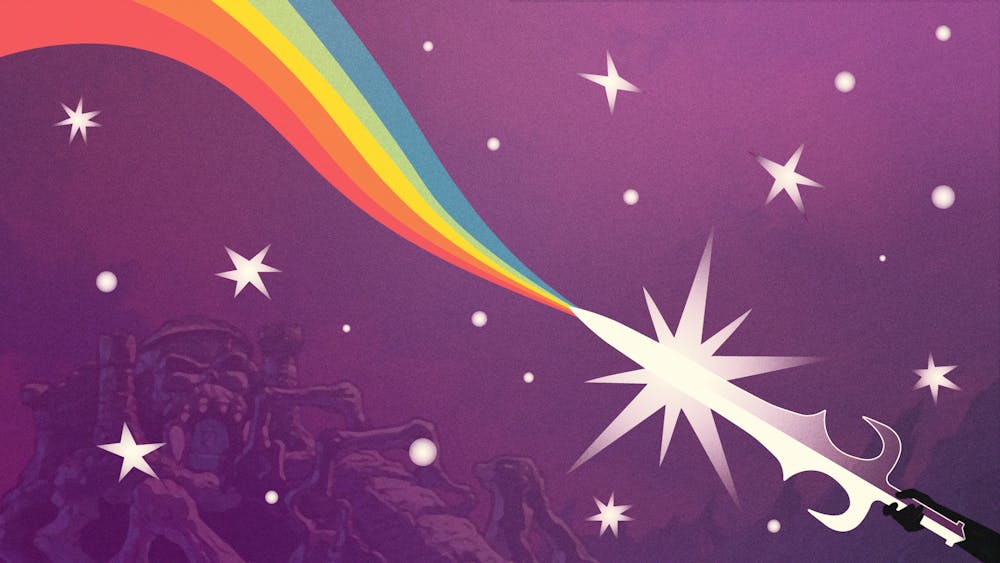
For those unfamiliar with the property, Masters of the Universe began in 1982 as a Mattel toy line, before rapidly exploding into a multimedia phenomenon. The mythology centers on Prince Adam of Eternia, a seemingly ordinary royal who—through an iconic magical girl transformation involving the Sword of Power—becomes the mighty He–Man. Alongside friends like Teela, Man–at–Arms, and Battle Cat, he protects Eternia from the forces of Skeletor, one of the great cartoon villains of the ’80s.
Director Travis Knight’s film reimagines Adam (Nicholas Galitzine) as a young man stranded on Earth after Skeletor’s (Jared Leto) invasion of Eternia. Working a dead–end HR job and struggling with feelings of inadequacy, Adam spends years searching for the lost Sword of Power before eventually returning home to confront his destiny.
From the very beginning of the movie, it’s obvious that the story wants to interrogate masculinity. Adam is physically unimposing compared to the warriors around him. He prefers empathy to violence. His father views him as an utter disappointment, not even turning around to check on his ten–year–old son after knocking him to the ground during a spar. Adam struggles to reconcile his own identity with everyone’s expectations of what a “real man” should be.
However, the film never develops these ideas beyond the level of observation, and straight up ignores these themes by the end. It’s especially frustrating because there are few pop culture icons more uniquely positioned to explore masculinity than He–Man himself.
For decades, He–Man has occupied a fascinating place within queer culture. Though never explicitly written as gay, the character has long attracted queer interpretations. There’s a whole Wikipedia page about it. His hyper–muscular physique, leather harness, blonde hair, and campy aesthetic have often been compared to gay clone culture and the homoerotic imagery that emerged within LGBT communities during the ’70s and ’80s. Prince Adam’s dual identity has also resonated with many queer audiences, who saw parallels between Adam’s secret life and the experience of remaining closeted.
The comparisons are hardly obscure. Entire academic essays have been written about the queer dimensions of Masters of the Universe. Mattel executives have openly acknowledged He–Man’s queer following, with Rob David, Mattel’s Vice President of Creative Content, saying in an interview with Queerty: “If people see any of our characters as an icon for what they identify with, that’s wonderful.” Even Chris Butler, the screenwriter behind this new film, has discussed how his childhood fascination with He–Man was intertwined with growing up gay in the ’80s.
The film knows this history, references this history, and even jokes about this history. But it does nothing to engage with it.
Instead, Masters of the Universe repeatedly falls back on the safest possible approach: endless gay innuendoes without any actual queer representation. The movie is packed with jokes about swords, fists, bodies, and male physicality. There’s an actual line in the film about “[He–Man’s] long sword dangling between [his] glorious thighs.” Characters named Fisto (Jóhannes Haukur Jóhannesson) and Ram–Man (Jon Xue Zhang) become the punchline of entire comedic sequences. The film wants the audience to recognize the queer coding, but doesn’t want to do anything with it.
And it’s unfortunate because making Adam canonically queer would have elevated every major emotional beat in the film.
Imagine if Adam’s discomfort with weapons training wasn’t simply about being physically weaker than his peers. Imagine if his father’s disappointment stemmed from something deeper than Adam failing to conform to traditional expectations of masculinity. Imagine if their devastating reunion later in the film carried the weight of a son who spent his life believing he could never be the man his father wanted him to become. Suddenly, Adam’s journey toward self–acceptance becomes genuinely meaningful. More importantly, it would align perfectly with the themes the film already attempts to explore.
Turning a childhood icon into a canonically queer character has already happened—in this very franchise. Netflix’s 2018 animated series She–Ra and the Princesses of Power, created by ND Stevenson, remains one of the best examples of how to modernize a property while staying true to its core themes. The series openly embraced queer storytelling, culminating in a canon romantic relationship between Adora—Adam’s twin sister—and Catra. Yet, it never felt like an abandonment of She–Ra’s identity. If anything, it deepened the franchise’s long–standing themes of friendship, self–discovery, belonging, and heroism.
As society becomes hyperpolarized and regressive, it’s no surprise that Masters of the Universe is unwilling to commit to something so explicit. Instead, it treats queerness as subtextual decoration rather than meaningful storytelling. This lack of commitment extends beyond sexuality, and ultimately, poisons the whole film.
The film’s entire approach to masculinity becomes very superficial. Like Barbie, it clearly wants to analyze the cultural meaning of one of the most iconic toys of the twentieth century. But where Greta Gerwig at least presented a surface–level dive into womanhood and feminism, Masters of the Universe circles around questions of manhood without arriving at any conclusions.
Adam begins the story believing he isn’t strong enough. He learns that empathy and communication matter. He learns that violence shouldn’t always be the answer. He learns that masculinity can take different forms. And then the movie proceeds to resolve every conflict exactly the way an ’80s He–Man cartoon would: through punching.
Again and again, the film introduces an interesting idea before immediately backing away from it. Any moment of sincerity is undercut by an eye–roll. Any emotional revelation is followed by a joke. Any opportunity for introspection gets swallowed by self–aware comedy. The audience is never allowed to sit with a feeling for more than a few seconds.
It sucks because Galitzine is good. His version of Adam possesses a softness and vulnerability rarely seen in blockbuster male heroes. There’s a very compelling version of this movie where that sensitivity becomes the foundation for a more genuine exploration of modern masculinity.
But the script continually treats those qualities as both strengths and punchlines. By the end, Adam’s stated desire to become a more complete and well–rounded man doesn’t really mean anything. The character changes very little internally. The themes remain unresolved. The questions posed in the opening scenes are left hanging.
There’s still plenty to enjoy. Eternia looks fantastic, Galitzine is charismatic, and Jared Leto might have just delivered the best performance of his life. But much like Adam himself, Masters of the Universe is torn between competing identities. It wants to be a sincere examination of masculinity while also functioning as a crowd–pleasing Mattel blockbuster. It wants to acknowledge He–Man’s queer legacy while also refusing to engage with it. It wants to celebrate the franchise’s campiness while simultaneously apologizing for the cringiness. In trying to accomplish all these goals at once, it never serves any of them.
The film attempts to ask what kind of man He–Man should be. First, it should’ve decided what kind of movie it wants to be.