
I never thought I’d hear “Benjamin Franklin” and “rock–and–roll” in the same sentence, let alone in the same show. But as Friday night rolled around, I found myself in the cool air conditioning of Old City’s FringeArts Theatre, a welcome reprieve from Philly’s record–breaking heatwave. As I received a wristband and playbill from an employee, white–haired save for his purple mohawk, my heart buzzed with something I can only call open anticipation. I had absolutely no clue what to expect from this show, besides its Mad Libs of a description and some insight into its creation from its writer, Randall Lane. And with that, the lights began to dim.
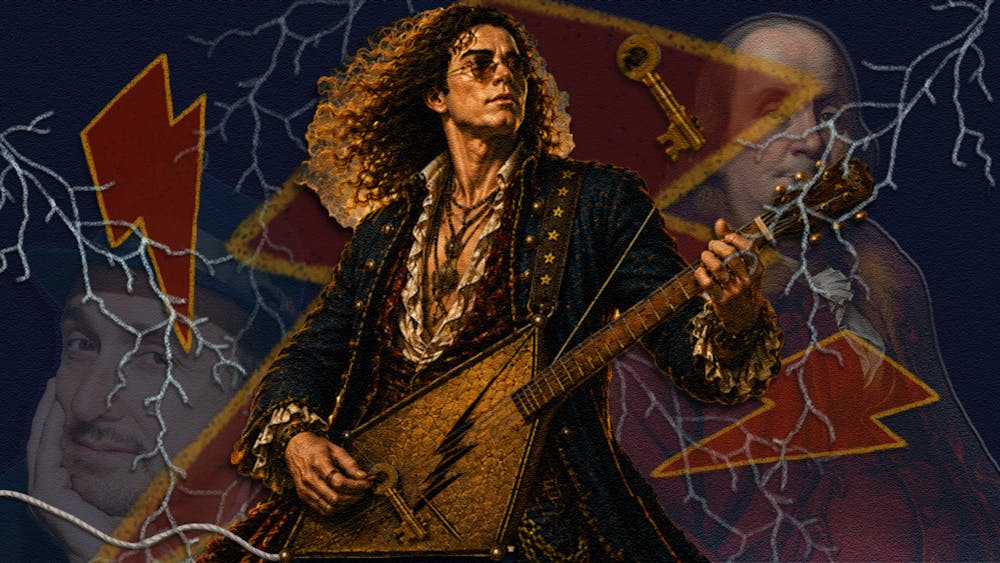
The Sound of America is a biographical musical retelling of founding father Benjamin Franklin’s rise to fame, beginning with his arrival in Philadelphia. Put like that, it sounds like Hamilton with a new face on the cover. What distinguishes The Sound from facially similar projects is its extended metaphor; here, Franklin is more than a writer and inventor. He is an aspiring rock star, working to create a name for himself and his band, the ragtag Leather Apron Club. After a lightning strike leads to his discovery of the electric guitar and the rock–and–roll genre, Franklin skyrockets to international fame, and must stave off external and internal villains for his band’s survival. Another unique facet of the performance is that the stage is set and the show performed like a concert. The band is upstage, not in a pit, and they engage with the actors during the show as though they’re members of the cast. Multiple standing microphones are planted on the stage’s edge, and characters go up to the mic to narrate, sing, or engage with the audience. There’s no typical musical theatre dance numbers, but the actors work the stage during the performance just like an artist during a set.
One of the smallest joys in watching The Sound of America is its details, which are intentional without feeling obvious. Franklin wears bifocals and plays the harmonica, both of which were invented by the founding father. He trades in a traditional guitar pick for a small metal key, and his electric guitar has a string tied to the bottom to mimic a kite tail. The musical also harkens back to its rock–and–roll roots by referencing iconic songs and artists. A Gene Simmons mask here, a couple iconic guitar chords there—all of these small elements show the level of care and knowledge that was imbued into the show by its creators. More so, much of the cast has visible tattoos and piercings which are usually hidden in shows, especially period pieces. Keeping them in speaks to a core tenet of rock music: nonconformity.
While the show focuses attention on its smallest parts, it does so without sacrificing its larger features. The central metaphor of the show layers musical and American history well, reflecting the recurring patterns in each. While the narrative is quick to say what it means, and some of the script can feel heavy–handed, the show’s themes of strength in unity and community are well delivered without feeling cheesy or overbearing. The actors give the show its soul and its voice.
Despite only having a five person cast, each actor brings a unique musical style and dimension to their character. The leading man, Kohl Pilgrim, brings out a spunkier side to the founding father, imbuing him with the swagger typical of a leading man. His ability to sing across different genres was the backbone of the show’s musical exploration. Federica Andino–Vega, who plays Deborah Read, stands out as a dynamic actress. She portrays Franklin’s common–law wife with spirit, but still allows her emotions to bleed through in ballads like “Ever True.” Her voice showed both its strength and softness throughout her various musical numbers, with each performance better than the last.
Whether in the scripted audience engagement or the ad–libbed remarks characters made facing technical difficulties, the heart of The Sound extends past the stage. The actors embody the purpose of rock–and–roll by pouring everything into each show, and reveling in it. Seated in FringeArts, you’re close enough to make eye contact with the actors while they perform. That might sound unnerving, but it allows for the best part of the show: seeing just how much fun everyone onstage is having every second they’re out there.
The Sound of America will be performed at Philadelphia's FringeArts Theatre until August 1st.