Who doesn’t love Spider–Man?
Some find Batman too dark, others think Superman is too powerful (a strange complaint for a superhero, but okay). But Spider–Man? He’s one of the only fictional icons who somehow belongs to everyone.
That helps explain why excitement surrounding Spider–Man: Brand New Day reached such a fever pitch. As the MCU’s first film in over a year and its only non–Avengers movie until 2028, it promised exactly what fans had spent years asking for: a grounded Spider–Man story centered on a broke, lonely Peter Parker (Tom Holland) scraping by in New York. No billion–dollar nanotech suits, no Avengers, and no Tony Stark. And for the most part, that’s exactly what was delivered. Judging by the record–breaking box office, the studios got exactly what they were hoping for, too.
More importantly, the movie understands something simple: Spider–Man himself is almost impossible to get wrong.
His powers are inherently kinetic. Superman flies, Flash runs, Doctor Strange teleports, but Spider–Man falls. Every swing begins with gravity winning, the world pushing him down. He throws himself off a building and hopes the next web catches in time. There’s risk in every movement, and the audience feels it. You don’t simply watch Spider–Man stick his arm upward and take off—you instinctively lean with him, feel the drop in your stomach, hear the wind ripple against his suit, and brace for the landing with him.
But the movement is only part of it. Peter Parker is perpetually caught between what he wants and what he believes he owes everyone else. He is powerful enough to save strangers yet rarely capable of preserving his own happiness. He is funny, isolated, exhausted, hopeful, and constantly running late. Brand New Day understands all of that.
But before talking about the film itself, I do need to briefly defend Jon Watts, the director behind Holland’s first three solo Spider–Man outings. For nearly a decade, people dismissed this Peter as “Iron Boy Jr.,” arguing that he relied too heavily on Stark technology and spent too much time seeking Tony’s approval. I’ve never understood that criticism.
The MCU didn’t need to remake Sam Raimi’s or Marc Webb’s Spider–Man. Audiences had already received two iconic portrayals within the decade before Holland’s debut in Captain America: Civil War. Instead, Marvel dropped Peter Parker into a universe where Iron Man already existed and asked how that would realistically shape a 15–year–old kid. Holland’s Peter never lost Spider–Man’s defining qualities—his kindness, humor, empathy, and resilience. His circumstances were simply modernized.
Brand New Day works better because those earlier films existed.
The ending of No Way Home stripped Peter of everything. His friends forgot him, his only family was gone, and his apartment barely qualified as livable. In hindsight, the “Home” trilogy feels less like three standalone adventures and more like one extended origin story, ending with Peter finally becoming the isolated, street–level Spider–Man many fans had wanted all along.
So, did Brand New Day accomplish what it set out to do? Yeah, I think it did.
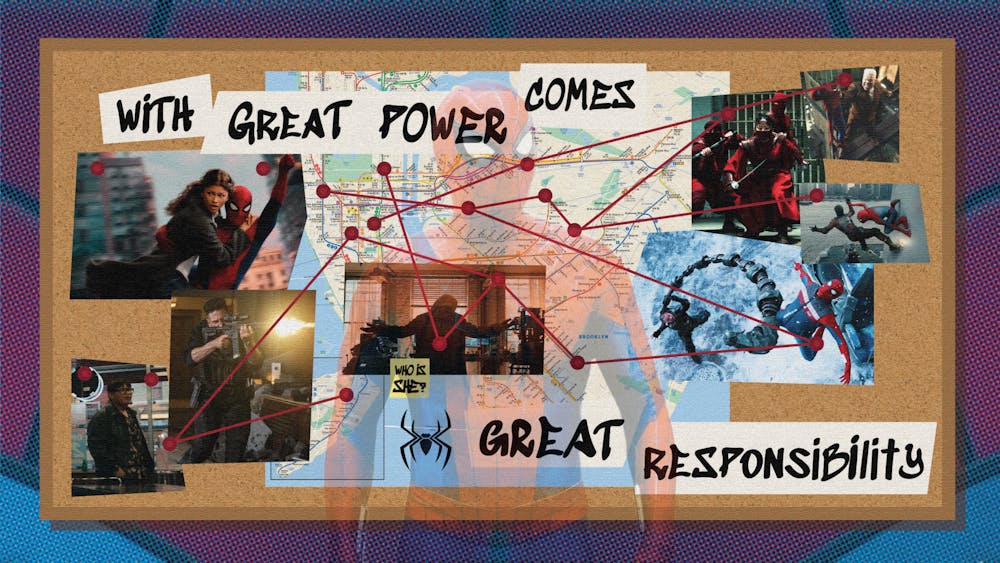
Simply put, the opening hour is some of the best live–action Spider–Man ever. New York finally feels like a living Marvel city; Punisher (Jon Bernthal), Yelena Belova (Florence Pugh), Hulk (Mark Ruffalo), the Hand, and Damage Control all occupy the same world without turning the film into an overcrowded crossover. It feels wonderfully comic–book–y. Spidey’s banter with Bernthal’s Punisher oozes chemistry and perfectly captures why Peter Parker is so endlessly likable. And finally paying off Michael Mando’s Scorpion, first teased way back in 2017’s Homecoming, is deeply satisfying.
The cast is excellent across the board, but Tom Holland might just be the perfect Spider–Man. He is unbelievably good as both Peter and Spidey. He also deserves more credit for something people rarely mention: his physical performance. Holland moves like a cartoon brought to life—even standing still, he never stops acting. Every conversation, whether it’s a throwaway exchange with a stranger or an emotional monologue with the supporting cast, reminds you why Peter Parker has remained the world’s most relatable superhero for over 60 years: he feels like someone you know. His performance perfectly balances physical exhaustion, latent grief, and the stubborn decency of someone who has spent four years living entirely for other people.
Perhaps the movie’s strongest decision, though, is refusing to undo No Way Home. MJ (Zendaya) doesn’t know Peter. Ned (Jacob Batalon) doesn’t know Peter. The two of them went off to live the college life the three of them dreamed about together, while Peter can only watch from the outside. The life he sacrificed to protect them is simply gone. Watching him commit to that decision—choosing every day not to tell them the truth even when doing so would restore the only real happiness he has known—is arguably the most Spider–Man thing ever put on screen. Most superhero movies are at their best when the costumes come on, but Spidey is one of the few characters whose civilian life is just as compelling as the action.
In fact, my favorite scene arrives a little past the halfway point and puts Peter, MJ, and Ned back in the same room. On paper, nothing about it is particularly groundbreaking, but the scene has three earlier films of history behind it. Every pause, look, and almost–connection carries the weight of a friendship only Peter remembers. Without the earlier trilogy, the scene would still work. But because of it, the scene hurts.
That history also helps Brand New Day function as both “Spider–Man 4” and a fresh starting point. New audiences could jump in without much trouble (though why anyone would willingly start here is beyond me), while longtime fans feel every year Peter has endured.
From there, my praise comes with more caveats. The overall story is perfectly solid—the movie rarely makes a bad choice. The problem is that it almost never makes one you don’t see coming.
Sadie Sink’s character provides a clever reinterpretation of existing Marvel mythology, and credit is deserved for keeping her identity out of the marketing. Even what she is searching for leads to one of the film’s few genuine surprises (for those who know: V–Max). Unfortunately, what that discovery ultimately means for the story is far easier to predict, making the reveal exciting while its payoff is considerably less so.
The eventual “primary antagonist” (hard to describe accurately without spoiling things) also functions well enough. The issue is that the reveal of who they really are is so obvious that Peter becomes the last person in the theater to figure it out.
That reveal also marks a noticeable turning point. The first portion of Brand New Day is bursting with world–building, character work, and momentum. Then the movie pivots toward its larger, more conventional mystery. For a stretch, you almost forget you’re watching a Spider–Man story—and not in a good way. Rather than watching a young man navigate impossible responsibilities, you’re mostly just watching a basic plot unravel. The movie eventually recovers and ends on a strong note, but the middle–to–late stretch feels like a slightly lesser film than the one that began.
Peter is also undergoing a strange physical transformation throughout the story. It externalizes his emotional deterioration and loneliness, and the metaphor works in theory. Yet the subplot never becomes important enough to justify how heavily the trailers emphasized it. If anything, it feels like a secondary (or even tertiary) storyline awkwardly shoehorned in and promoted as the movie’s central conflict.
Speaking of the marketing, Spider–Man movies have developed an unfortunate habit of treating trailers like extended highlight reels. Brand New Day is no exception.
Every major action beat is shown off. Large chunks of the Hulk fight. Peter’s transformation. Several moments that would have been pleasant surprises in the theater. Good trailers answer a few questions while creating ten more. These answer almost all of them.
There’s nothing wrong with revealing a little and surprising audiences with a lot. What’s frustrating is revealing almost everything and having surprisingly little left to discover. Thankfully, the movie remains entertaining enough because Spider–Man himself is just so likeable.
Visually, Brand New Day also takes a noticeable step away from Watts’ trilogy. One small touch I especially appreciated was letting Peter’s eyes subtly show through his lenses—it gives Holland’s performance far more emotional texture. Director Destin Daniel Cretton also imbues the film with a more stylized identity, drawing clear inspiration from Insomniac’s Spider–Man games in the action. A handful of effects look slightly unfinished or wonky, but several sequences stand out for the better.
Cretton’s path to Spider–Man has been interesting. Shang–Chi proved he could comfortably handle blockbuster action, while Wonder Man—despite attracting a smaller audience—showed a filmmaker with a more distinct voice. The series became one of Marvel Television’s best projects, earning Yahya Abdul–Mateen II an Outstanding Lead Actor Emmy nomination and an unexpected Season 2 renewal before Marvel abruptly reversed course on the eve of Brand New Day’s release. No official explanation has been given, but the timing inevitably invites speculation. Some fans have wondered whether Marvel simply decided Cretton’s time was better spent elsewhere after seeing what he accomplished with Spider–Man. If that’s true, it’s an oddly flattering reason to lose a television show.
Regardless of what happens next for Cretton, his success shouldn’t come at Watts’ expense, yet that’s exactly how many people have been reacting to Brand New Day. They’ve used the new film as an opportunity to dismiss Watts’ Spider–Man movies as visually bland or creatively empty. I don’t buy it.
Yes, Cretton’s movie occasionally looks stronger. Yes, it tells a more grounded story. But none of that changes what Watts accomplished. Homecoming remains one of the MCU’s best films, No Way Home became a genuine, undeniable cultural phenomenon, and without those movies patiently building Peter into this version of Spider–Man, Brand New Day would carry far less emotional weight.
You don’t elevate one filmmaker by pretending another failed. Spider–Man certainly wouldn’t.
My second viewing clarified something for me. I saw it with one of my best friends, someone I rarely get to see anymore because life has placed actual distance between us. We laughed and cracked jokes throughout, just having a great time. Then the credits rolled and he broke down crying. This is not a friend I’ve ever seen cry—frankly, people don’t usually break down during MCU movies at all. But that is the power of Spider–Man.
Peter’s separation from MJ and Ned comes from a wizard’s spell, but the emotion underneath it is painfully ordinary. People grow apart. They move away. Life separates friends who still care about one another. You remember what the relationship was, miss what it used to be, and wonder whether you will ever fully get it back.
That’s what Spider–Man has always done better than any fictional character. He takes ordinary problems and gives them extraordinary costumes. That is exactly why everyone loves him.
He swings through the sky, sticks to walls, and fights monsters, but his greatest struggles remain recognizable: loneliness, guilt, money, responsibility, and the fear of losing people. He’s spectacular because he’s ordinary. Brand New Day doesn’t reinvent any of that; it does something more important: it lets those qualities carry the movie.
Spider–Man: Brand New Day ultimately delivers what it promised. It’s the grounded, street–level Spider–Man movie fans spent years asking Marvel to make. Its plotting becomes predictable, its trailers reveal too much, and parts of its second half lose the power of its opening.
But Spider–Man himself is perfect.
And the lonely, weathered Peter Parker at the heart of this film only resonates because audiences watched him grow into that person over four solo movies and three guest appearances. For years, people treated those earlier films as detours from the “real” Spider–Man. But for all of the criticism the “Home” trilogy has received, Brand New Day quietly vindicates it. Sometimes becoming who you are takes longer than anyone expects.
And sometimes distance is exactly what reminds you how much someone means to you.