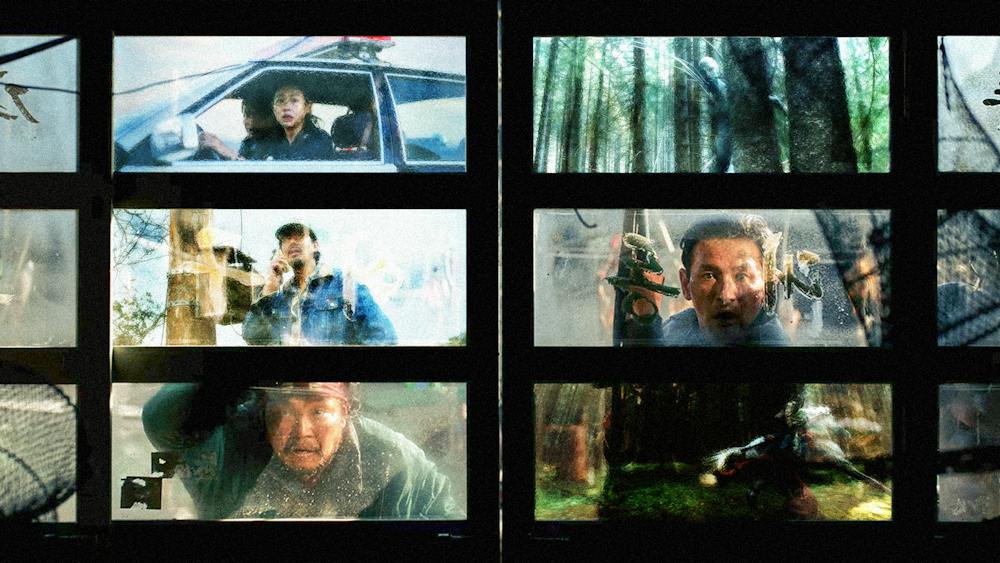
It’s a week into the Cannes Film Festival and I don’t think I’ve ever been so sleep–deprived in my entire life. After getting back to my bed at around 3 a.m., I was up and at ‘em at the break of dawn to down a coffee and try to stay awake for one of the many slow and meditative films of the festival. Afterwards, fellow Film & TV beat Élan Martin–Prashad and I skipped our lunch to finally see our most anticipated movie—Korean filmmaker Na Hong–jin’s first film in a decade, Hope.
We knew very little going in; the first look of the film only revealed a rider on a galloping horse sweeping a man up by his collar. Knowing the movie had already been bought by Neon—the studio whose films have won the highest award at Cannes six years in a row—Élan and I were certain that the movie was going to be an experience like no other.
An “experience” might be the best way to describe Hope. It was certainly nothing like the restrained arthouse cinema that dominated the rest of the festival. It’s one of those movies where no words can do it justice, and for maximum pleasure, it must be watched in a packed theater. At Cannes, the audience was laughing, screaming, and groaning for the entire 160–minute runtime.
The premise of Hope is relatively simple: the residents of a remote town find themselves under attack by a mysterious, otherworldly creature. It’s a sci–fi action horror plot that evokes comparisons with plenty of other critically–praised genre films like Nope, Godzilla Minus One, The Mist, and most recently, The End of Oak Street.
With such a promising and seemingly fool–proof concept, it may be surprising to hear that Hope flopped among critics. Unfortunately, it just couldn’t live up to its predecessors.
There are stretches of Hope that contain some of the best action filmmaking I’ve ever seen. Both times I left the theater after watching it, I couldn’t help but think: if the entire movie had sustained the pace and quality of its first 45 minutes, it would be one of my all–time favorites. The suspenseful build–up into the frenetic action, the explosions and gunfire and reload sequences, the squeals of the wheels when a car drifts into a turn—it’s phenomenally gritty and real. Na and cinematographer Hong Kyung–pyo, known for the beautiful shots in Parasite and Burning, make the camera feel like another participant in the action. People lean out of car windows to fire shotguns, and instead of cutting away, the camera glides alongside them, drifting with the actor in an impossibly fluid shot. The precise blocking allows the camera to anticipate every movement, whipping between bodies, vehicles, and gunfire without ever losing the momentum of the action. The horse sequences in particular are extraordinary. There’s a sweeping, almost mythologically western feeling as the audience watches riders tear through forests and fields as horses gallop at full speed. They instantly reminded me of Nope—which may also be due to the fact that both films share composer Michael Abels.
Hope also certainly calls for comparisons to the ever–popular Godzilla Minus One. Both movies understand that a monster spectacle works best when the destruction remains grounded in the physical reality of the people experiencing it. Both films also had a fraction of the budget of a typical Hollywood monster blockbuster, though Hope is also the most expensive Korean movie of all time.
The thing is—while Godzilla Minus One created beautiful VFX sequences with their titular monster—Hope stumbled at the finish line. The CGI was very, very bad at Cannes, and it’s barely better now. Na has apparently spent the months since Cannes tweaking the film, including altering some of the creature effects, changing the sound mix, and restructuring several sequences. The theatrical cut is only four minutes shorter, with some repetitive moments removed and three minutes of new material added, and it definitely improves the flow of an action–less middle act that made the movie drag. But though the theatrical version is cleaner, it doesn’t transform Hope into a blockbuster masterpiece.
Bad CGI is forgivable. Tell a great story, and audiences will overlook almost anything else. Doctor Who and BBC’s Merlin built entire childhoods on effects that wouldn’t feel out of place in an early–2000s video game. The problem with Hope is that there isn’t enough story to support its 156–minute runtime—the film is essentially a series of very long, very elaborate action sequences strung together. And because those sequences are so, so good, it takes a while to realize that the movie isn’t going anywhere.
There are themes—or at least, attempts at themes. Na is obviously interested in monstrosity, and there are a few heavy–handed scenes showing that the aliens aren’t so different from the humans. I felt a pang of sympathy when (spoiler alert!) it was revealed that the first alien only leveled the town because someone killed its baby. That goodwill immediately evaporates in the next scene, though, which delivers the gruesome, gory deaths of a hunter group the audience spent 90 minutes growing attached to. Perhaps part of that difficulty did lie in the CGI; the aliens are obviously meant to be human–like, but appearance alone doesn’t mean kinship. It’s much easier to feel sympathy for the UFO–shaped Jean Jacket from Nope or even Godzilla, two monstrous–looking creatures that we understand are operating on instincts different from our own. Hope is less philosophically disciplined, and by arguing that the humans and aliens in the film are not so different, it makes their massacre feel more cruel.
Other themes are not so obvious but more compelling. Hope is filled with community. But unlike another summer creature feature with a small town and plenty of dinosaurs (the underrated End of Oak Street), this contained community does not self–isolate when the inexplicable threat appears. Instead, police chief Ko Bum–seok (Hwang Jung–min) rushes toward the danger despite his survival instinct telling him to hesitate, elderly veterans congregate with machine guns to shoot off the intruder, and the fired–up young officer Yim Sung–ae (Hoyeon) stitches wounds and commiserates with community members that are scared shitless—literally.
Themes alone don’t make a narrative, so it’s quite startling when after spending almost two and a half hours refusing to explain itself, Hope suddenly has its aliens drop an enormous chunk of exposition directly into our laps. A crashing spaceship flips the situation as the humans lose hope and the aliens, in their own way, try to regain it. It’s quite an audacious way to end a film, especially when it’s not guaranteed that Hope’s already–written sequel will ever be made. As the audience processes the ending, it gets one more bit of hope through the mid–credit scene, which establishes the seemingly supernatural invincibility of one of the film’s most entertaining characters. It’s simultaneously thematically obvious, narratively ridiculous, and absolutely delightful.
I had quite a few months to ruminate on the film between my first and second watch, and it’s clear that the theatrical cut is better. Na himself said that the Cannes version was intentionally more complicated before he decided to simplify the narrative structure.
The thing is, being too complicated wasn’t the problem. Hope doesn’t need a simpler story, it needs more story. It’s such an astonishingly well–made action thriller that the real shame is it doesn’t have a movie’s worth of story to support all that action. When a camera is flying alongside a galloping horse or zooming down a road with the wheels of a police car, when an entire town is caught in a perfect sequence of gunfire, explosions, and bodies flying in every direction, the janky CGI doesn’t matter. For those glorious few minutes, I barely even care that the movie makes no sense. I just want to see what happens next.
For a movie so obsessed with whether its characters have hope left, the thing it never quite gives us is a reason to hope that there’s something deeper underneath the spectacle. But if Na gets to make that sequel, I’ll be there opening night anyway. I guess I still have hope.