Fresh off the Wuthering Heights soundtrack in February, Charli XCX released her album Music, Fashion, Film on July 24.
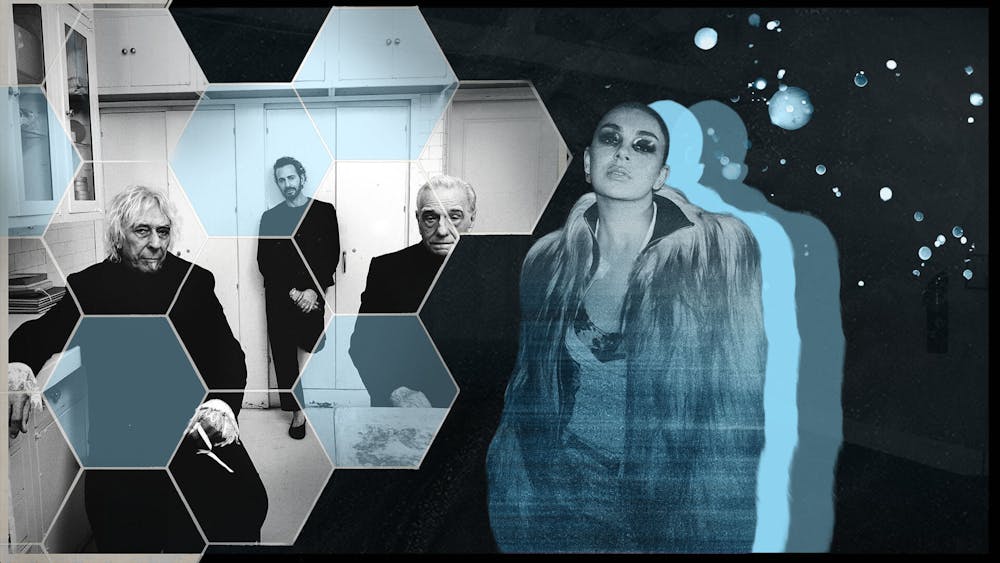
The album is short, with a modest 30–minute run time and 11 tracks in total. If fans are in need of more content, it also has a companion film available on YouTube. Charli officially announced her album via an Instagram post with the cover featuring a black–and–white photo of John Cale, Marc Jacobs, and Martin Scorsese photographed by collaborator on The Moment, Aidan Zamiri. Guitar–heavy in nature, Charli’s newest project ventures into a rock–adjacent realm while still keeping that signature electronic feel.
The album answers the pressing question on audiences’ minds: How does one follow a phenomenon quite distinct and universal as Brat?
Charli’s response? You don’t.
Music, Fashion, Film wasn’t made with the intention to replicate Brat. In an interview with Rolling Stone’s Angie Martoccio, Charli elaborates on the interaction between her albums as “repelling” each other.
With “Rock Music”—Charli’s lead single released in May—the album shows this departure from previous projects immediately. Declaring the dance floor “dead,” the single marries glitchy vocals with heavy guitar. Opening on the image of the indie sleaze revival movement’s darling hanging out a window, the “Rock Music” music video directed by Zamiri leans heavily on visuals of cigarettes and the electric atmosphere of a mosh–pit–like scene. It also features cameos from A.G. Cook and Finn Keane—both collaborators on her previous and present album along with her spouse George Daniel of The 1975.
Though titled “Rock Music,” the track feels like it transcends genres. And that’s because it does—as Charli explained in her Rolling Stone interview, she does not think of genre in a “binary way.”
The rest of Music, Fashion, Film is equally as experimental, but lends itself to more emotional depth. “SS26”—another single from the album—comments on the inauthenticity of art in a doomsday–like tone. Charli’s pre–chorus is brimming with references to past experiences being utilized as a way to commodify her art. “Think my politics could work as a press strategy / And my heritage could give me quite the USP,” she sings over a guitar hum in the background.
Directed by Torso, the music video for “SS26” speaks to the second component of Music, Fashion, Film—taking the viewer behind the scenes of a fashion show. “SS26” is not short on representing the fashion industry, with appearances from Creative Director of Yves Saint Laurent Anthony Vaccarello to “famed editor” Carine Roitfeld. Amid the show’s disarray, her lyric about “walking on a runway that goes straight to Hell” manifests literally, as models disappear at the end of the catwalk.
Throughout the album, the act of pretending—and the pressure that accompanies it—is woven into the lyrics. “Card Declined” is the most prominent example, projected through a materialist lens. In it, Charli adopts a monotonous voice as she meditates about buying a “personality” over slowed guitar in a cycle of emptiness. The track is closely tied to how materiality can change a person, and despite its ability to “unlock a new side of your personality,” it can feel “very, very fake,” Charli confesses to TapeNotes Podcast.
“Card Declined” is dark yet complex. Keane notes that the chorus brings back a higher and more “hopeful” tone. Charli adds on to this, likening the track to “put[ting] the jacket on and becom[ing] who you’re supposed to be.”
“Magic Metal Montana”—a tribute to Charli’s friendship with Cook—stands out on the track list with its levity. It treads the balance between vulnerable and playful, with indie rock instrumentals and a lively synth overlay. The song contrasts with the dark tracks in the rest of the album: “You’re my best friend, but we don’t talk / We make music, we talk that way.” Charli sings as she shares her admiration of their friendship. The shift almost feels out of place. But then the next track plays.
By far the longest song on the album, “No One Lasts Forever” is a welcome reprieve from angst and anxiety. This closing note also features film director David Cronenberg, who Charli named one of her dream collaborators on a film in her interview with Martoccio, citing his movie Maps to the Stars as one of her favorites.
As she sings about impermanence, a recording of a conversation between Charli and Cronenberg begins to play, recounting the director’s near–death experience where he collapsed on a sidewalk. “As I was lying there on the sidewalk / I did not think about art at all / I thought about people, I thought about life,” Cronenberg says. A line of dialogue begins to loop, his voice capturing the piece’s focus on mortality: “They are dead, they are gone / No one lasts forever.” As the words play again and again, the unease built up from each previous track begins to purge away.
“No One Lasts Forever” is a culmination of the album’s thesis, urging the listener to sober up and face the fact that life is fleeting. Music, Fashion, Film—in many ways antithetical to the hedonism of Brat—asks what matters most: the present or the legacy that you’ll never see?