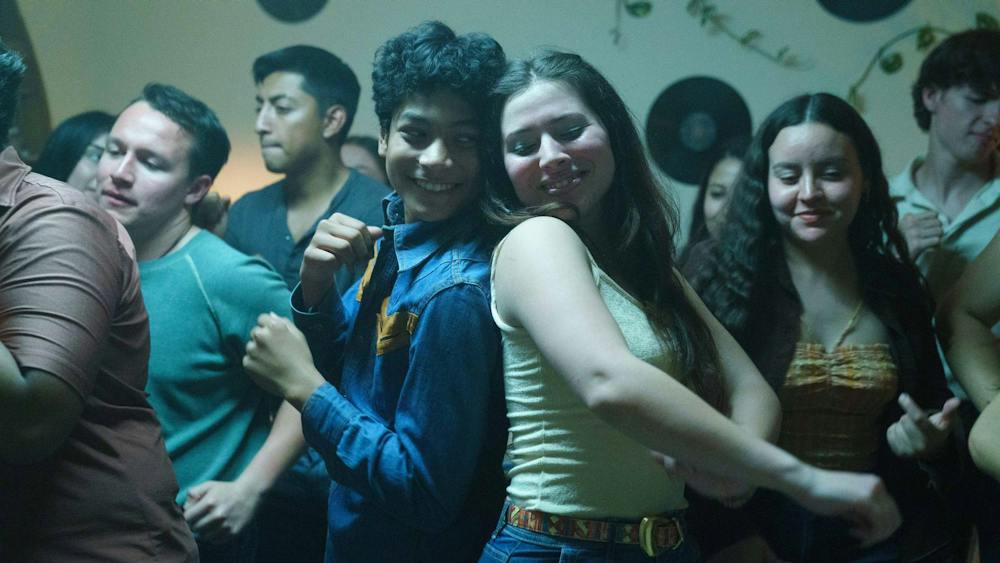
First released a year ago at the 75th Berlin International Film Festival, Fernando Eimbcke’s film Olmo is set in 1970s New Mexico and follows 14–year–old Olmo (Aivan Uttapa) through a full day of taking care of his sick father and trying to get to a party. Uttapa stems from Berkeley, Calif. and has had recent appearances on HBO’s hit show The Pitt. Released in the United States on Aug. 6 by Greenwich Entertainment, Olmo was executively produced by the Oscar–winning team who helped create Moonlight and Minari.
The opening shot to what is a very beautifully colored film finds Olmo sitting on a sun–lounger, eyeing up his newly–hot neighbor Nina (Melanie Frometa). In reality, it’s one of his many fantasies the film slips in over the course of its hour–and–a–half runtime. Within the day the film takes place, Eimbcke introduces his audience to Olmo’s complex yet loving family. His father, Nestor (Gustavo Sánchez Parra), is bedridden with multiple sclerosis, and requires a caretaker at all times. The family is more than behind on rent, leaving Olmo and his sister Ana (Rosa Armendariz) to take care of their father while their mother Cecilia (Andrea Suárez Paz) tries to pay the bills.
Simply put, Olmo and Ana are just kids looking to be kids. Olmo wants to impress Nina and Ana just wants to rollerskate with her friends, but at the end of the day, family comes first.
17–year–old Aivan Uttapa is himself a kid who just wants to have fun, and sees a lot of himself in Olmo. And just like Olmo, he knows where family rests. In an interview with Street, Uttapa reflects on his role in Olmo and the experience of making the film.
What drew you to this character in particular, and what did you first understand about who Olmo was?
When I first got the script, I read it and I was like, yeah, this is pretty much me. You know what I mean? He’s a kid who wants to grow up and have fun with friends and do things and explore. As a teenager, that's what you desire. That’s what you want to do. So when I got into the movie, the whole feel of it …, I knew what movie I was in. So it wasn’t really that much of a challenge. It was a challenge, but it was never tiring.
Your director Fernando Eimbcke is generally known for having films that blend comedy with a sort of baseline of sadness. How did he describe the tone that he wanted from your performance to you?
He never really explained it. All he just said was just like, “just be true to yourself,” and don’t worry about your performance, don’t worry about anything, just let it free flow, just let it all out. I had no clue what that meant because I was just really new at this. But after getting into character and working with Fernando, he gave me a lot of feedback. A lot of feedback. Whether it was harsh or not, I always made sure to give him 100% that day, the next day, and so forth.
When you started working with the character, how did you base the character around this sort of mix between comedy and a fairly melancholic story? What was the difference between navigating comedic versus serious scenes?
When you read the script, you can’t really tell the difference. Fernando tells me. He’s like, “The scene’s sad, but then there’s gonna be a little bit of a comedic part.” He just told me, like I said, to just free flow it, and then when the time comes for the comedic drop, he’ll let me know. So it was just good communication. That’s really helped a lot. Also, because I’m a goofball on set as well, that also helped a lot. It was pretty fun.
Getting into the sort of more serious part of the film—Olmo obviously carries a lot of responsibility as a 14 year old who’s caring for his father with multiple sclerosis. How did you prepare for those caregiving scenes? Was it ever difficult?
No, it wasn’t really difficult. I think that was the most natural for me because I kind of pictured it as like, what if this happened to me? What would happen if I went through that? So I kind of played it how I would. I kind of brought myself into Olmo to make it as truthful and authentic to me.
A scene that I really liked between Olmo and his father is the scene where he’s trying to teach you how to work the record player, but there’s a kind of a tense dynamic where Olmo doesn’t really want to learn; he just wants it fixed so he can go to this party. Whereas his dad is trying to connect with him when it’s already harder because of his illness. What was the experience like of making that scene?
If I’m so eager to go out somewhere and do something, and my parents are talking to me over and over and over again, I’m just like, dude, I just want to go. I just want to leave. So I kind of played it like that. But the difference is that Olmo was a lot more aggravated, a lot more mean to his father. I just kind of tweaked it a little bit to fit the character.
How would you describe the relationship between Olmo and his dad then?
Complex, very complex. It’s very dysfunctional. It’s complex and so are the characters. That’s why they make the mistakes and the choices they make. But people have to understand why they make them, and why he’s like that. When I watch the film, I understand that he’s like that because he wishes he can have his dad back. He wishes he can do things, watch boxing with him, do all these kinds of things, but it kind of sucks because he can’t anymore. And that’s why he gets rid of the grill as a symbol of letting the past go.
Something I found really cool were the dream or sort of hallucination sequences. Even with the fight with Miguel (Diego Olmedo), it was like I knew that there was a bruise on your face, but for a second, I didn’t think it had actually happened. What do you think that sort of dream space brings to Olmo’s character?
I think what helped with the dream sequence was kind of just like you’re a completely different person. This is a dream, you want to get the girl in the car. I tried to do it as a comedic free flow, as dorky as possible. So that’s why when I put the shades down, I raise my eyebrow—all of that was just being a dork.
And the one where you grab the random dead man in the casket?
That was kind of crazy because like I said, it’s almost like hallucinating. I like how they made that scene not sentimental, but kind of just like “oh, he misses his dad, yeah” and then he comes back like “Jesus Christ!” and then he drops him. Like John Hughes, it’s very organic. It’s also like Charlie Chaplin. He had a lot of movies that had some very intense scenes, but then he added funny background music to make it not as bad. So that’s kind of what we all wanted to do.
Was there a particular scene that you think was the most emotionally demanding for you to shoot?
The hospital scene. That was the most demanding. And also the scene where I’m getting mad, and I drop the clothes on the floor. That was also demanding. It was because Fernando really wanted it. He really wanted it to be real. He really wanted it to have a lot of emotion, but not too much, just in the middle. He was like, “That’s not good, that’s not good, keep going, we need more, we need more.” It’s a lot of pressure, but it’s never tiring. So I was like, “I’m gonna give 100%, 100%, 100%.”
I went into that scene with the attitude that Olmo’s not mad at his dad. He’s mad at the fact he doesn’t have his dad anymore. That’s what really makes it a lot more deep. That’s why he’s like, “Why do you have these clothes? Who wears them? Why do you still have them? You can’t get up, so why?” He drops the clothes on the floor, yells at him, all that kind of stuff—and that really took a while, actually, because I had to find that.
The hospital scene took a while as well. I think it really helped that I lost my Nino a few months before we started filming. I remember when I told Fernando about it. He got behind my back and he was like, “Pretend that is your Nino in the bed.” Oh Jesus, so now I’m crying. It was kind of crazy.
And last but not least, definitely the crying scene in the car, because, when the scene happens, he just stopped crying. It’s like that little one tear right there on his cheek—cinematic, cool—but it made the audience think that he just finished crying. The scene had a lot of cool dynamics and a lot of deep thinking.
How do you think Olmo navigates what his parents’ relationship becomes?
I think he navigates it by understanding that when choosing your friend over your family, always keep family number one regardless of anything. That’s one thing I always admired about Olmo—he always made sure to keep those priorities straight. So when you see that in the movie, it’s like okay, now he’s learning and he’s gonna understand how to become a better son, a better brother, a better friend. All it took for him was for one incident to change. This stuff really happens in the outside world.
A bigger thing with the film is that obviously the film is bilingual. How natural was that dynamic for you? Because a lot of your lines are basically like in Spanglish. How did you navigate having a Spanglish script?
Well, in the script, those lines are in Spanish, and then, in parentheses, it’s in English, right? So it’s translated a little bit. But for me, I speak no Spanish, like at all. I am so guilty about that. I feel like an imposter. I feel really bad about that. But the thing is, my family spoke Spanish to me, and I would answer in English. And like as I get older, I don’t understand it because I’m not really around it anymore as much. My mom doesn’t speak that much Spanish to me anymore.
When I was younger, that’s all I grew up around. Spanish speaking, answering in English. So in the scene where he’s talking to me in Spanish and I’m arguing with him about the stereo, the first assistant director would talk in English and I would respond in English. Gustavo would answer or not answer, but he kind of made those expressions like he was talking. So meanwhile, I’m looking at him, but the English is from another person.
How has the response to the film since it premiered in Berlin at Berlinale shaped how you feel about the role?
I think the responses of people going like, “You and Miguel’s friendship reminds me of my friendship.” Or like, “You really tackled how I feel whenever I take care of my dad.” You know what I mean? It’s so good to hear. It’s amazing to hear. I feel accomplished whenever people say that. That’s why I do what I do. I think I feel positive about the role and how I shaped the character because I was being relatable to other people.
What do you think this experience taught you about acting that you plan to carry on into future roles?
Always be vulnerable—that’s the main thing that I learned. When you’re vulnerable, you step out of your comfort zone, and when you step out of your comfort zone, you don’t hold back on anything. So if it’s like a screaming, yelling scene, people can feel you’re holding back. Like, “No, scream! I want to see that scream.” That’s one thing that I can also give notes to myself on and for other future actors. For those who want to become actors, just don’t hold back. Don’t hold back whatsoever. Nobody cares how loud you are. No one cares about any of that. Just yell, cry, scream, whatever you need to do. Just be completely vulnerable. Because when you’re vulnerable, that reflects on your performance, and people really might enjoy it as much as you may enjoy screaming.
What would you say is the central takeaway that you want viewers to get from this movie?
Have fun. Do what you want, you’re still a kid—especially teenagers. This movie doesn’t just relate to teenagers. It can also be adults who want to have fun, too, adults who want to have a good time with their friends and do things or go party or whatever. Teenagers go hang out with their friends, get girls, and do all these different things. Like all of that is universal. All of that is just human. There’s always going to be room for mistakes or room for improvement, but you’re always going to make mistakes, so never let your mistakes or the past determine your present or your future. Just have fun with it. Just live life, just do whatever. I sound like Mac Miller right now. You know, that’s real. He’s right. That’s what he taught me, and that’s what I’ve gotten, and that’s what I get to tell people.
This interview has been edited and condensed for clarity.