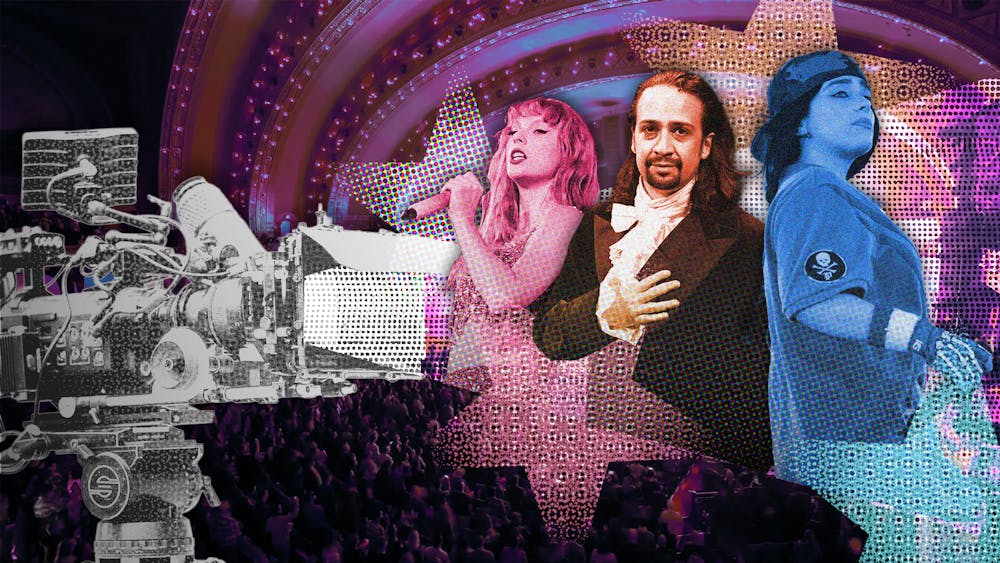
While walking on the streets of New York, tourists (and locals too) can pass dozens of Broadway marquees—from Hamilton to Hadestown, pedestrians can experience centuries of music, history, and art in a matter of seconds. As easy as it is to see hundreds of billboards, though, it’s nearly impossible to see the same amount of shows live in a theatre due to high ticket prices and finite show runs. Enter stage right: proshots.
Proshots are professional recordings of theatrical performances that are distributed to audiences through movie theaters and streaming services. While they are known for being able to make live–art more accessible and affordable, they also do so much more: for the theatre community, they’re a chance to watch their favorite shows again and again; for movie–goers, they’re an opportunity to discover a totally different art form using a familiar format; and most importantly, for producers, they’re a way to create new connections between viewers, live–audiences, and performers.
Take Merrily We Roll Along, for example, which was launched theatrically in December 2025 and released on Netflix in April 2026. Merrily We Roll Along is a Tony Award winning show that follows a trio of friends, Frank (Jonathan Groff), Charley (Daniel Radcliffe), and Mary (Lindsay Mendez), over the course of their 20 years of friendship. The musical moves in reverse chronological order, which allows audiences to see how developments in their careers and changes to their ambitions result in an eventual unraveling and disintegration of their relationships, and ultimately, the loss of their special connection. The show joins over 150 other Broadway, West End, and international stage productions to be recorded as a proshot—with more productions joining the list soon, such as, SIX the Musical Live! and Stranger Things: The First Shadow.
If the prevalence of proshots is surprising to you, it’s probably because they aren’t advertised as widely as movie musicals and screen adaptations of musicals, such as Wicked, The Music Man, Tick Tick Boom!, In The Heights, and Mamma Mia!.
This trend within the past decade towards recording and releasing proshots can arguably be attributed to the introduction of Hamilton onto Disney+ in 2020. The recording was initially scheduled for a theatrical release in October 2021, however, when COVID–19 hit, production efforts ramped up to bring the show to Disney+ even earlier in July 2020. Like the show itself, the film found immediate success and transformed the audience and producers’ perspectives on proshots from being mainly archival footage to global phenomena that audiences could watch and enjoy from the comfort of their homes.
In fact, the recording completely furthered the initiatives of the Hamilton cast to make the theatre space accessible. According to Vox, “Miranda and his cast did everything they could to connect with fans who wouldn’t get to see the show due to cost and geographic access. They performed web-only exclusives with casts from other Broadway shows, remixed and reimagined their own performances, and actively promoted fan videos…” This production not only demonstrated a desired return to live arts, but also a move towards making and rekindling connections.
Inside of a Broadway theatre, the amount of passion, raw talent, and emotion is palpable on stage, but bringing the audience even closer through a camera lens provides insight into the development of characters and their story arcs. Merrily We Roll Along, which was filmed live in the Hudson Theatre, is a particularly interesting example of this, where many of the ensemble and cast members make direct eye contact with the camera (and therefore, the movie theater and watch–from–home audiences); each character connects with theatergoers through the screen. This allows for more nuanced emotions that in–person audiences might miss to be revealed and add depth to the production. Through the proshot’s eye–level perspective, it feels like you are sitting on stage with the actors, experiencing their every emotion.
There is truly nothing like sitting in the audience of a live performance and being present in the moment, but some things simply can’t be captured from sitting in the audience and overlooking the stage—small details can be missed, emotions can be hidden. A camera’s proximity to the faces of actors can impact audience members’ relationships with performers, bringing a similar level of intimacy to every single viewer that simply cannot be recreated with a live audience in a theatre.
This experience can be seen with the newest addition to the proshot slate—Hadestown, which presents the show as something unlike fans have ever seen before. There is one specific shot during the recording that is incredibly eye–catching … when the camera shows the perspective of a character being lowered under the stage—which is something that audiences in real–life will never get to see. As all of the characters make eye–contact with the camera lens while it travels underground, there is something so haunting and intimate about the moment because there are so few characters that travel using a stage lift during the show, including Eva Noblezada’s character, Eurydice.
Additionally, there are moments in the proshot where audience members’ reactions are shown. When sitting in a Broadway theatre, interactions with audience members are limited to hearing audible gasps, cheers, and claps. Seeing their faces during the show itself is a unique experience and special way to see the show from others’ perspectives.
The level of connection that is created through a movie theater screen can also be discovered in concert films. Artists such as Taylor Swift, Olivia Rodrigo, Beyoncé, and most recently, Billie Eilish and Harry Styles released professional recordings of their concerts for fans to watch in movie theaters or on computer screens within their homes. Capturing the artists’ live music on film provides a way for fans to relive it and for some to see it for the first time. This connects people in a newfound way because of the level of audience interaction there is during the live–performance. Audiences are allowed to sing, scream, and participate during concerts. This social norm/expectation is also reflected in movie theaters, with audience members going to the front of the room and dancing together or singing in their seats. Allowing viewers to see the performance from new perspectives, with “behind the scenes” content, close–up shots, and footage of fans lets viewers to connect with the artist, the music, and fellow fans both in the venues and in the movie theaters.
As the next batch of proshots are being prepared for release, it will be interesting to see how their production is approached or if they will forge the same connections with audience members as their predecessors. At the end of the day, art is about resonating with and creating connections with viewers, and proshot musicals and concert films seem to be at the top of the game. They don’t just aim to create shared experiences for audiences in movie theaters, but to capture ones as well within arenas, stadiums, and theaters. That sense of community and connection through the live arts is something the movie industry can help to capture, preserve, and develop so perfectly—so, take with that what you will, Timothée Chalamet.