
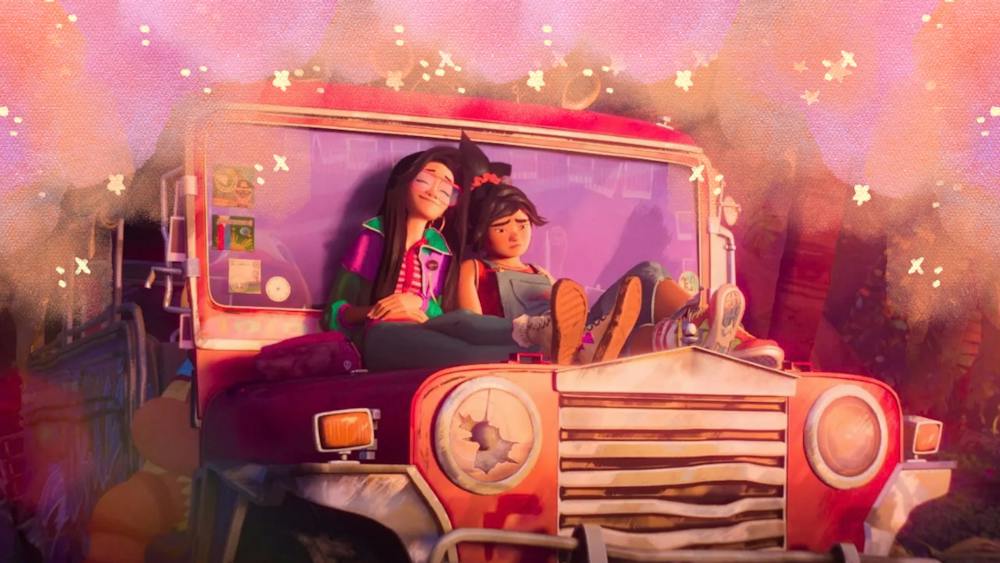
As one of approximately 4.6 million Filipinos in the United States, it’s strange seeing my culture laid out so unapologetically for public consumption in a mainstream Hollywood production. The feeling is novel, and it doesn’t necessarily feel wrong, more so overdue. Perhaps that’s why DreamWorks Animation’s newest feature film, Forgotten Island, often feels less inclined to tell an intriguing story than to treat audiences to the beauty and glamour of Filipino culture.
That’s not to say that Forgotten Island’s narrative is wholly ineffective. It’s simply predictable and unoriginal, partly because it has to be. It is clear from the get–go that the film’s priority as set out by Filipino American Januel Mercado and long–time friend Joel Crawford, who together wrote and directed the film, is to celebrate the Philippines, its people, and its stories.
So raise your hand if you’ve heard this one before: A duo composed of one type A individual and one type B individual journeys through a strange new mythical land, meeting its inhabitants in order to get back to the real world and understand the true meaning of family. Coco, anyone? Or how about Moana, Soul, or, if we’re willing to venture there, Teen Beach Movie? Interestingly, the movie’s most original idea comes in its seemingly Hangover–inspired second act. Here, main characters Josephine, or Jo (H.E.R.), and Raissa (Liza Soberano) retrace their steps throughout the island with the help of shapeshifting man–dog Raww (Dave Franco) after mysteriously losing the memory of, apparently, the best night of their lives.
To give credit where credit is due, the film does thoughtfully recontextualize “found family” cliché to fit the characters’ narrative backgrounds. Jo’s mother is out of the picture and her father immigrated to the United States, leaving her behind in the Philippines to be raised by her grandmother (Dolly De Leon), who instills in her a love for Filipino folklore and storytelling. When Jo befriends Raissa, we discover that she takes the idea of sisterhood more seriously than most, latching onto Raissa in a way that Raissa’s parents aren’t particularly fond of, especially as their daughter grows up to eventually study aerospace engineering at Caltech. It’s a culturally unique take on friendship and family dynamics that certainly lends itself well to the arcs both Jo and Raissa will venture on over the course of the film.
Fortunately, the formula still works well enough. Sure, the film’s ending is pretty clear within its first 30 minutes, and its magically dubious third act relies heavily on viewers’ buy–in to a largely unexplained power wielded by Jenny Slate’s furry, plushy, catlike creature, Batiba. Problems solve themselves, arguments are settled in minutes, and Manang (Lea Salonga), the frightening, menacingly imposing vampiric creature is—aside from one sequence—hardly ever given the antagonistic gravitas she deserves. But for the familial target audience, there’s more than enough substance to go around.
The narrative’s core and the key to its emotional gravity lies in the powerful friendship between Jo and Raissa. It’s a beautiful narrative that blooms in the film’s opening minutes, as we watch the two grow up together, make memories, and commemorate such memories by adding new charms on matching friendship bracelets.
The film’s climax, a masterclass in colorful storytelling and a beautiful ode to friendship, is a treat. The film capitalizes on what is easily its greatest narrative strength and does it with style, as its two leads very genuinely use the power of friendship wielded in their bracelets to save their shared memories and return to the real world. It’s a stunning culmination to the film’s emotional build up, especially with Jo and Raissa’s friendship at stake.
Forgotten Island’s great strength—what makes it different, fresh, and new—comes in that it is undoubtedly a bold, fun, visually striking adventure, and a thoroughly satisfying representation of everything that makes Filipino culture so beautiful. The film’s colors pop off the screen, its vibrant representation of Western cultural influence in the Philippines during the 1990s and early 2000s is played for punchy nostalgia and jokes, and its obvious anime influences add a two–dimensional visual novelty and appeal that uniquely complements the rounded, three–dimensional computer–animated look of the rest of the film.
For another, the casting of prominent Filipinos in entertainment, like Grammy and Oscar–winner H.E.R., young Filipino film and television superstar Soberano, comedian Jo Koy, and Tony–winner Salonga, subtly celebrates the presence Filipinos have quietly had in entertainment spaces for years now. The film opens with Jo colorfully narrating Filipino mythology, using terminology and cultural references from Tagalog and other regional dialects scattered across the island chain. Between the lines, this sets the precedent the film follows for its duration: this is the Philippines, this is its culture, and this is going to be fun.
So I can forgive that the film, at times, can be overly saturated with Y2K references, anime motifs, and repetitive punchlines, because in centering itself around Filipino culture and themes about the importance of friends and family, Forgotten Island churns out a 110–minute romp that is nothing short of larger than life.
I’m more than willing to relent that Forgotten Island, by all narrative metrics, is fairly forgettable. I’m also inclined to set that aside for the pure notion that for the first time, Filipino culture was unabashedly well–celebrated and honored for a mainstream Western audience, and done with style. For that, I think I’ll choose to remember this one.




