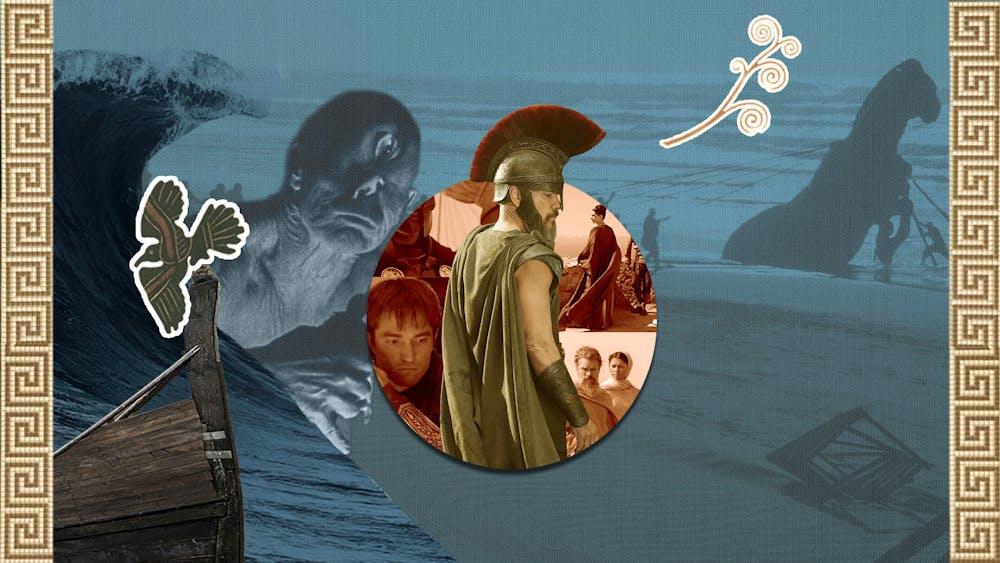
Christopher Nolan is undeniably one of the best filmmakers of all time, with a catalog that ranges from Inception to The Dark Knight to his last hit, Oppenheimer, which netted him seven Oscars at the 2024 Academy Awards. His newest project, The Odyssey, which came to theaters on July 17th, is another success, thanks in part to its star–studded cast, including Zendaya, Matt Damon, Tom Holland, and Anne Hathaway. More so, Nolan and The Odyssey made history, becoming the first feature film to be filmed entirely with IMAX cameras—even inventing new technology to do so, such as a box to mask the very loud camera’s noise when filming more intimate scenes.
One of the most striking parts of the movie, and of Nolan’s filmmaking in general, is Nolan’s commitment to practical effects and real, human moviemaking. The film, which produced over 2 million feet of IMAX film, was shot mostly with practical effects at real locations. Even monsters like the Laestrygonians and Polyphemus (the Cyclops), which would normally be created using CGI, are portrayed using a combination of puppetry, forced perspective, and wirework. The movie was filmed across the Mediterranean, in Iceland, Scotland, and Morocco. And surprisingly came in under time and under budget. The many boat scenes were filmed on a Norse longship, an experience Nolan described as “primal,” but also incredibly informative as to the conditions his characters would have to face. This achievement of human artists, producing a film as fantastically epic as The Odyssey with limited visual effects and studio time, proves one thing: the art of human filmmaking isn’t dead; in fact, it’s better than ever.
Almost every cast member gave absolutely generational performances, a testament not only to Nolan’s ability to draw out star power, but also to his ability to inspire incredible performances. The true soul of the movie comes from the (relatively) small part of Elliot Page as Sinon, a character borrowed from The Aeneid who was recruited by Odysseus (Damon) as a child to serve in the Trojan War. The beauty of Page’s performance is in its nuance and humanity—a perfect reflection the lives lost in the wake of war. He especially shines during an emotional confrontation between Sinon and Odysseus in the Underworld, in which he urges Odysseus to properly honor the members of the crew that he lost. He also reveals how Antinous (Robert Pattinson) manipulated him into taking his place in Odysseus’s army, which would eventually lead to his fate at the hands of the Trojan army.
Another standout performance came from Tom Holland, playing Odysseus’s son, Telemachus. Telemachus, who is often portrayed as whiny and generally useless, is now characterized as a man who grew up the son of the ultimate absent father, personally empowered to find out Odysseus’ fate. This role also marks Holland’s transition from the superhero blockbuster to the more cerebral film—a role he executes with only minor hiccups. Although Holland’s Telemachus has a penchant for telling strangers that they have “Athena’s eyes,” as well as a dogged adherence to Zeus’s code, he draws rare sympathy for this unpitied character.
It’s impossible to speak of performances in this film without discussing Matt Damon’s portrayal of the eponymous hero. The beauty of a Damon role is that he manages to make you root for his character (Interstellar aside). Beyond generating audience support, Damon also showcased the Greek hero’s deep flaws. Odysseus is notoriously full of hubris, which gets him and his crew into several horrible situations, and is ultimately the reason that he takes twenty whole years to get home.
Despite the men’s awe–inspiring performances in The Odyssey, the real heart and soul came from the women. Although Nolan’s female characters have characteristically limited screen time, not a second of it is wasted. Zendaya, who appeared for less than five minutes in the film, did a fantastic job playing an extremely cryptic Athena, an essential character in any adaptation of a Greek myth. Anne Hathaway also did a great job playing Penelope, furthering her character beyond a wife waiting at home to a woman with intellectual autonomy, enduring an impossible situation. The true standout, however, was Samantha Morton as Circe, the witch who briefly turns Odysseus’s crew into pigs. Morton was able to play both the creepy witch that many of us read about in sixth grade, whilst also allowing us to understand the depth of her distrust and her motivation to turn the heroes who happen upon her into swine. Circe portrays the reality that many of those having the misfortune of running into errant Greek soldiers experienced—sexual assault and theft, all because men feel entitled to you and your property.
Nolan, never afraid to make a political point in his films, also uses The Odyssey to showcase two essential themes—the horrors of war and the importance of inclusion. Many battle scenes in your average swords–and–sandals movie portray war as glorious, with the “good guys” prevailing after a valiant struggle. Nolan completely circumvents this tradition, portraying the brutality and horror behind sacking of Troy—the Greeks were shown hurting women and children, beheading statues of goddesses, and burning Troy to the ground. Even the Trojan Horse, normally portrayed on wheels, was dragged up a tall hill by the Trojan people, its belly full of Greek soldiers (including Odysseus).
In addition, many characters constantly harped on the importance of Zeus’s law, the concept known in Greek as xenia, which emphasizes universal hospitality, on the assumption that any guest could be a god in disguise. Both these points come at a particularly poignant time, with war raging in Iran and the escalation of our country’s horrific immigration policies.
The film, however, was not universally loved—especially by Penn’s own Emily Wilson, head of the Classics department and first woman to translate The Odyssey into English. Wilson, who had previously expressed her excitement for the film to be transcribed to the silver screen, described the writing as “abysmal,” saying it lacked “psychological, emotional, political, and ethical depth.” Although Wilson certainly has the credentials to criticize an adaptation of the Odyssey, given the amount of time she’s spent with the story, and although she is right that the writing could have been stronger, the mentioned critiques did not, personally, affect my viewing experience.
This review could go on and on, much like Odysseus’s original journey, but the point stands that The Odyssey is one of Nolan’s best works to date, encapsulating the heart of the original epic. Combining modern political relevance and expert human filmmaking with a millennium–old saga, Nolan proves these stories to be eternally relevant, emphasizing that no technology can best human creativity and emotion.