
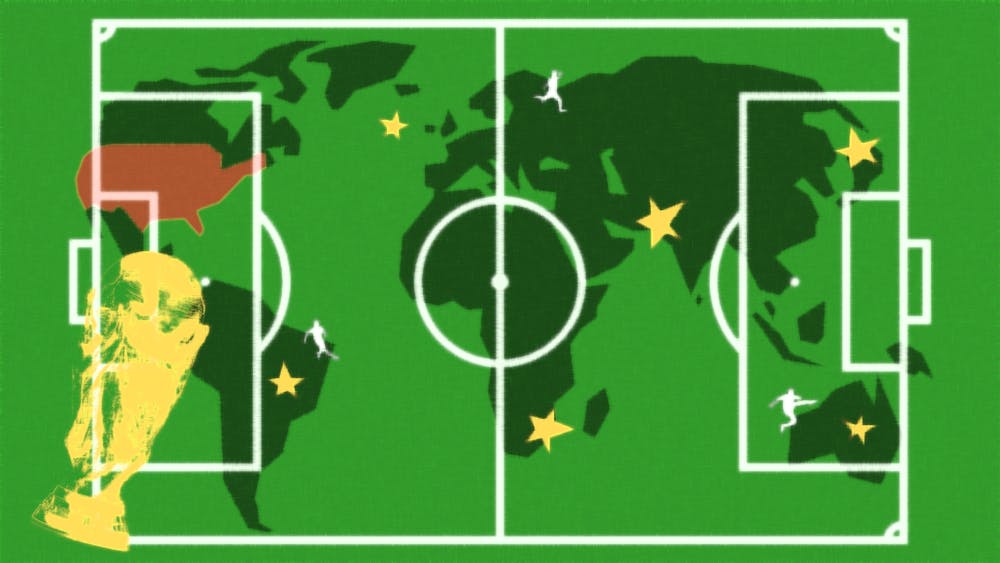
Aside from the Olympics, there’s no global event that brings people together in the world of sports quite like the FIFA World Cup. With male and female divisions (since 1991) uniting the globe’s top soccer players, FIFA is where legends are born and champions are forged in the hottest furnace: the world stage.
The first FIFA World Cup game was held as early as 1930, with two matches happening simultaneously—one pitting France against Mexico while the United States took on Paraguay. Since then, the sport has stretched across the earth, turning players like Lionel Messi and Kylian Mbappé into international stars with billion dollar net worths.
But thirty years ago, professional soccer didn’t exist in the United States the way it does now. So what changed? How did America successfully host a game that is more popular abroad?
Cultures across the world have entire identities built on soccer—especially in European, Latin American, and African countries. The sport is deeply rooted in the UK, beginning in Scotland and England as a sport that bled into culture, class, and work life. Many local clubs were created around the time of the Industrial Revolution, when England’s period of modernization led to increased urban populations. Soccer was not only a social activity, but evolved into a cultural identity. Rivalries between regional teams were passed down through generations. The Football Association was later founded in 1863 to formalize the rules of the game—a moment that is widely considered to mark the official formation of modern soccer.
Soccer was then introduced to Africa by European colonialism. The sport’s low economic barriers to entry made it widely accessible for people from lower income backgrounds, quickly growing the sport’s popularity across the continent. Government and company–sponsored clubs helped accelerate this growth, making the world of professional soccer a way for players and countries alike to build careers and expand opportunities for economic growth and development. As African countries began winning their independence, soccer exploded, culminating in the formation of leagues that competed in national and continental tournaments.
The United States’ place in the history of professional soccer, however, looks a little different. Like in the UK, the sport began in the late 1800s, primarily played at schools and colleges. However, the sport was discontinued in schools in favor of rugby, before Europeans from countries such as Germany, Italy, and England reignited the popularity of the sport when they immigrated to industrial American towns during the late 1800s and early 1900s.
So why did soccer never catch on in the United States the way it has around the world? One argument points to viewer intimacy.
Psychologists have cited that fans watch sports to be a part of them. When our favorite team wins, we win, too. We wear jerseys as badges of honor in public, displaying allegiances, welcoming conflict, and signalling strong identities. We spend hundreds of dollars on tickets, or do whatever we have to do to catch the game on our phones, laptops, or living room TVs. Because as fans, we want to feel as close to our heroes as possible.
American sports broadcasters understand that impactful camera work and angles help the viewer obtain this closeness. American football matches are undeniably fast–paced. Quick tracking shots and alternating angles put viewers watching from home right in the heat of the action. Close–ups of the athletes themselves allow for greater emotional proximity between them and the viewer. Shooting large quantities of footage with cinematic equipment and using Hollywood–level creative choices gives the team footage to turn into match highlights and recaps—stories of the players that reinforce the stakes and make us truly feel them.
In contrast, soccer broadcasts very seldom cut between large overhead shots of the entire field and close–ups of passes and goals. Though overhead shots are useful for getting a bird’s eye view of the team strategy, they do not captivate American audiences because of how much they physically distance the viewer from the action on the pitch. Hence, the American audience feels emotionally distanced from the story. Hockey in the United States suffers from a similar issue as soccer. Football, basketball, and baseball, on the other hand, play right into American viewing preferences. As viewers, we want drama. We want narrativized stories we can get excited about. We want household names to latch onto—celebrities and distinct personalities that excite us outside their teams.
A lack of viewer intimacy is one window into why American viewers aren’t as captivated by soccer compared to other sports. Yet there’s a deeper reason dating back to the inception of sports leagues and live television.
In their book, National Pastime, Stefan Szymanski and Andrew Zimbalist trace the origins of baseball versus soccer, exploring the diverse socioeconomic contexts under which these respective sports developed into what they are today. According to their discussion, baseball developed in the context of a highly capitalist American society, through which sports and broadcasting evolved to become highly commoditized. Cable networks and teams fought over broadcasting rights, until the now Disney–owned ESPN transformed the sports viewing experience—from providing extensive real–time game statistics and updates through multiple digital channels to driving consumer product marketing through cross–promotion. Ad breaks inserted naturally between baseball innings came to define the American broadcasting model, enabling baseball to grow through increased sponsorships and product placements.
Soccer, on the other hand, did not develop in this same commercially–driven environment. Leagues were at first reluctant to broadcast matches, worried it would lead to lower in–person game attendance with the boom of television across England. And even after FIFA matches finally began broadcasting in 1954, regulations imposed across Europe to avoid the privatization of live television made it more difficult to follow the same ‘American formula’ of commercialization. Match broadcasting was financed by government funding instead. As a result, soccer leagues did not need to rely on the same ad sales from commercial breaks as baseball did to keep operating. Additionally, soccer’s longer pacing and lack of frequent time–outs made it more difficult for advertisers to insert commercial breaks, preventing the sport from having longer air time on American television. American broadcasting companies therefore favored streaming sports that conformed to their revenue–driven model, preventing soccer from growing in popularity during the earlier days of sports television.
Despite soccer’s continued unpopularity in America, this year’s World Cup has shown impressive viewership. Watch parties have attracted thousands of viewers, turning streaming into powerful live events that bring spectators together even outside the stadium. Streaming numbers regardless of viewing format have brought strong results, too. Paraguay’s match against the United States drew over 21M views, a record for a men’s soccer match streamed in the United States. Viewers began tuning into other matches that weren’t fought by the United States, too, with Fox reporting 7M views for the match between Mexico and South Africa. So what changed?
The answer: connectivity. Mixed media platforms are fueling globalization, allowing the stories and lives of international players to reach Gen Z audiences and enabling them to find that viewer intimacy off the field. Soccer players use social media to build massive fandoms—this year’s most obvious example being Norway’s ‘Striking Viking’ Erling Haaland, after his distinct internet personality won him a plethora of new fans. Further, Gen Z viewership has spiked soccer’s popularity on streaming platforms thanks to the multimedia modes in which they have been engaging with the sport. Such platforms include video games as well as online creator content in the form of fan edits, match recaps, and prediction videos. As Gen Z’s media consumption habits continue to challenge the entertainment industry, we could see a rise in soccer’s popularity thanks to viewers’ engagement through the digital space. And if American broadcasters shifted tactics to capture soccer in a similar cinematic style as American football and basketball, soccer could climb in popularity over the years and evolve into its own distinct staple of American sports culture.
Regardless of the United States’ current broadcasting techniques, this year’s World Cup is just another reminder that sports narratives are a profound window into group psychology, human achievement, and global culture. At the end of the day, it’s all about the love of the game and how it’s captured, created, and shared through the fans.