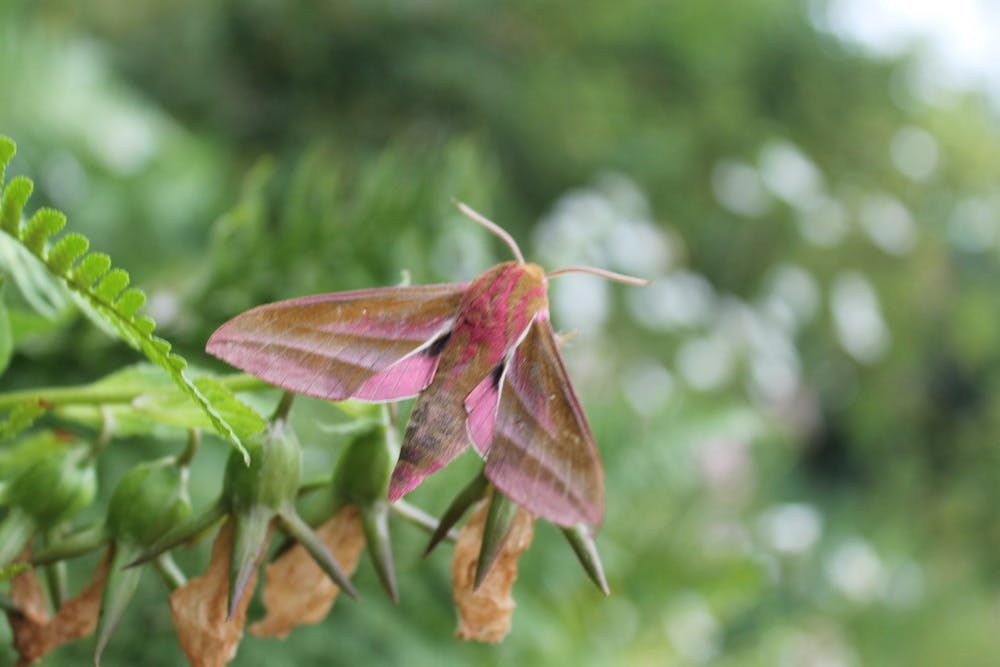
There’s a plausible theory that moths fly into light because they mistake it for the moon. The thinking goes that, being nocturnal, they evolved to orient themselves around the singular large, bright thing in the night sky. Some use celestial pathways to navigate their migrations, but this fails to explain the short–range attraction. Newer research suggests they’ve learned to fly with their backs to the illuminated sky, that they are not so much flying into light as being trapped in an endless orbit around it to keep from facing into our lights—the much closer, man–made moons. But like so much of science, there is no certainty, and the truth of their inclinations remains in only in their minds for the time being.
In Coxwold, North Yorkshire, there is almost no light to distract them from the moon at night. Sunlight eats up most of the summer day, appearing before five and setting just after nine thirty, but once it’s gone, there are no street lights or porch lights or neon signs. The only gleaming things are the light from my kitchen and that of my bosses’, the lights outside the pub down the road, and, on nights we set it out, the moth trap in the middle of the west garden.
A large, plastic bin with a light bulb in the middle, filled with old egg cartons for the insects to climb inside. It’s high–tech compared to other moth–gathering strategies, which tend to involve large, white sheets with lightbulbs behind them or pieces of wood slathered in whiskey and sugar. Ours allows for easy, humane capture, then sometimes tedious identification while they’re dormant in the day, and then easy, humane release at dusk.
Many say it’s a shame they only fly at night. They, and all of Lepidoptera, are covered in tiny scales, often subtly beautiful and at times ostentatious. Some grow long, like fur, and make them look mammalian. There’s a curious intelligence in their eyes, and I like to tilt them upwards when they land on my finger or a paintbrush so I can peer into them. It feels like a breach of the anti–anthropomorphizing apathy of science, but it also feels like they’re wondering about me just as much as I’m wondering about them. I, too, am disoriented by artificial light. My freshman dorm looked directly out at a street lamp, and I was almost perpetually unhappy seeing it at night.
Insects are going through an invisible apocalypse: in the U.K., there’s been a 58.5% reduction in flying insect biomass in the past twenty years, and this trend is paralleled in worldwide populations. Pesticides, habitat loss, and climate change have wreaked their havoc on all of life, but the extinction rate of insects is eight times that of birds and mammals and yet they’re significantly understudied. They’re the basis of most food chains, and our agriculture and food systems would collapse without them. The simple act of tracking them, as I’m assisting with at Shandy Hall in Yorkshire, allows us to gauge both the biodiversity of the gardens and the greater trends of moth populations across the continent. We celebrate at finding a new or rarely seen species, grimace at the invasives, and observe the northward climb of typically southern species as they follow the ascending temperatures. Climate change is huge and overwhelming, and it’s tempting to look the other way, but even small observations like these help us make some sense of it.
When I’m not moth–trapping or reading about them, I help with the general running of things in the museum shop and gardens. I sell tickets and books to people wondering what someone with my accent is doing in the middle of rural England, go through stacks of feedback forms, and run around with buckets and gardening tools.
Chris, the Head Gardener, has me on a rigorous schedule of being out of the house at ten and doing at least thirty minutes of weeding. There is a plant growing in the wild garden, Goose Grass, that will eat away the world if I don’t go back there and pull it up. She is an only recently retired librarian and has the neat and pensive air of one. She moves through the world like she knows exactly where things should be, but there is a lovely look in her eye that tells me she would have been hesitant to shush giggling children and gossiping teenagers. I ask her once about the prison system here, thinking it must be at least slightly more humane than ours, and she tells me it is an awful mess (I’m not sure what other answer I was expecting). She also tells me they sometimes have formerly incarcerated volunteers who help in the gardens. She ends with a sigh, “I only want to make a beautiful place for people to come and visit.” She has more than succeeded.
I do not have a car, and the bus comes only once or twice a day, so most times I need to go somewhere I am driven. I stare out the window and sometimes ask questions. These are often inane, but I am genuinely interested in cow breeds and what they do with roadkill around here and what happened to the rest of the red phone booths.
About this last question, my other boss, Patrick the Curator, exclaims, “I long for them!” He was once part of a traveling theatre company and you can tell in the way his voice carries. He makes sweeping hand gestures, and still bows at the end of some conversations. He does not need a stage to make his presence known. He also does not have a mobile phone—or has one sometimes but loses it, perhaps on purpose—and misses the time when the world was built for that. I also sometimes miss when it was a little harder to get ahold of each other, and short disappearances were more forgiven.
On my days off, I find places to wander. I go to one priory turned private home that’s haunted. There are snarling taxidermy fox heads, a chair ripped apart by a magpie, and Oliver Cromwell’s skull and thigh bone lie in the attic next to a room that was never completed after a maid burned to death in it. A visitor from the National Trust apparently called it ‘a memorial to one family’s abominable taste.’
The woman who gives us a tour lived here until her son and his wife and five daughters moved in and it has been in their family since the English left behind Catholicism. She makes a few strange off–hand comments about slave labor and poverty that convey a distasteful superiority, and this further confirms in my mind that this kind of wealth, even if historical and mostly vanished, does nothing but deplorable things to the psyche.
I visit one abbey that feels sacred. It’s in ruins, crumbling stones filled in with moss and lichen and blue flowers, and is surrounded by pale, grazing cows so well–formed they could be Apollo’s. It was inhabited by hundreds of vegetarian monks and laymen, and I stand in the long hall that would have been their dining room. The once stone floor is now filled in with grass.
I read Alice Oswald’s poem about Sisyphus, because who else would I be thinking about in a landscape of crumbling rock?
and for an hour, all he could think was
caught in a state of shadow—this persistent
breathing pushing sound, this fear of falling,
fear of lucidity, of flight, of something
bending towards him, but he pushed he pushed
until the sun sank and the shadow slunk away.
I was warned this job might be isolating, and it has proven to be a summer of some solitude. I live alone in a medieval barn that was fitted into a flat sometime in the 1970s. It is full of rough carpets and shelves of CDs and a cherry–red Aga stove, and the view from my kitchen is a vast pasture of golden grasses and bleating sheep. The village pub is usually at least half–full of people, but none that I know, and I’m wary of sitting down with married couples and loner middle–aged men. There are endless open roads to walk, their emptiness somehow inviting.
In many ways, though, I am never fully alone. Every time I shower there are at least three spiders in there with me, and I found one of their egg sacs laid in a pair of my shorts a few weeks ago. There are bees living in my walls, sometimes making their way into my kitchen, and swifts and swallows and bats roost in the eaves of all the buildings. Patrick and Chris lean into this: they leave out calcium tablets and biscuit crumbs for the birds, and adjust the gutters on their roof so they can access their nesting sites. Many of them return to the same places year after year, and they worry when something doesn’t come back.
“What in God’s name are you doing in rural Yorkshire?” a friend asks, and I say I ask myself the same. What exactly am I aiming to find here? But I ask myself this almost wherever I am. What the hell am I doing anywhere? I often find myself desperate, grasping for and clinging onto some concrete purpose, something to make the tedium worthwhile. Here, though, I am learning the simple elegance of survival; that elemental need to pass on genes has produced countless beauties, flight, fur, fungi, fruit. I have taken more pleasure in feeding myself here than I have ever felt, cooking simply and awkwardly but feeling somehow in tandem with the larvae fattening themselves on their foodplants, the hawkmoths at the honeysuckle. I don’t presume to know much more than they do.
I call people I love, write them postcards, read to myself out loud, and when the sitting in my kitchen alone at night becomes tiresome, I have one or two glasses of my Tesco red wine and go out to the wild garden in the old stone quarry to look for badgers and breathe everything in.