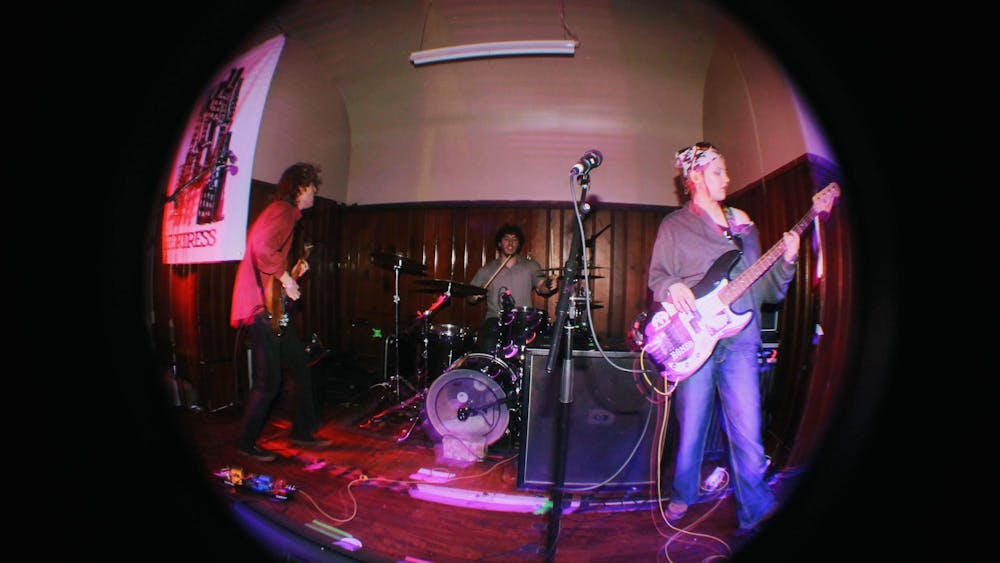
It’s summer in Clark Park, where the open grass is filled with West Philly residents playing chess and relishing in some pleasant weather. Sitting across from me is Harrison Lennertz, lead vocalist and guitarist to the Philly–born, “dawg rock” band armbite. In just three years, the group has developed a unique presence in the local music scene—and an equally particular sound. Lennertz, who grew up in the suburbs of Los Angeles before truly engaging in musical collaboration in Haverford, founded the band after discovering Philly’s Do–It–Yourself music scene—this exposure, he says, opened up a new world.
It wasn’t chance and circumstance that brought the three together, says Lennertz, but a shared enthusiasm for the unconventional. While running Haverford’s Federation United Concert Series club, he met eager applicant Marin Duff, now the group’s bassist, and was swept by their passion for the scene. “You love DIY, you love music, you’re on,” he says. The two were already writing armbite’s first songs when Duff thought to introduce Lennertz to the band’s eventual drummer, their good friend Matt Guardiola, who is next to show face in sunny Clark Park. Guardiola has always had a healthy musical life, from jazz bands to high school choir. Currently, he drums for armbite and four other bands, and runs a concert booking business.
You could say the trio’s meeting was statistically destined; after comparing shockingly similar Spotify Blends, Duff knew an introduction was in order.
“Marin introduced me to Harrison because me and Marin did that Spotify blend thing,” recalls Guardiola. “And they were like, I only have this close of a match with one other person, and it was Harrison.”
After a quick Remo Drive cover to break the ice, the trio soon realized their musical chemistry.
“Harrison was able to communicate what he wanted out of my drum parts, rhythmically, or like, I was able to pull out what I think he wanted,” Guardiola explains. The group soon found something beyond musical chemistry; they found efficiency and process, allowing them the room to experiment.
Together, Guardiola and Lennertz detail this process from conception to performance, which begins with Lennertz’s appreciation for music theory. Their starting point is often his rhythmically complex, theory–heavy guitar riffs, which are then built upon by Duff’s bass and Guardiola’s drums. As Harrison puts it, “It’s mostly Matt extrapolating what I want. … Very few times do I have to specify.”
Mid–sentence, Lennertz and Guardiola pause to wave at another locally based band, Lahnah, putting up posters. What are the chances we would run into another band at a park in the middle of the week? Pretty high in a city like Philly, according to the musicians. “There’s so much music in Philadelphia, in every aspect and genre you could think of,” says Guardiola. With an abundance of universities, conservatories, and liberal arts colleges, Philadelphia is rampant with musically driven and passionate young people. Guardiola knows this especially well; running a concert–booking company has allowed him to encounter hundreds of eager musicians. “There’s so much different music and so many people sharing ideas,” he says. “This place is like a hotbed for it.”
But it’s not just the people who have made Philly the vibrant scene it is; its the cost of living, housing stock, and a relative lack of industry pressure that creates the conditions for bands like armbite to exist in the first place. As LA–native Lennertz can attest, the barrier to entry for DIY music is far higher in cities like LA and New York, where “everyone who moves there wants to make it big.” Philly has escaped some of that pressure, remaining comparatively affordable and retaining the kind of dense, unpolished residential infrastructure that lends itself well to the scene. Even the city’s abundance of row homes and basements makes someone’s living space the perfect rehearsal space. As Guardiola shares, “All you need is some shitty equipment and a shitty cement room. That’s what my practice spaces always were: some dingy basement and a $100 drum set.”
Going forward, the band is moving towards a more experimental sound they describe as “less structured” and “math–adjacent.” While they aren’t diving completely into the genre’s alternative, irregular, and arrhythmic style, they are drawn to its structural freedom. Their earlier sounds drew from the more melodic elements of emo and math rock bands such as Origami Angels, Sweet Pill, and Remo Drive. Lennertz cites the grind–pop of Now, More Charm and More Tender by P.E.E as significant inspiration and one of his favorite albums.
“They have a lot of very math themes, a lot of guitar work, dual vocalists, a lot of just non–four–four meters; they just go a lot of places within the sonic palette.”
Still, he hopes to maintain the balancing act between a thoroughly composed piece and the catchy, “poppy” style. “Every single verse should be a hook” is a writing philosophy Lennertz hopes to embody.
A full U.S. tour is a hope for the band in the distant future; as for the near future, they have set their sights on more live performances in the Northeast. But for now, the band is taking advantage of the vibrant Philly scene and performing in its array of venues. They started playing for passion, and in this city, that’s all you need to keep going.