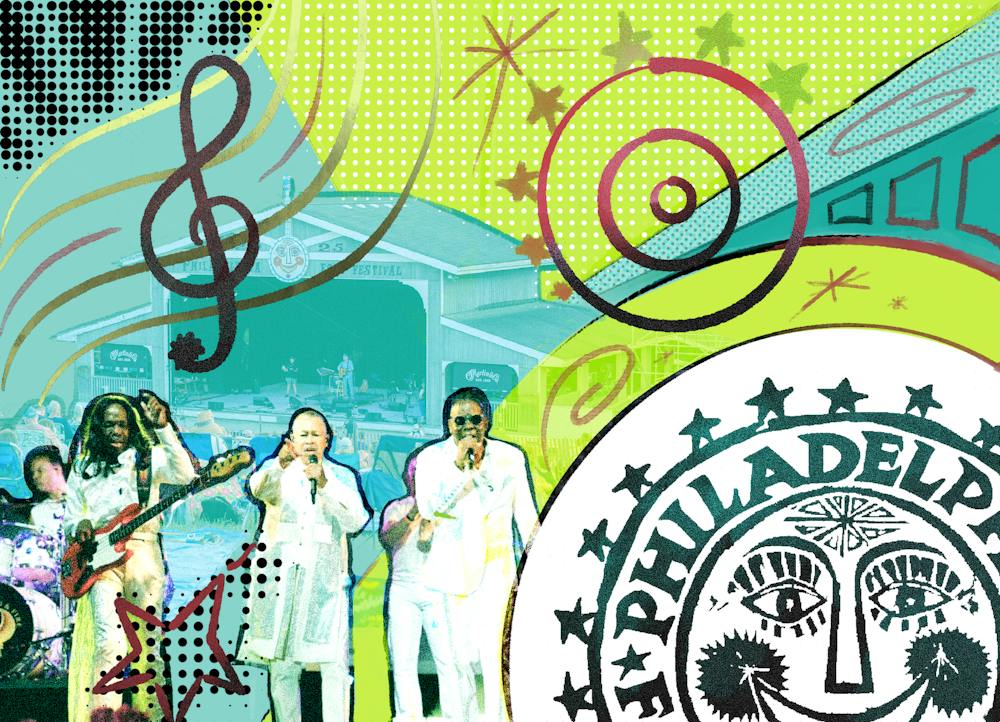
I have no idea how long I’ve been at the Philadelphia Folk Festival. At the longest running folk music festival in the nation, days aren’t counted by the calendar as much as they are by clouds turning from sun to rain. Like a large percentage of the attendees, I am a “Fest–baby,” aka someone whose first babbles were the opening lyrics to “This Land is Your Land” and whose Virgo birthday is celebrated a month prior during a dusty tie–dye weekend. By my seventh Fest, my dad had gifted me a Martin guitar with a green paisley strap. But this year, no one in my group brought any instruments at all—a transgression thoroughly condemned by our self–proclaimed Fest mother.
She takes the same shuttle as us—a pickup truck driven by a tall woman in a cowboy hat—and asks us if this is our first time here. I respond “No,” at which point we both realize that we know each other (she sometimes plays the banjo at gigs with my dad). My boyfriend and my friend admit that, regretfully, we all left our instruments at home. That’s a difficult thing to admit to any hippie in the Philadelphia Folk Song Society, which aims “to preserve the past, promote the present and secure the future of folk music.” The community of jam sessions and campfire songs loves nothing more than to come together to forget time for a few days. So Fest–mother Stacy leaves a mandolin, a ukulele, and a guitar at our campsite. Under the shade of a languidly constructed tent, we strum some new songs together.
Although I can barely remember the lyrics to a song we’re learning, mistakes in folk music turn into new beginnings. “I wanted to play, so I figured it out” is painted next to a 12–foot–tall portrait of Elizabeth Cotton beside the main stage of the festival. So, when I can only recall “Shut the door, keep out the devil / light a candle, everything’s alright,” we intersperse the phrases between improvised lines by each player. Nostalgic tunes become a call–and–response game. Music becomes a communal economy.
This game keeps us thoroughly entertained until we’re tired enough to swing ourselves back and forth on someone else’s hammock—a tradition in the festival’s forested Dulcimer Grove. When the sun peeking through the tree canopy makes the grove too hot, we follow the sound of a fiddle until we can join a crowd swaying to the beat of a tambourine. There is always a melody you could parse out from the fog of cicada chirps and giggly chatter, but at night, the music is louder near the tents than by the stage. The party won’t sleep until the weekend is done.
The festival’s first iteration occurred in 1962, headlined by folk royalty like Reverend Gary Davis and Pete Seeger. The community philosophy of these big names didn't end at the edge of the stage: Pete Seeger, for example, was so moved by the atmosphere that he donated his performance payout back to the festival.
The 63rd annual Philadelphia Folk Festival is not easily documented. The festival may have big names as headliners to welcome in new attendees, but its real heart can be found within the pedestrian crowd. Alongside those big names are local acts like Roberta Faceplant (referred to as a “cowpunk miracle” and “honky–tonk hurricane” in the program), who embody the eccentric yet humble heart of the weekend. Partway through her set, she brings her sister onstage to sing harmony, fusing Roberta’s enormous, unruly voice with her sister’s timid smile. A shirtless man wearing overalls and a guitar slide tears into a solo that bends notes until they nearly break, and my friends and I dance to choreography we invented with strangers. We learned this line dance choreo with new friends we met last night in front of a dulcimer player’s small crowd, right across from the tent where Roberta had joined the campers to sing after midnight.
We set up our tent in the suburbs of the campground’s party epicenter, north of “WhoHill” and south of “Jonestown.” Attendance once reached 12,000 to 14,000 people in the second half of the 20th century; after a series of economic concerns, however, the population has fallen to roughly a third of that number in recent years. What remains is not just the legacy of a historically massive gathering of folk musicians and artists, but the burning fervor of a community both intimate and strikingly alive. Our tent goes quiet before most of the surrounding tents—we don’t have Fest stamina yet—and a mandolin’s tremolo is already going by the time the heat wakes us. We set ourselves apart by being perhaps the only tent to be practicing Rihanna’s “Pon De Replay,” which we were arranging ourselves with just three voices, stacking harmonies by trial and error. We make sure to plan for a not–yet–assigned fourth part to turn our cover from pop performance to folk tradition. Then we switch instruments and cut a new pick for the mandolin out of an old debit card.
Stacy’s daughter laughs when we perform our improvised songs for her—her first impression of us—and joins in anyway. By nightfall she’s leading us to the big events: catching beads thrown into the crowd by Terrance Simien & The Zydeco Experience and then finding the Big Dipper in the stars behind Tom Rush. “In Louisiana,” the creole band’s singer says over a piano vamp, “we say you can’t feel the music in your seat—you gotta feel it in your feet.” We’re up off our blankets, hopping to the beat of “Going Down the Bayou” until the band leaves the stage halfway through the song to parade through the audience of outstretched hands. My shoes are falling apart, but behind a melody wheezed out of an accordion and a rhythm section refusing to let up behind it, not one person between the ages of four to 94 can resist the call to dance.
Each season, Fest babies will continue being born and a bagpipe will sing in memoriam for recently passed friends. Even amateur guitar players who recently moved to Philadelphia from Virginia become part of the family by the second song of a moonlit jam session. My boyfriend and my friend can already feel this hospitality when the content of our conversations has switched to discussing all that we’d do when we come back next year. For as long as we’ll continue finding grass in our backpack or humming to “Take Me Home, Country Roads,” there’s no real difference between being at Fest and having just been. Out here, community is the campground’s real currency, and a jam session doesn’t care what day it is.
So, I have no idea how long I’ve been at Fest. It’s just been one long song. The beat never drops, and the walls of the tent can’t even block out a whisper. But year after year, the oasis at Old Pool Farm in Upper Salford remains. Someone there will light a candle at a campsite in the dark, and for a few days, everything is alright.