I got into Resident Evil in perhaps the least dignified way possible: watching the Smosh Games playthrough. As someone who is historically awful at video games—I’m decent with a gun in real life, but I can’t hit a single target in a first–person shooter—playthrough videos are my lifesaver. But I quickly fell in love with the games anyway, from the ridiculous lore and gory body horror to the very lovable protagonists. So when it was announced in January 2025 that there was going to be a new Resident Evil movie directed by horror newcomer Zach Cregger I immediately went “Fuck yeah.” Then I watched his horror debut Barbarian and my excitement multiplied tenfold. When Weapons came along later in the year—which I got to see in an IMAX theater on a 96–foot–tall screen with hundreds of other people—I knew Cregger was the perfect person to adapt Resident Evil. It quickly became my most anticipated movie of the year.
I am a huge coward, but I love horror movies. I’m drawn to films specifically designed to make me cover my eyes and cringe into my seat, trying to block out that inevitable scare. The only thing I enjoy more is watching someone experience the single worst day of their life.
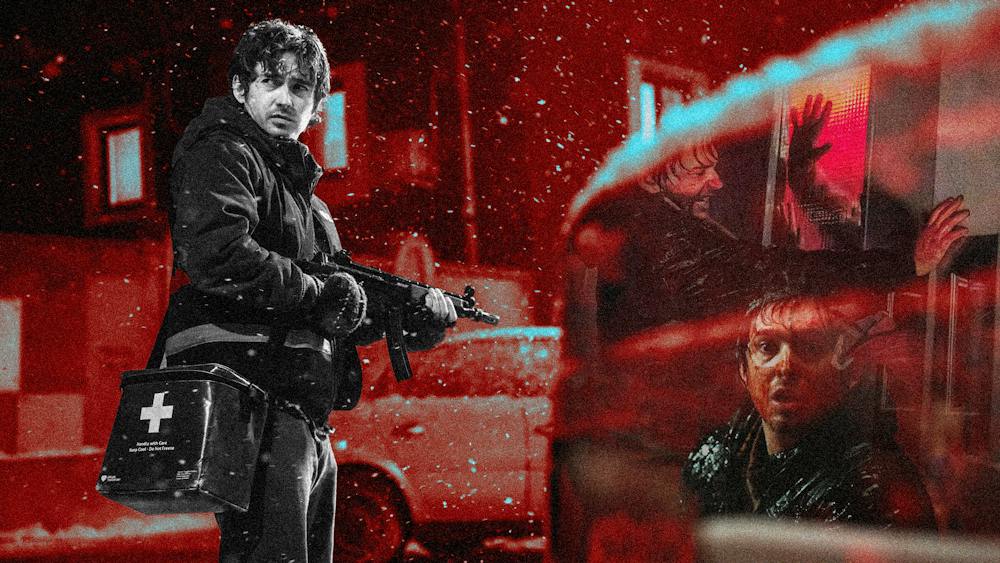
Luckily, that’s basically the entire premise of Cregger’s Resident Evil, a gloriously entertaining yet surprisingly thoughtful video game adaptation that has quickly become my favorite horror movie of the year. The film stars Austin Abrams—the scene–stealing drug addict from Weapons—as Bryan, a medical courier whose already miserable life gets significantly worse when he accepts a late–night delivery to Raccoon City. Everything quickly falls apart as Bryan crashes into an infected woman, stumbles through a series of increasingly horrific encounters, and spends the rest of the movie desperately trying to survive long enough to get his package delivered.
For the uninitiated, most Resident Evil games follow an ordinary person stumbling into biological disasters caused by the nefarious Umbrella Corporation, a pharmaceutical company secretly developing viruses and bioweapons that turn people into zombies and grotesque monsters. Each game usually sends its protagonists through some combination of abandoned buildings, labs, and isolated towns, where they have to solve puzzles, find weapons, and figure out what the hell happened before whatever is lurking around the next corner gets them.
Bryan is no Leon Kennedy or Chris Redfield, the franchise’s heavily armed and absurdly capable heroes; instead, he’s the NPC who leaves tragic voice memos behind for the playable protagonists to find on their quest. He never fully becomes an action hero, remaining the relatable everyman who is completely unequipped for the nightmare unfolding around him. He barely knows how to use a gun, makes the wrong decisions, panics constantly, and has absolutely no idea what is happening.
There’s been a lot of hand–wringing from fans of the Resident Evil games about Cregger’s decision not to directly adapt one of the games or center one of their established protagonists, but that’s what makes the film such a brilliant adaptation. It’s not a one–to–one recreation of a game, which any person could see a playthrough of on YouTube. Cregger creates perhaps his best film yet by recreating the experience of playing the game and finding the core of the survival horror genre. He understands that the heart of the franchise isn’t the playable characters or any particular plot, but the feeling of being trapped somewhere hostile, figuring out what the hell is happening, and desperately trying to survive.
The movie isn’t a straight compilation of references, but it still captures the feeling of games like Resident Evil 2, Resident Evil 4, and especially Resident Evil 7. The inventory logic, locked doors and puzzle–like progression, sudden acquisition of weapons, ammunition conservation, occasional first–person shots, and even little sound cues in the score all evoke gameplay without screaming at the audience. There are moments where a subtle musical ding or a neat camera zoom feels exactly like when the game is handing over a new item.
Most importantly, though, Cregger understands that Resident Evil has always been at its best when its horror is rooted in the suffering of ordinary people. For all the ridiculous lore and new monsters and cryptic conspiracies, the nastiest part of the franchise is how it depicts corporate greed: the Umbrella Corporation destroys entire communities and prioritizes profits over safety in its pursuit of biological supremacy.
There’s a moment when the action slows to show a simple shot of a framed photograph of a couple. The audience has just spent the last half hour terrified by what they have become, and suddenly the movie reminds us that these unholy creatures were once people with lives. The monsters are also what keeps the movie from becoming another general zombie flick—Cregger smartly leans more heavily into the G–Virus, which turns its host into continuously mutating monsters that allow the creatures to become increasingly bizarre and grotesque instead of a standard undead horde. The body horror gets stranger and nastier as the movie goes on, giving the film a mean sense of escalation.
More than anything, though, Resident Evil is Cregger’s most confident film yet—and, I think, his best. After the narrative flaws of Barbarian and inconsistencies of Weapons, this movie feels like Cregger fully hitting his stride. Every technical choice is perfectly designed to put the audience inside Bryan’s increasingly awful night. The cinematography by Dariusz Wolski, who also worked on Pirates of the Caribbean, immediately makes this film stand apart from the franchise’s other adaptations. Considering the recent epidemic of poorly–lit movies, it may have been a risk to set a movie entirely in one night, but Wolski knows how and when to use darkness. Instead of burying the action in blackness, we see headlights carve through snow, flashlights isolate tiny pieces of the frame, and pools of artificial light make every stretch of darkness around them feeling like something could be hiding just out of sight. Tracking shots keep the movie moving, while occasional first–person sequences put us directly into Bryan’s panic.
The sound design is aggressive without becoming exhausting and the editing keeps the movie moving without making it feel frantic. The pacing is ridiculously tight, coming in at a crisp 95 minutes. Cregger doesn’t waste time explaining every corner of this universe because Bryan doesn’t have time to learn it either. The audience is forced to discover the rules at the same time as him, and the more knowledgeable viewers get to scream at the screen when Bryan doesn’t grab a green herb to restore health or search a room for the key he’ll need to unlock the next level.
The film is a brilliant addition to the Resident Evil universe but it’s also clearly not just another IP film—it fits right in with Cregger’s horror filmography. Barbarian, Weapons, and now Resident Evil are all fascinated by fear: both how people behave when they’re terrified and how fear can make them selfish, stupid, compassionate, or unexpectedly brave. Cregger’s protagonists are never traditional heroes, they’re flawed people who reveal their goodness precisely because they are scared. Bryan is an especially good example. He’s selfish, scared, overwhelmed, and that makes him kinda stupid sometimes. But he does keep trying to help the people he comes across.
Abrams makes that dynamic work. Bryan could easily be selfish and unlikeable, but Abrams turns him into a hilarious, pathetic, deeply lovable disaster. His performance is almost entirely built around panic, confusion, and increasingly horrified disbelief. That makes him more relatable and compelling than a more badass protagonist could ever be.
Abrams also plays perfectly into the movie’s simple thematic core. Bryan is terrified of adulthood—his girlfriend is pregnant and he takes an overtime shift rather than go home and confront how quickly his life is changing by. Unfortunately, he’s forced to face those fears as the world begins to mutate around him and he is attacked by a series of very on–the–nose monsters.
That anxiety helps make Resident Evil feel so distinctly like a Cregger movie despite being his first major piece of franchise IP. He takes the horror of a citywide biological catastrophe and filters it through the very human fear of change. Bryan spends the first half of the movie trying to preserve his old life by pretending everything is still normal. By the end, he has finally decided that he wants the thing he was running from, only to discover that the world doesn’t care whether he has figured himself out.
That’s what makes horror so fun. The genre has felt so consistently exciting this year because it’s one of the few genres that treats moviegoing as unapologetic entertainment. Horror movies want to give the audienc__e a physical reaction, it wants you to jump, scream, laugh, squirm, and immediately ask, “What the fuck was that?” Resident Evil makes it work better than almost any horror movie this year.
The genre is also at its most entertaining when it’s willing to be cruel—when characters make terrible decisions and the movie refuses to save them from their ugliest consequences. That mean–spiritedness is what makes the works of filmmakers like Jordan Peele and Cregger, both of whom came from comedy before turning toward horror, so compelling. The audience can feel the comic instinct underneath all their scares. There’s a carefully constructed set up, precise timing, and a horrifying yet hilarious reaction as someone or something gets absolutely destroyed.
Cregger’s films are practically all horror–comedies. Barbarian starts with a stressful first act before pivoting to straight humor in the second act, and closes it off with a fantastically wild ending. Weapons goes from grief and suspense to the wacky hijinks of a desperate drug addict. Resident Evil might be the purest version of it all, taking one extremely unprepared guy, throwing him into the worst night of his life, and finding new and increasingly horrible ways to make things worse for him.
The film is exactly what anyone should want from a studio franchise movie: made with enough genuine passion for the source material to understand what makes it special, but enough confidence to become something of its own. It’s definitely a Resident Evil movie, but it is also unmistakably, unapologetically, and thankfully, a Cregger movie.