
Tinashe opens Popstar with a meditation on sensory deprivation. On “Sunglasses,” she dons blackout shades and noise–cancelling headphones—just like that, the outside world switches off entirely. The song is an obtuse invitation to borrow those headphones for the next forty–some minutes. Its rhythmic challenge and vocal layering excess throw off our footing with syncopation that lands equally unexpected every time. The terms of the listen are set: We are going to hear the music her way.
In an Apple Music interview, Tinashe described how her former label, RCA Records, confined her to R&B earlier in her career because of its limited view of her potential as a Black woman in music. Now independent, she calls herself the “through line” between the album’s disparate subjects, citing Britney Spears and Janet Jackson as her musical influences—both of whom built their artistry around persona rather than genre. Popstar spends its duration proving why Tinashe is worth listening to, no matter the style; the tracks span dreamlike trap, R&B, dancefloor blitz, K-pop, country twang, and piano ballad.
The album explores a constant tension between an effortless persona and the labor behind it. “Too Easy” pairs K–pop’s airtight rhythm and gloss with a beat that's anything but easy to catch up with. In a genre specialized in precision and polish, claiming effortlessness becomes part of the performance. The music video sharpens the irony: a falling light fixture knocks Tinashe out on a green–screen set, open auditions are held to replace her, and cue cards feed her the song’s lyrics for a TV interview. Even an offensively obvious EOS placement ad works, because the industry’s shallowness is the point. For a song about how easy this all is, the video embraces snags at the seams in stardom’s loose stitching. “Crash Out” runs the tension in reverse. The lyrics, steeped in online culture, detail exorbitant anger, while the delivery stays nonchalant, chill, and even sexy. She never needs to raise her voice; the restraint makes the fury land.
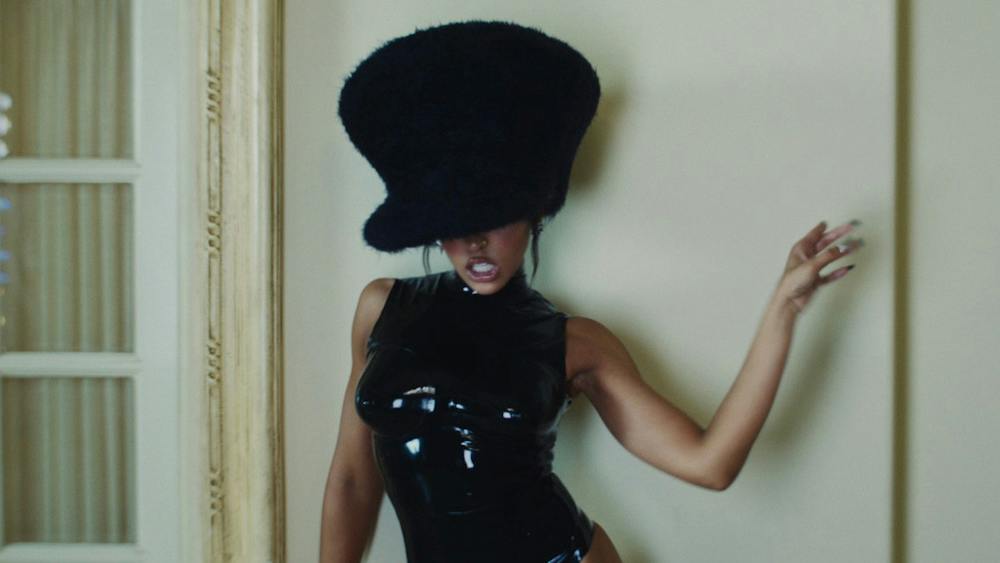
Tinashe’s genre–hopping has an emotional cost, and the album admits it. “Empty Stadium” is a garage cut, akin to FKA twigs and PinkPantheress’ “Wild and Alone,” making a case for her range while confessing how much it hurts when that range goes unnoticed. “Melatonin” shrugs the anxiety off, ruling that anyone who can’t recognize what she’s doing is sleeping on her. The production runs hot and propulsive, in the dancefloor–blitz territory of Shygirl. In the music video, an empty, expensive–looking room hosts a ballerina, a thrashing punk rocker, a hip–hop dancer, and Tinashe herself, in a latex bodysuit and a huge, furry, Abraham Lincoln–style hat. Together, they sketch the eclectic mix of interests and influences that inform her music.
Elsewhere, Tinashe lets that versatility speak for itself. “Overdramatic” is a brief, tangy interlude that could slot into Ariana Grande’s sweetener, while “I’d Rather Be Alone” is a ballad built on sparky bursts of electric guitar and the heights of her vocals. “Brainrot” settles into a quasi PC Music haze—the same unsettling ambience that made “Aquatic Ambience” a viral sound—exposing a lost, liminal feeling beneath the hedonistic lyrics. The clear highlight of the album is “Nobody Wanna Dance Anymore,” which folds country twang into rough electronic bass and gospel–adjacent ad–libs. It lands better than Miley Cyrus’ similarly themed “Bass Persuades” from this year. It seems every genre Tinashe visits just bends to her will.
More overtly sensual tracks like “Flashbacks” and “Pillow Fight” remind us we’re listening to the artist who made “Nasty.” “Flashbacks” opens in a bratty register over a woozy, spacious, cloud–rap production reminiscent of FKA twigs’ Caprisongs, and grows more compelling by the second. The song implies a reunion of sorts, possibly with someone from Tinashe’s past, or evokes her tendency to linger on old memories. “Pillow Fight” may be flirting with us, the audience, rather than with a partner. Its music video, in which she lounges on an endless shipment of differently sized beds and seemingly can’t keep still, may be a metaphor for all the different genres she tries on for size here, as well as a very knowing performance of the intimacy she’s created with us listeners as a result.
The brief “The Show Must Go On” hypes her up for the title track, where Lana Del Rey–style California imagery sits beside her disillusionment with the pressures of being in the game so long. It’s Tinashe’s catchiness at its peak, with rhymes and timing sharp enough to make succumbing to her artistry inevitable—even as she has doubts of her competence herself.
Where her fame anxiety is expressed with less opacity, the record’s weakness in writing is briefly exposed. “Still, I dress it up, but it’s all a mirage,” off the record’s title track and “Keep on repeating the cycle, maybe that makes me a psycho” on “Heavy Weight” land as jarringly impersonal and void of cleverness. Still, that’s a minor cost for an album that so effectively capitalizes on its ambitions.
Popstar makes the work of an artist its greatest illusion: you can hear her proficiency everywhere, even when Tinashe makes it sound easy. The headphones go on—what sounds effortless is anything but.