
Street: Do you even like Korean food? Lily Kim: Of course! Korean food is very flavorful and quite healthy. I like that it’s not as greasy compared as other Asian foods and incorporates lots of vegetables. Vincent Park: Definitely! I probably cook/eat Korean food about 1/3 of the time here at Penn.
Street: If you could open a Korean BBQ place in Philly, what would you call it? LK: I might call it Dae Jang Geum (a popular Korean historical drama), but to appeal to non–Koreans, I would maybe choose a less difficult name to pronounce, like Meat 2NE1 (a popular Korean girl group). VP: Korny Koreans. It'd sub–specialize in aphrodisiac desserts and corn–based Korean side dishes.
Street: Did you grow up eating it? LK: I grew up in Iowa, but I still ate Korean food from time to time. My parents liked to cook Korean food for our family and for any potluck or cultural event. There aren’t many Asian, much less Korean, restaurants in my home state, so I only had homemade Korean food growing up. VP: Yeah. I've lived about half my life in Korea (I was born and raised there till I was about 10). Even in the States, the only kind of food I ate at home was Korean. I really hated that growing up but really miss that now.
Street: Do you ever make Korean food at Penn? If so, what? LK: Yes, I like making simple soups and stews such as meeyukgook (seaweed soup) and soondooboo (spicy soft tofu soup). I also use Korean spices such as red pepper paste to make sauces and marinades for meat. But my favorite Korean food to make is kimchi fried rice! VP: I think one of the best things about Korean food is the fact that it tastes really good while being extremely healthy at the same time. Most Korean dishes are veggie based and high in nutrient while also low in things like fat.
Street: What’s your favorite Korean restaurant in Philly? LK: Jong Ka Jib is a restaurant in North Philly that specializes in soondooboo. It has a pretty good rating on Yelp and the price is good! New York has a much better selection of Korean food, though. VP: I make some of the simpler dishes since it's more cost and time effective. Some of the ones I regularly make are soft tofu soups, bean paste soups, and scallion pancakes. I also buy side dishes and some easy to prepare items, such as premade Korean curry or dumplings.
Street: The Korean Student Association is having a picnic. Where do you get the food? LK: Koreana! Or H Mart, by the 69th Street Terminal in West Philly. VP: H-Mart near the 69th station. It's accessible via SEPTA, has fresh ingredients, and items are reasonably priced.
Street: What makes Korean food better than American food, or any other kind of food? LK: I like it because, although people think Korean food is all about meat (Korean barbecue), it actually is more vegetable–based and has many healthy ingredients. It’s not as greasy and it’s pretty light. It also has a lot of culture. Each dish has a history and reason for being created. For instance, kimchi, which is basically fermented vegetables like cabbage and radish with spices, came about so that Koreans could enjoy vegetables harvested in the fall throughout the long and cold winters. Or, there is a dish called budae jjigae, which can be translated literally as "military stew." It is a stew with spam, sausages, ramen noodles, assorted vegetables and rice cakes that originated in the Korean War era, when the economy was crumbling and Koreans were scrambling to find food. American GIs would give leftover packaged meats and ramen to the poor, and Koreans would just mix all these ingredients together to make a stew. VP: I think one of the best things about Korean food is the fact that it tastes really good while being extremely healthy at the same time. Most Korean dishes are veggie based and high in nutrient while also low in things like fat.
Street: What are the three most important components of Korean cuisine? LK: I would say rice, side dishes, meat and soup are the most important components of Korean cuisine. White rice is served plain with most meals. Side dishes are an important part of Korean cuisine because they incorporate a lot of vegetables and flavors. Kimchi would be one of these side dishes. Meat and fish have started to take up a bigger portion of the Korean dinner table, with the economic growth of Korea and popularization of Korean barbecue meats. Soups or stews usually accompany the bowl of rice at every meal. VP: I would definitely say pepper paste, pepper powder, and just straight up peppers. But really, Korean food is usually very red and spicy since various forms of pepper are key ingredients in most dishes.
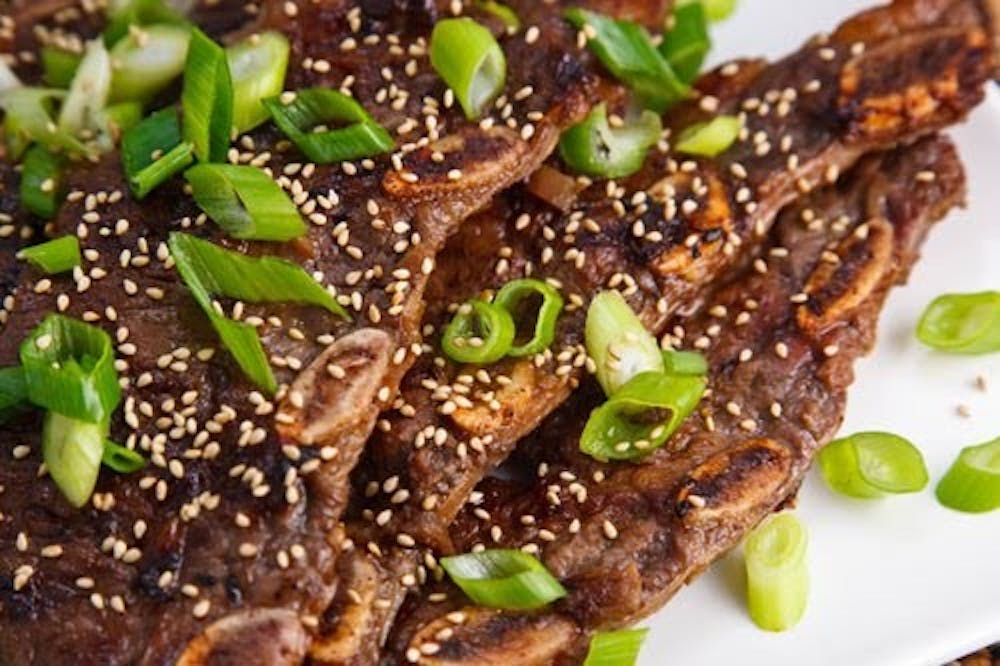
Street: You’re stuck on an island — indefinitely — and you can have just one Korean dish. What do you pick? LK: This is a tough question because I’d want to think about what would be nutritious enough to sustain me, but I guess I’d choose miyukgook, a seaweed soup. It has a lot of vitamin and minerals and is pretty light. I suppose a lot of other people would go for galbi or bulgogi, which are Korean barbecue meats. VP: Definitely bulgogi. I'm fairly certain that I'd die quickly from vitamin deficiency and whatnot, but it'd be great till the final hour.