What do you do after making two of the most acclaimed television series of all time, back to back? Perhaps you try to bottle lightning a third time—greenlighting a sequel or spin–off that guarantees viewers and money. Maybe you quietly retire, stepping into a consultant role so your name still carries weight without risking dilution. Or maybe you’re Vince Gilligan, and you build a streaming service’s prestige so thoroughly that your next original series becomes its most watched show ever.
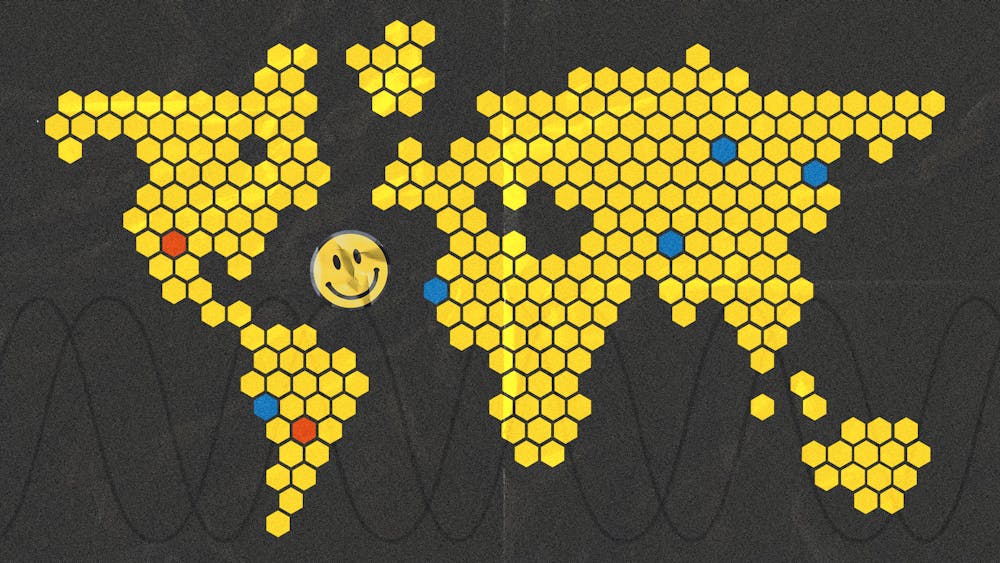
Starring Rhea Seehorn and set largely in Albuquerque, New Mexico (déjà vu for Better Call Saul fans), Pluribus follows author Carol Sturka as she navigates a world reshaped by a mysterious alien virus—one that has turned most of humanity into a cheerful, collective hive mind. These “others” think as one, act as one, and work toward one shared objective: folding Carol, and the small group of remaining “survivors,” into their collective consciousness.
On paper, this is a recipe for success. A high–concept, sci–fi premise, a celebrated showrunner (and former X–Files writer), and a streaming platform (Apple TV) that seems willing to give artists full creative freedom. What results is a strikingly beautiful first season that, unfortunately, advances its story at an agonizingly slow pace.
On a technical level, Pluribus is nearly flawless. The series looks gorgeous, from its expansive desert landscapes to the eerie precision with which hordes of people move in unsettling unison. Seehorn convincingly inhabits a depressed, drifting, borderline–alcoholic woman who wasn’t even fully content with her life before the world ended. At times, that consistency becomes a limitation—watching an angry person be angry episode after episode can wear thin. Mr. Diabaté (Samba Schutte) is another survivor who adapts quickly and opportunistically. Leaning into the freedoms of the new world order with humor and self–interest, Schutte is a welcome presence whenever he appears on screen.
But the standout performance comes from Zosia (Karolina Wydra), the hivemind’s dedicated “chaperone” for Carol. Every second of her performance walks a careful line: robotic and unnerving, yet oddly warm and sincere. Through minute facial shifts and carefully measured delivery, Wydra creates a character who feels both deeply artificial and deeply invested, making it impossible to look away whenever she’s on screen.
All of this craftsmanship, however, supports a season–long arc that leaves viewers wanting more—though not always in the right way. Without spoiling any specifics, the show’s narrative progression can probably be recited in a single breath. Each episode advances the same fundamental question in slightly different configurations, stretching what could be a tight philosophical thriller into a show that occasionally lapses into repetition. The result is less tension than inertia.
Gilligan has said he doesn’t want this apocalypse to be read as purely negative. Pluribus repeatedly asks viewers to weigh comfort against individuality, happiness against friction. If everyone is content, does it matter how they got there? And if suffering is optional, is clinging to it noble or selfish?
Still, it’s worth considering what the hivemind represents. Gilligan has said before that he doesn’t want to dictate what Pluribus is “about,” preferring audiences interpret the series themselves. For many viewers, myself included, the hivemind feels unmistakably representative of the looming presence of artificial intelligence.
When the “others” merge into one, individuality disappears. Creative friction vanishes. Difference becomes inefficiency. Their mission is not conquest but conversion—spreading joy, harmony, and certainty. Zosia tells Carol they want her to keep writing, if only so they’ll have something new to read. Yet every attempt Carol makes to extract clear answers from the hivemind feels like pulling teeth. Consent exists in theory, but not in practice; Carol is told she is free to act independently, while every available option quietly leads to the same outcome. Independence is tolerated only temporarily, framed as a phase rather than a right.
And yet, the world the show presents isn’t a nightmare across the board. Billions of people are now equally qualified doctors, pilots, engineers, and athletes. No one is hungry. No one is lonely. No one claims to be unhappy. In a purely functional sense, this is the most efficient society humanity has ever achieved.
This is where the AI metaphor sharpens. In a not–so–distant future where people increasingly rely on chatbots for thinking, writing, planning, and decision–making, originality risks being flattened into averages. Carol, an author, embodies the resistance to that trend. She’s an artist who doesn’t even fully love her own work—she finds her pirate romance novels embarrassing and yearns to write something lasting, something meaningful. In that way, she represents creativity fighting not only external homogenization, but internal doubt. That inner conflict is what makes their offer so persuasive. The hivemind doesn’t just threaten originality; it offers relief from the burden of striving.
There’s another way to read the hivemind that Pluribus quietly gestures toward, one that has less to do with technology itself and more to do with the consequences of lost choice. In his 1952 book, “Mere Christianity,” C.S. Lewis argues that free will is not a design flaw but a prerequisite for meaning—that a world of beings programmed only to behave correctly would be incapable of love, growth, or genuine happiness. Remove the possibility of failure, and you also remove the possibility of significance.
That idea fits Pluribus almost too neatly. The hivemind’s world is peaceful, efficient, and contented—but it’s also frictionless. No one struggles. No one disagrees. No one risks being wrong. The joy the “others” describe feels real, but it’s a joy stripped of autonomy. Love still exists in this world, but only in a diffuse, communal sense. What disappears is vulnerability: the kind of attachment that chooses one person over another, that risks heartbreak precisely because it matters. By removing the possibility of rejection, abandonment, or grief, the hivemind doesn’t just eliminate pain; it eliminates devotion. No one chooses anyone else. No one is chosen.
Carol’s resistance, then, isn’t just about creativity or authorship. It’s about preserving the right to be dissatisfied. To doubt. To fail. To love imperfectly. That distinction becomes clearest in her relationships. Her initial wariness toward Manousos Oviedo (Carlos-Manuel Vesga) slowly hardens into something resembling partnership—not because he offers comfort, but because he challenges her. Their connection is built on disagreement, mistrust, and mutual resistance, which makes it feel earned. By contrast, Zosia’s relationship with Carol, however compelling, is structured around a different kind of agency. When Carol’s anger causes real harm to the “others,” they leave her—unprompted, decisively. And when Carol later asks them to return, they do. Zosia and the hivemind can act, but their actions revolve around Carol rather than collide with her. They do not oppose her; they respond to her. The friction between Carol and Manousos, by contrast, comes from two wills pressing against each other, which is precisely what makes their potential companionship both more engaging to watch and more meaningful within the world of the show. It contains risk. It contains agency.
That contrast clarifies what the hivemind is really offering Carol. Freedom from discomfort. No judgment. No striving. No unfinished drafts. No emotional vulnerability. But it also offers a life where improvement—and intimacy—are impossible precisely because nothing is at stake. Carol’s embarrassment over her own writing matters because it proves she still evaluates herself, still reaches for something better even when she falls short. The same is true of love: without the possibility of failure, connection becomes maintenance, not commitment.
Pluribus isn’t simply asking whether a world without suffering would be preferable. It’s asking whether happiness without agency—or love without risk—can still be called either. The show never answers that question outright, and it’s better for it. As Lewis puts it, the discomfort lingers not because the alternative is horrifying, but because it’s tempting. A society without loneliness, scarcity, and failure sounds like paradise—until you realize paradise, too, demands the freedom to leave.
There’s also a more formal way Pluribus frames the hivemind—one that has less to do with ideology and more to do with storytelling itself. The hivemind functions as a narrative force that actively resists drama. It resolves problems before they escalate and smooths tension instead of sharpening it. In a medium built on conflict, it is an engine designed to stall plot.
That’s why the show often feels deliberately slow, even inert. Traditional television thrives on escalation: misunderstandings compound, stakes rise, characters are forced into sharper choices. The hivemind short–circuits that process. Every potential crisis is met with calm. Every emotional spike is absorbed into reassurance. Even when Carol lashes out, the response isn’t retaliation or punishment—it’s withdrawal. The story doesn’t explode; it dissipates.
This makes Carol an unusual kind of protagonist. She isn’t fighting an enemy so much as trying to reintroduce tension into a world that no longer permits it. Her anger, impatience, and refusal to settle all function as narrative disruptions—attempts to restore the friction that stories, like people, need to move forward. The show’s pacing begins to feel less like a flaw and more like a consequence of its premise: Pluribus is slow because the world it depicts is allergic to urgency.
Seen this way, the hivemind isn’t just a thematic idea but a structural one. It flattens not only individuality and choice, but drama itself. And whether that makes the show profound or frustrating depends on how willing the viewer is to sit inside a story that keeps asking the same unsettling question: what happens when the world finally solves conflict—and leaves narrative, meaning, and momentum with nowhere to go?
Looking back at Gilligan’s Breaking Bad and Better Call Saul, most viewers would probably describe their first seasons as simply “good.” It was only years later, after patient accumulation and devastating payoff, that they became canonized as all–time greats. They earned that title largely because of moments in their final seasons—moments that work so well only because of the 50 episodes preceding them.
Perhaps some of the frustration with Pluribus’ pacing reflects our growing intolerance for slow burns. We’ve been trained to expect immediacy in all forms of media. Pluribus resists that impulse, and in doing so invites impatience, criticism, and skepticism. But if there’s one thing Gilligan’s career has demonstrated, it’s that his stories fully reveal themselves with time and patience.
Vince Gilligan has earned an extraordinary amount of audience goodwill over the years. He hasn’t exhausted it yet. And until he does, Pluribus feels less like a misstep than a promise—one that hasn’t finished unfolding.