
At a networking event filled with current Daily Pennsylvanian staffers and rather successful alumni, I flag down New York Times Book Review editor Scott Heller and attempt to sell myself as an upcoming writer. Now that I’m a senior, these events offer much more than free Dunkin Donuts and a chance to show off my thrifted professional clothes. Swirling a half–downed gin and tonic, feeling positively out of place in a blazer at Smokes’ on Saturday afternoon, I pitch myself harder than I’ve ever pitched any article.
“I want to be a journalist,” I tell him. Well, not directly: I wax poetic about long form, expound the importance of art criticism—as if I need to convince him of that—and tell the tale of my latest endeavor attempting to hunt down a long–lost skull.
“I see,” he replies, finally getting a word in. “What internships have you had? What did you do this summer?”
I pause. “I went to Alaska.”
“Oh.”
A month after my high school graduation, my family and I took a trip up to the 49th state. By plane, train, and automobile, we explored America’s final frontier. On a scenic bus ride to Denali, I learned about this little thing called “seasonal work”—when hordes of young adults go up to Alaska for the summer to staff bars, restaurants, hotels, and white water rafting tours during peak tourist season. For me, this was love at first sight.
So, three years later, when none of the summer internships I had applied for panned out and I was reaching the peak of junior year burnout, nothing sounded more appealing than temporarily running away to the great white north—and thus began my Alaskan adventure.
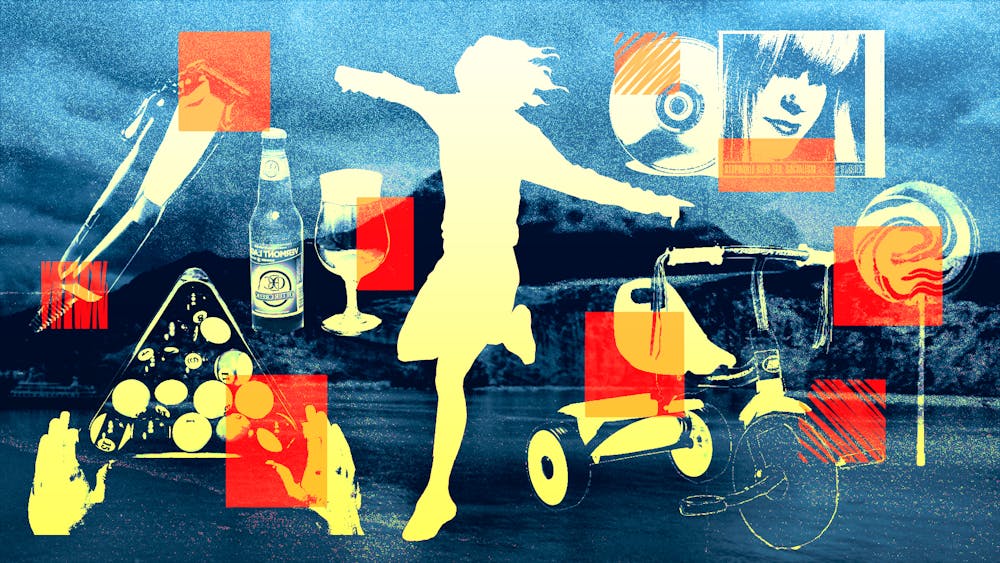
It’s become my party trick and fun fact. I talk about it the way those people talk about their semesters abroad: “It like, totally changed my life.” As a matter of fact, it, like, totally did. For three months, I worked as a barista at a candy shop in a frilly, pink–striped apron and nannied two kids for free housing. I learned how to play Thai card games and gambled away a lot of my tip money. I learned to wrangle a five–year–old and watched Alvin and the Chipmunks about a dozen times. I spent my Fourth of July drinking with Australian tourists and listened to local bands play every Friday night at the only dive bar in town.
I learned how to play pool from some 30–year–old with no phone who had spent the previous seven months in Africa. When we left the nearly empty bar at 2 a.m., I could clear a whole table by myself. “We’ll never see each other again,” he said, waving goodbye.
“Definitely not,” I laughed. We never got each other’s names.
In Alaska, I was a nobody. I didn’t know anyone or anything. I didn’t have the right shoes for hiking and had to relearn how to ride a bike—but it really is quite easy. I was so incredibly free from any preconceived notions; I was not a college student, or an English major, or a wannabe journalist. I was so incredibly alone; most of my time was spent working or doing everything solo: hiking, biking, running, reading, going out to eat, and watching movies.
Midway through the summer, as I hung up my apron and unpinned my bangs, ready to go home and veg out, my boss stopped me and asked, “What were you hoping to get out of this?” Philosophical questions like this were kind of his forte. It was far from uncommon to fall into these deep conversations any time you stopped into the kitchen.
“I don’t know,” I answered. “I think just to get away from things.”
I was completely lost that spring. I felt as though school and work had burned a hole in my brain. I was defeated—utterly demoralized—by the state of journalism. I was afraid of what would become of me after graduation without the routine of school and the comfort of my best friends down the hall. I had become increasingly fond of the recent past and increasingly fearful of the near future.
Hopeless and helpless, I sought an escape from my own life. Is there anything worse than being 21, caught between childhood and adulthood? Obsessed with fulfilling your dreams but unable to formulate the reality of getting there? Woe was me, the lost college student.
The week before I left, Norah gave it to me straight. “It’s hard, but it’s worth it,” she said, harkening back her past summer in India. “You’ll become solid.” In my bedroom, she helped me pack my too–big suitcase with warm sweaters, worn jeans, and more pairs of shoes than one person should need. We listened to “Stephanie Says” and to Lou Reed crooning for a woman, unformed: “But she’s not afraid to die / the people all call her Alaska.”
It’s impossible, really, to boil that summer down into a concise, tight piece. I had one true goal: “You want to be a writer,” I told myself, “So write.” Then, I didn’t. Alaska is incomprehensible. I will never tell it right no matter how many times I try—this is attempt number four, yet it barely scratches the icy surface.
At chef Gabrielle Hamilton’s Kelly Writers House talk, writer Al Filreas asked her why, after pursuing her MFA, she pivoted into the restaurant business. Simply put, she answered that she wasn’t writing: “There’s a difference between thinking about writing your novel,” she explained, “and getting up every morning to sit down and actually do it.”
I was struck—whether by lightning, paralysis, or realization, I’m not sure. Yet, she was right. I talked the talk, but did I ever walk the walk?
They say how you spend your days is how you spend your life. Here I was, having spent a summer in love with Alaska, and yet, I was utterly incapable of putting it into words.
In Hamilton’s class, Cooking with Words, our final reading assignment was on established food critic Wyatt Williams’ piece “Eating the Whale.” The article follows Williams’ journey to the edge of the world to eat whale, yet he writes about everything but. At the end of his trip—and of his piece—he stumbles onto a hidden treasure: a whale graveyard.
“There were a few fresh bones, ribs still stuck with pieces of white fat and blood, but mostly there were old and weathered remnants, bones turned gray like stone. They seemed ancient,” he writes. This was it: nature, in its cruelest, most glorious form, and it was Alaska, in its entirety. “I wrote nothing in my notes,” Williams concludes. There was nothing more to be said.
I spent one of my final nights in Alaska drinking on the roof of a friend’s apartment complex. We had met a few weeks earlier at the only dive bar in town, and he let me shave his head in the complex’s communal bathroom. He was the second friend I’d made that had the word “saw” in their name.
At 1 a.m., we watched the sun finally set. It settled behind the mountains that carved out the edges of town. With a six–pack of cheap beer, we drank to our past few months. How would we ever explain it to anyone who had never experienced it? We talked of the things we’d been missing: Target, fast food, movie theaters, and halal carts.
“Do you think this place has changed you?” he asked. I nodded. “Yeah,” he said. “Me too.”
“How so?”
“It made me kinder. You?”
Norah had been right (she usually is). Something in me—my soul, maybe—had become more concrete. I had an inkling of who I was. My body and mind had been calcified by the sea salt that clung to every corner of this place.
“It made me stable.”