
I still remember when I first sat down to play The Last of Us Part I, not knowing that it would change the way I viewed video games as a storytelling medium. Created by developer Naughty Dog in 2013, the two–part game is set in a post–apocalyptic world where a fungus called Cordyceps has infected most of the population, leaving it a desolate, zombie–infested wasteland. What set the game apart, though, was the depth of its characters Ellie and Joel, whose bond forms the emotional core of the narrative.
More recently, the games have been adapted into a television series on HBO Max, with season one premiering in January 2023 and season two in April of this year. The show has since received praise for its faithfulness to the source material and the strength of its performances. Starring Bella Ramsey as Ellie and Pedro Pascal as Joel, the show has been able to reach an audience unfamiliar with the world that video game fans have cherished for years.
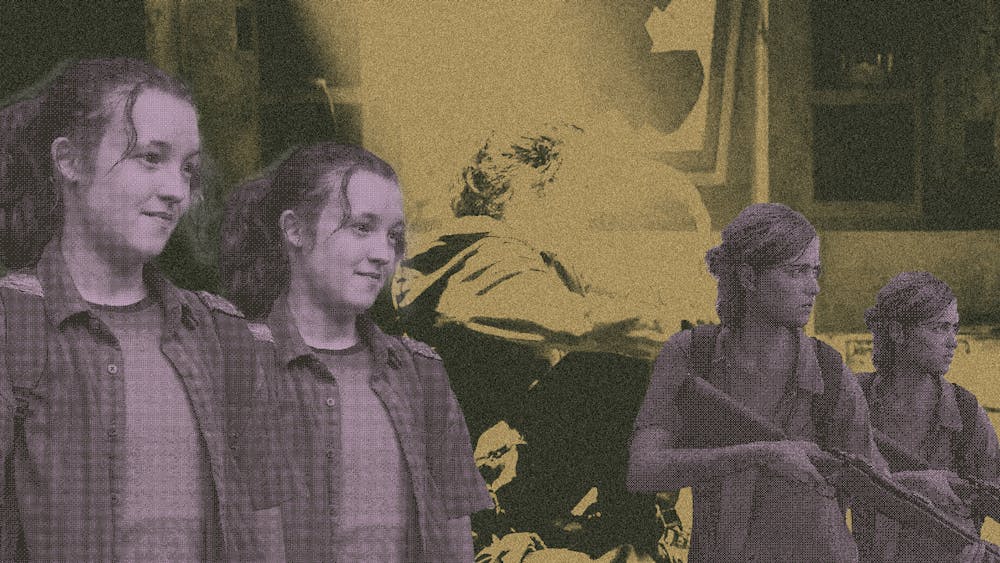
But with that new popularity comes backlash. While Ramsey has received praise from critics for their performance, a vocal segment of fans took to social media to criticize their appearance, arguing that Ramsey doesn’t look enough like the Ellie of the game. Despite Ramsey identifying as non–binary, much of the criticism they received comes through a gendered lens, rooted in ideas of how a female protagonist “should” look and act. This response mirrors audience backlash to the character Abby in The Last of Us Part II, whose muscular build and stoic demeanor drew intense vitriol when the game was released in 2020. Many fans claimed that she was “unrealistic” and “too masculine,” ignoring the context of her character’s trauma and survival.
Now, as HBO Max has begun to set up Abby’s character in season two with actress Kaitlyn Dever, similar casting criticisms have arisen from the opposite end of the spectrum. Fans claim that Dever simply doesn’t have the physical build that is essential to Abby’s character in the second game.The backlash toward both Ramsey’s portrayal of Ellie and Dever’s portrayal of Abby reveals how audiences often struggle to accept complex female characters, notably when they don’t conform to traditional, often patriarchal ideals of femininity.
This backlash was most prominent on, of course, TikTok. Fans posted countless videos scrutinizing both Ellie and Abby’s appearances, albeit in different ways. The reproval of Ramsey’s Ellie was immediate and loud, and much of it centered not on their acting ability, but on how they looked. After the first and second season’s premieres, comment sections were filled with comments like “not my Ellie” and even taunts calling the show “The Chopped of Us.” On Reddit threads and YouTube reaction videos, fans questioned whether Ramsey could pull off Ellie’s storyline, and many called for a recasting before the show even aired.
The wording wasn’t subtle: “ugly,” “manly,” or “not feminine enough” were common, often paired with side–by–side comparisons of game Ellie with Ramsey’s Ellie. Many comments simply targeted the “wrongness” of Ramsey’s face because it didn’t conform to fans’ mental image of what a traditionally beautiful, white, teenage girl protagonist should look like. Ramsey’s features and androgyny were read as “unsettling” and “miscast,” even though Ellie is not a character portrayed in–game as glamorous or hyper–feminine. She is ruthless, badass, and, most importantly, dealing with trauma. These critiques of Ramsey’s casting were rooted in aesthetic expectations shaped by previous portrayals of female protagonists in other games and shows, which portrayed them as delicate and pretty, but not too challenging or unconventional. We know from Ramsey’s past roles in shows like Game of Thrones and BBC’s Time that they aren’t lacking in acting ability. They are more than capable of delivering a compelling performance as Ellie, but the show’s writing in comparison the game's narrative depth has undermined their potential.
This is most notable in a scene where Dina, Ellie’s love interest, admits to her that she is pregnant from her past relationship with Jesse, one of Ellie’s friends. In the TV series, Ellie looks up at Dina and exclaims, “I’m gonna be a dad!” In the game, by contrast, the pregnancy reveal was much more emotional and hard–hitting, as Ellie, enraged by Joel’s death, takes her anger out on Dina. The contrast between these two essential scenes was not a result of bad casting, but of bad writing. Ramsey easily could have portrayed the anger Ellie felt in that moment, but they were underutilized as an actor.
When HBO announced the casting of Dever for season two’s Abby, reactions were also immediate and divided. While Dever is a talented actor, her physique does not match that of Abby’s in the game, whose story revolves not just around her physical strength, but her emotional strength. Her transformation in the second game from a ruthless, near–soldier–level fighter obsessed with avenging her father’s death to who she is at the end of the game, physically emaciated and weak, is essential to her storyline. Her ability to overpower enemies (and, controversially, our protagonist Joel) is what made her arc in the game so haunting. The show’s portrayal of this, with Dever being physically much smaller than Pascal, didn’t have the same emotional weight. To strip away and underplay that aspect of Abby’s character is to water down her character's complexity and misunderstand why she is so essential to the broader narrative of the show. Casting someone who doesn’t embody the same qualities the game’s Abby did risks sanitizing a character who was never meant to be easily digestible.
Amidst all this backlash, however, there has been a noticeable shift in audience sentiments since the season two finale. Many fans have come around to Ramsey’s casting, praising their ability to portray Ellie’s quiet grief, escalating rage, and trauma, such as in Nora’s death scene, where Ellie first gets her revenge for Joel’s death. Fan edits began to frame them not as “not my Ellie,” but precisely the kind of Ellie the story in–game demands: resilient, wounded, and imperfect.
The conversation around Abby is evolving, too, now that it has been confirmed that season three of the show will prominently focus on her storyline. Although some fans do continue to bring up how Dever’s physical build compares to that of in–game Abby, many edits have been made comparing the arcs of both with praise like “she sounds so much like game Abby” and “Kaitlyn Dever is making me rethink everything I felt about Abby.” Some fans even defend Dever’s casting, suggesting that her ability to portray that emotional intensity and strong direction can communicate Abby’s strength in ways that aren’t purely physical. While this audience turnaround doesn’t erase the gendered expectations that still define much of the online discourse, it’s undoubtedly a step forward.
These reactions show that fan culture, even for an audience as dedicated and passionate as that of The Last of Us, is never static. Viewers are capable of changing their minds, seeing past appearances, and valuing performances. Bella Ramsey and Kaitlyn Dever both stepped into difficult roles weighed down by fan expectations, and emerged with portrayals that challenged and moved people, even if the writing was off.
The Last of Us teaches us that survival doesn’t have to look one way. It can look like grief, rage, vulnerability, and strength, all existing in bodies that don’t have to conform to any traditional standards. And maybe the more we sit with characters like Ellie and Abby, both from the game and in the show, the more we’ll expand our ideas about what protagonists can or should look like, allowing new actors to take up space in the stories we care most about.