
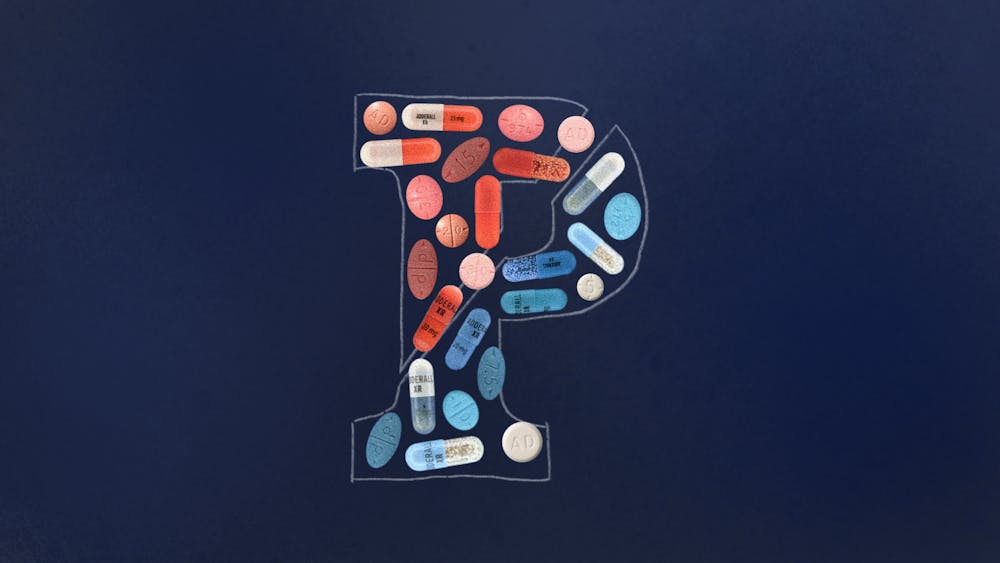
“Poppin’ pills is all we know,” declared Travis Scott in his 2015 hit “Antidote.” Within the United States, no sentiment rings truer. Decade after decade, the nation’s health epidemics appear to only accumulate, from smoking to obesity to depression. These ongoing sagas have spurred Americans to consume rather diverse, colorful combinations of tablets. After all, nothing new is our ardor for convenient, short–term solutions to anguish. Why undergo a strenuous exercise regimen when Ozempic injections can burn equal fat? Or work to adjust your sleep schedule while the local CVS carries Olly? With approximately two–thirds of adults utilizing prescription medications, these substances have become potent forces dictating our navigation of life.
Among ongoing public health sagas, cognitive deficits have recently taken the spotlight—specifically regarding concentration: Since 2004, psychologist Gloria Mark reports the average U.S. adult’s attention span has dropped from about 2.5 minutes to 47 seconds. Many deem this trend’s ubiquitousness to suggest a great culprit: digitization. America’s current “all–on economy” has yielded the population’s codependency on electronic applications for nearly all functions—both business–related and leisurely. Equipped with pinging notifications and infinite web browsing capabilities, these devices have surged user distractibility. Additionally, this phenomenon has shifted consumer habits for informational digest. Condensed segments such as reels have outcompeted lengthier, denser sources—books, films—as preferred mediums for entertainment and knowledge acquisition. Despite modernizing communication and workflow, big tech has produced a seemingly irreversible crisis in attentivity.
Luckily, stimulants such as Adderall have alleviated long–term concentration span issues for millions of Americans. While doctors have utilized these neurotransmitting powerhouses as remedies for a range of conditions—from narcolepsy to eating disorders—they are most commonly revered as treatment for attention deficit disorders. By raising the brain’s norepinephrine levels, these stimulants boost alertness and mood. For individuals with attention deficit hyperactivity disorder, these pills are game changers: Aside from antidepressants, no other solution’s effectiveness has neared the rapidity or potency of those of amphetamines.
Consequently, stimulants have gained another audience: chronically stressed college students. Among this population, these substances have obtained a distinct reputation as “study drugs,” granting hyperfocus abilities. When midterm and final cycles recommence, students desire the ultimate remedy countering distractibility. Enter, Adderall, an academic weapon’s most prized possession. Pop one, retrieve those noise–cancelling headphones, cue that Phoebe Bridgers, and voila! You’ve just transcended into the nirvana of study environments, 100% distraction–free for the next four hours.
Among health professionals, college students’ misuse of amphetamines has garnered attention for over a decade. However, more recent proliferations of study drugs correlate to a critical social transition: contemporary youth’s heightened susceptibility to quarter–life stressors. For example, the lagging job market has intensified careerist pressures for undergraduates. Simultaneously, as humanities careers—and therefore academic programs—remain on the chopping block, big tech and business positions offer immense wealth: Thus, a greater homogeneity in computer science and engineering pathways exists among students. With utmost expectations of higher–order thinking and innovation, these professions demand a strict rise–and–grind routine from individuals. For many students, reaching this superhuman cognitive level necessitates Adderall intake.
Furthermore, while study drugs have proliferated across campuses nationwide, their intake is densest among private, top–tier university attendees. In 2016, Harvard alum Charlotte Lieberman reflected that Adderall misuse complemented perfectionist ambitions: “With Adderall, I believed, I would not only write a great paper but would also be a more involved member of my literary magazine … have good grades, a clean room, and a flat stomach, and I wouldn't burn out.” Likewise, College Board researchers found that Ivy League undergraduates with intense extracurricular loads—such as student–athletes—more often utilized stimulants as academic aids. Among these students, performance–enhancing supplements are the key to overachievement.
When Adderall misuse becomes addiction, however, long–term side effects can shadow the momentous dopamine rush. In an interview with E! Online, Ashlyn Harris explains how this substance’s suppression of appetite was toxically appealing—provisioning an effective, yet unhealthy manner of weight loss. While Adderall’s manifold other cognitive boosts—such as increased social battery—might appear helpful, repeated consumption may lead to insomnia and other health deficits. Ultimately, unchecked high dosages can even deflect the drug’s perceptual effects, instead raising one’s susceptibility to psychotic disorders. The crash is never as glamorous as the climb.
And then there are the cultural case studies: Caroline Calloway, the once–viral Instagram memoirist and self–styled literary muse, has openly attributed much of her chaotic academic and personal life to Adderall addiction. In an interview with The Telegraph, she describes the drug as “helping me make bad decisions … and tolerating the consequences when I did”—fueling all–nighters and internet infamy before it destroyed her health. For Caroline, like many others, Adderall blurred the line between ambition and mania.
While Adderall may appear an infallible elixir, the long–term implications of misuse are non–negligible. From the pharmacy outward, it remains a tablet with impermanent powers.