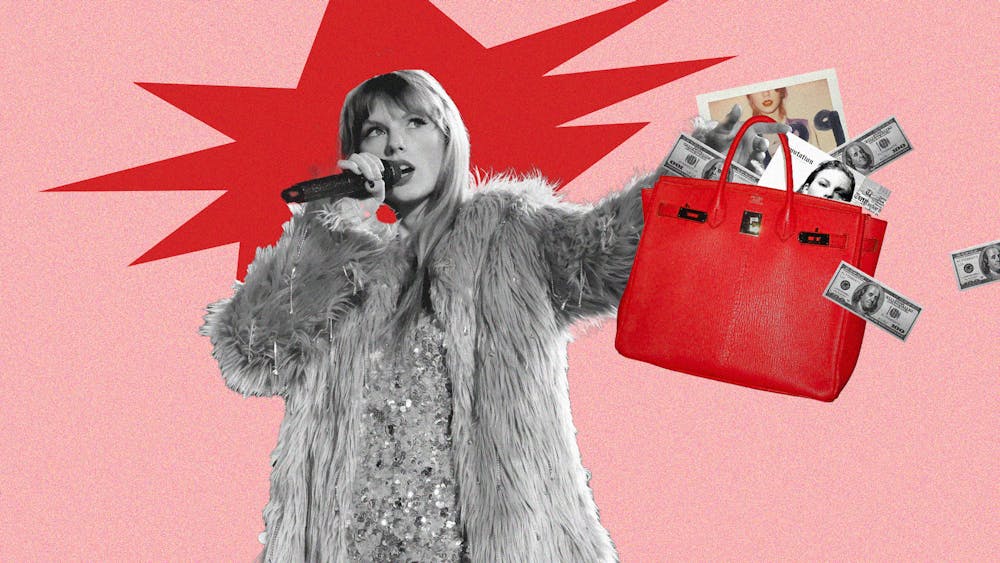
What happens when a pop star commands the economy of a small nation, the allegiance of a cultish fanbase, and the attention of the entire internet?
In 2021, Taylor Swift began re–recording her first six albums in a move framed by some as nostalgia bait and by others as an act of defiance. Behind her mature vocals, however, was a billion–dollar power play that disrupted long–standing music industry norms. Swift’s campaign wasn’t just personal—it was political. It wasn’t just emotional—it was economic. And it wasn’t just successful—it was seismic in reshaping the entertainment world.
It began with a bitter battle over ownership. After releasing six albums with Big Machine Records—Taylor Swift (2006) through Reputation (2017)—Swift left the label in 2018. A year later, Big Machine was sold to music executive Scooter Braun for $330 million, transferring ownership of the original recordings, or masters, of her songs to a man Swift accused of “manipulative bullying” for his role in fueling the 2016 “Famous” phone call controversy involving Kanye West and Kim Kardashian.
Legally, whoever owns a song’s masters controls how the recordings are used: in films, on streaming platforms, and in re–releases. Attempts by Swift to buy back her masters were met with what she called “unfavorable terms”—including an offer to “earn” one album back for every new one she recorded for Big Machine. She walked away, signed with Republic Records, where she would own all future work outright, and began one of the most audacious artistic reclamation projects in modern music.
Despite not owning her masters, Swift still held the publishing rights to her work, thanks to being the sole or lead songwriter on nearly every track. In United States copyright law, this distinction is vital. The songwriter owns the lyrics and melody of a song; the label typically owns only the final recorded version of the song. And once the re–record clause in their contract expires (usually after five to seven years), a songwriter can legally re–record and distribute their old work.
In 2021, starting with Fearless (Taylor’s Version), Swift began reclaiming her past. She set out to re–record and re–release all six of her early albums, recreating each track in meticulous detail while adding in new material from her archives. The goal was to offer fans an alternative to the original versions and shift cultural and commercial attention to music that she controlled. Each re–recording carried the parenthetical tag (Taylor’s Version), transforming a legal footnote into a rallying cry. With each re–release, Swift expanded upon her older albums by adding in previously unreleased "From The Vault" tracks and reimagining forgotten corners of her discography—the Speak Now track “Girl at Home,” for example, became an electro–pop hit far removed from its country origins.
Later that year, she also dropped Red (Taylor’s Version), featuring a ten–minute version of “All Too Well” that debuted at No. 1 on the Billboard Hot 100 and became the longest song ever to top the chart.
When a 2021 TikTok trend sent streams of the original “Wildest Dreams” soaring, Swift surprise–dropped the re–recorded version. Within hours, it shattered her own streaming records and cratered the original’s numbers. This pattern repeated with every new release: each re–recorded album announcement spiked streams of the old version, followed by a sharp drop after the Taylor’s Version release as fans pivoted to the new recordings. The original Fearless saw a massive decline in daily streams after the re–recording came out. Red, Speak Now, and 1989 all suffered similar drops in streams—proof that in making new versions of her songs, Swift was simultaneously making the old ones irrelevant.
Each album rollout was orchestrated with surgical precision and fan–centered hype. Vault tracks. Music videos. Cryptic clues. Vault track puzzles on Google. Each of these elements formed a small part of a larger narrative about control and authorship. Swift’s interactive fandom model blurred the line between artist and audience, encouraging fan participation in everything from decoding track lists to “clowning” for Reputation (Taylor’s Version)—a fan term for the oft–delusional overanalysis of clues pointing to the album's imminent release.
With each release, Swift employed a marketing machine that no label could replicate—a brand that was fundamentally fan–fueled. Swifties created outfit trackers, analyzed "Surprise Song" setlists, and traded friendship bracelets inspired by a throwaway lyric from the bridge of “You’re On Your Own, Kid.” Swift benefited from a massive, mobilized audience that didn’t just consume her music passively—they promoted it, extended its reach, and transformed it into a cultural phenomenon. It was a level of organic engagement that no corporate campaign could replicate, as it was driven by the scale and creative energy of her fan base.
1989 (Taylor’s Version) sold 1.6 million copies in a week, more than the original’s already record–breaking debut. It also broke Spotify’s single–day album streaming record and made Swift the first artist to occupy all of the top six spots on the Billboard Global 200.
Then came The Eras Tour—a three–hour career retrospective spanning 632 days and bringing in over $1 billion in revenue—and the subsequent Taylor Swift: The Eras Tour film, the highest–grossing concert movie of all time. Pulling in over $260 million in global ticket sales and landing Swift a Golden Globe nomination for Cinematic and Box Office Achievement, the film offered a chance to experience the spectacle to fans who couldn’t afford the thousand–something–dollar resale tickets for the live shows. For Swift, it extended the monetization window for her tour. For critics, it raised a question: when does devotion become overconsumption?
While the Taylor’s Version project initially presented itself as a feminist stand for ownership rights, it evolved into something much blurrier. Each Taylor’s Version release arrived with color–coded vinyl variants, Target exclusives, and overpriced merchandise. Overconsumption was acknowledged, even celebrated, because it came signed in Taylor’s handwriting. Fans didn’t feel marketed to—they felt as though they were part of her greater plan.
The deeper we delve into Swift’s project, the more its contradictions begin to emerge. While Swift was recreating old albums, she also released two new projects, Midnights and The Tortured Poets Department. Midnights arrived at the height of Eras Tour mania and rode that momentum to astronomical success, spawning five different variants, multiple deluxe drops, and an endless fan–fueled marketing campaign. It didn’t reinvent Swift’s sound so much as condense it into a soft, synthy aesthetic that felt tailor–made for the algorithm. Was Midnights really a great album, or just the product of a great marketing machine that ultimately earned it the Grammy for Album of the Year?
TTPD, meanwhile, promised raw emotion but came out feeling overwritten. Billed as her most confessional work, TTPD was teased and then dropped as a surprise double album (The Tortured Poets Department: The Anthology) that spanned a staggering 31 tracks. The album contained flashes of brilliance, but also lines that read like rambling first drafts. Compared to the sharpness of Evermore or the lovelorn architecture of Reputation, TTPD felt less like a poetic concept album and more like a sonically stale info dump.
Cracks began to emerge within the fandom, as well. While many still buy multiple physical copies and decode every Easter egg with religious fervor, a quieter contingent has begun to ask questions: are we participating in art or just fueling a brand?
Then, in May 2025, Swift announced that she had officially purchased the masters of her first six albums for a reported $360 million from Shamrock Capital, the investment firm that had acquired them from Braun in 2020. She described the terms as “fair” in an open letter to her fans, who saw themselves not as customers, but as co–conspirators in her plan to reclaim her first six albums.
However, Swift isn’t the first artist to fight her label for the rights to her masters. Prince famously changed his name to an unpronounceable symbol and performed with “slave” written on his face to protest his contract. More recently, Olivia Rodrigo signed with Geffen Records under a licensing agreement that allowed her to retain ownership of her masters, a favorable deal that reflects the changing economics of music in the streaming age.
Swift is one of the few artists with the platform—and fanbase—to make her fight itself high–profile, profitable, and culture–shifting. Swift’s move was so successful that Universal Music Group quietly adjusted their artist contracts in 2021, doubling the length of time before artists could legally re–record their music. Labels scrambled to prevent another Swiftian revolt.
Artists like JoJo and Demi Lovato have also revisited their old music, but neither has matched Swift’s impact. That is because the Taylor’s Version project went beyond the legal. Swift turned her battle with Scooter Braun into a saga, a cause, a tour, and a lucrative business opportunity. And yet, as her version of 1989 was crowned Apple Music’s 18th best album of all time—outranking The Beatles’ Revolver—some began to question whether the re–recordings themselves lived up to the legacy they were revisiting.
Reactions to Swift’s re–recordings were mixed. Her vocals were cleaner, but sometimes less authentic. Her voice is more mature—but is that what the songs need? And in trying to preserve history, some wondered, had she inevitably changed it?
There’s a certain paradox inherent in recreating the past with the tools of the present. What once felt impulsive and biting now sounds measured or even cautious. Songs written in the haze of youth now arrive with their edges smoothed by time and experience. For some listeners, that evolution adds emotional depth. For others, it blurs the very contours that made the originals unforgettable.
The most infamous debate was around the lyric change in Speak Now’s “Better Than Revenge.” In the original, Swift delivered a biting, emotionally charged line about another woman’s promiscuous reputation. In the new version, the lyric was revised to better align with Swift’s current feminist stance and her broader messaging around empowering women. The change came at the cost of the song’s original emotional rawness, sanding down a sharp edge that made her songwriting honest, even if that honesty was messy.
Elsewhere, Swift’s obsessive control over authorship made her project feel overly curated. On Speak Now (Taylor’s Version)—famously her only entirely self–written album—she deliberately left off “If This Was a Movie,” a song co–written with Martin Johnson. Instead, she quietly released it as a standalone single. The move, clearly meant to preserve the album’s “written by Taylor Swift” purity, felt oddly disingenuous. In a project centered on authenticity, it served as a reminder of how carefully that authenticity is sometimes constructed.
Swift’s vault tracks often outshone her originals. “All Too Well (10 Minute Version) (Taylor's Version) (From the Vault” and “Nothing New (feat. Phoebe Bridgers) (Taylor's Version) (From the Vault)” with Phoebe Bridgers reminded fans why they loved Swift in the first place: for her heartbreaking vulnerability and emotional depth.
Not all of her albums ended up being re–recorded, namely her debut self–titled album and Reputation. Swift has confessed that Reputation is “the one album … I thought couldn’t be improved upon by redoing it.” Her decision not to re–record Reputation raised more profound questions about the entire Taylor’s Version project—if the original albums were already great, could they ever really be improved?
Reputation in particular was unlike any other album—snarling, mischievous, and deeply self–aware. It was bold, messy, and polarizing, chaotic in a way TTPD aspired to be but never quite reached. Reputation also introduced one of Swift’s most iconic lines: “I’m sorry, the old Taylor can’t come to the phone right now. Why? Oh. Because she’s dead!”
It’s a line that perfectly encapsulates her greatest magic trick: transformation. Over the last five years, she’s played every version of herself—ingenue, villain, survivor, mastermind. She outgrew the Britney Spears–style commodification that once reduced pop stars to label property. She reclaimed her image and then sold it back to us at scale. She didn’t just win—she redefined the game.
By buying back her masters after devaluing them—shorting her own catalog—Swift performed a billion–dollar bait–and–switch thanks to the fan–driven success of both her re–recordings and The Eras Tour.
Critics argue that Taylor’s Version became less about feminist reclamation and more about I.P. recycling—that she turned an emotional and artistic legacy into pure commerce, just as Disney turns animated classics into mass–produced, live–action remakes. Swift’s genius lies in merging the two—the storytelling and the strategy.
Swift built a narrative about reclaiming power in an industry that tried to silence her while tapping into the parasocial intimacy fans feel reliving her heartbreaks as if they were their own. Her branding transformed that story into a meticulous commercial spectacle, fueled by collectible variants, surprise drops, and stadium tours that converted fan devotion into both cultural and financial capital.
It was a masterclass in narrative control and market dominance. Was it always about art? Maybe not, but it was always about control. Which the fans don’t mind. If anything, they’re honored to have played a part in one of the boldest, most lucrative acts of ownership in modern history. In the end, Swift's project did exactly what it set out to do: “bury the originals.”