For many, the words “sexual education” often bring to mind a stuffy high school classroom—condoms on cucumbers, Googling STI symptoms, your gym teacher sitting you down to talk about “growing hair down there.” But it’s in college that these early lessons truly bear fruit. On campuses, sex ed morphs into something else entirely. Debriefs with roommates, whispers at parties, and Sidechat discourse become informal kernels of knowledge, filling in vast gaps left by inadequate high school curricula.
A 2023 report by The Daily Pennsylvanian found that 68.2% of Penn students consider themselves “sexually active”—so it’s up to the University, both students and administrators alike, to ensure equitable access to the knowledge and resources for healthy sexual practice on a college campus. At Penn, informal education is supported by both institutional resources and student–led initiatives, greeting a student body that arrives at very different starting points: Some undergraduates are schooled in abstinence–only programs, others with comprehensive curricula, and many international students have little to no prior exposure to pronounced sex education. They carry with them, consequently, the stigmas, silences, or overexposures of such systems.
This variation is hardly surprising considering how fragmented sex education is before college. In the United States, high school courses require, on average, just 6.2 total hours of instruction on human sexuality—the specifics of which are decided entirely at the state and local level. As a result, curricula differs greatly, from states like Oregon—which mandates annual instruction on STIs, contraceptives, and gender/sexual diversity to all middle and high school students—to those like Indiana—which does not require any sex ed and pushes schools that do teach the subject to encourage abstinence and display animated videos of “fetal development.” Access to sex ed is further complicated by the “opt–out” clauses many states have in place, which allow parents to remove their children from classes if they feel like the class content is inappropriate or objectionable.
That patchwork is striking enough within the United States. For international students, the contrast can be even sharper. Given that Penn’s undergraduate schools draw from more than 100 countries, the disparities are just as stark across international borders as they can be across state lines. Rebecca Lim (W ’27), grew up in Kuala Lumpur, Malaysia. Coming to Penn, she couldn’t help but find it absurd that other students would describe lack of space for open dialogue when, back home, any posts that her nonprofit, the Noeo Project, wanted to published about sex ed had to undergo several rounds of screening. “In the U.S., everyone is empowered to talk about everything,” she says. “There is less red tape.” Back home, she describes public schools where sex ed is glanced over and kept within the bounds of science classes.
At Penn, student sexual–health initiatives don’t live under one single office or program. Instead, a loose network of resources operates to fit the needs of a particular aspect of campus life or segment of the student body. The Penn Women’s Center, the LGBT Center, and Wellness at Penn work to bridge the gap between the diverse backgrounds that converge on campus.
For many students, Wellness at Penn is the central entry point for student health concerns, immunizations and insurance waivers, medical care counseling, and more. In terms of sexual health on campus, Jackie Recktenwald, the director of Wellbeing Initiatives at Wellness at Penn, describes their goal in terms of “sexual citizenship”—equipping students with tools to navigate consent, pleasure, identity, and digital intimacy in a new environment. On paper, it appears more than sufficient. But these resources are only effective if students actually use them. While many students harbor a desire to destigmatize conversations around sex and sexuality, Wellness at Penn staff themselves acknowledge that it’s rare for students to reach out directly.
“I would say students are sort of hesitant to have these conversations in person. It’s very rare that we get someone who calls us on the phone to talk about sexual health,” says Recktenwald. “More often than not, they’re looking online or hearing from friends or going to resources that are not us.” The result is a strange juxtaposition: a student body that desires institutions built on a culture of access but is at times reluctant or unsure of how to utilize them.
Administrators hope to resolve this tension with Vibe, Wellness at Penn’s newly relaunched sexual health program. Formerly known as Declassified, Vibe is asynchronous and email–based, aiming to provide some relevant, of–the–times insight into sexual health and culture at students’ own demand. It’s designed to reach students where they already are: on their phones, in their inboxes, searching for answers outside of University–designated hotlines.
“[Vibe] really runs the whole spectrum of sexual health and education. The first unit starts with basic anatomy, because we don’t know what level of education students have when they arrive to campus,” explains Wellness Director of Communications Mary Kate Coghlan. “Some of them are very well versed in sexual health and have a lot of experience with it; some have zero sexual health education or background. And so [you’re] really starting from the basics and then working your way through that, through communication and consent, and you know, all the different components of a healthy sex life and healthy sex education.”
The program contains a vast pool of resources. Later units cover overlooked topics in sexual health that appear frequently on forums where accuracy isn’t monitored, like a course on rough sex and choking that was added after research out of the University of Indiana flagged it as a growing area of emphasis. There are also sections on digital sexual health that reflect the realities of online relationships, dating apps, pornography, and even the rise of artificial intelligence companionship.
“Our philosophy is just providing sort of resource information up front,” says Recktenwald. “We know our students spend a lot of time online, right? We know a lot of people are meeting on apps. We know a lot of people are changing information there. And we want to just extend our general, educational approach to those places as well.”
But sex ed on campus is by no means limited to administrator–led initiatives. Penn Reproductive Justice is one student organization with a two–pronged mission—making up for the paucity of education students receive before coming to Penn and offering access to resources that ensure students’ sexual health while they’re at the University. On the education front, PRJ’s programs for college students are tailored to fit their needs in an environment where many have their first sexual encounters—“[we talk about] different kinds of contraception,” says co–founder Annabelle Jin (C ’25), as well as “how to access them on campus, like through Student Health Services.”
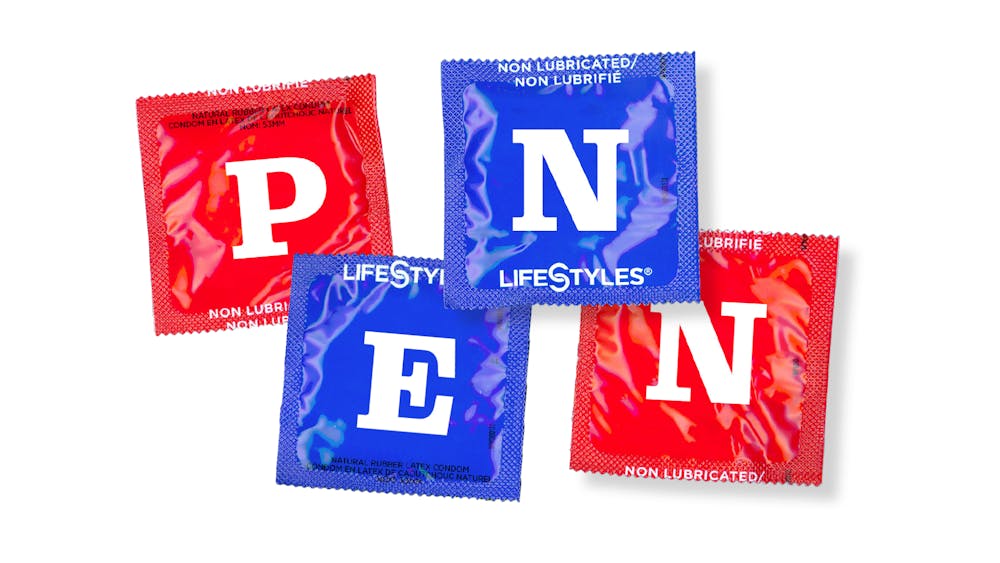
Where PRJ really steps up, however, is in organizing direct product distributions. One of their most high–profile initiatives is the “Wellness Express” on the third floor of ARCH. Planned in collaboration with groups like the Trustees’ Council for Penn Women, the Undergraduate Assembly, and others, the Wellness Express is a vending machine that distributes condoms, Plan B, menstrual products, and other essentials to Penn students free of charge. Antoilyn Nguyen (C ’25), another of PRJ’s co–founders, argues that while access to information is important, it’s actual, physical products that are often most vital to students’ well–being.
“I could be super educated. I can do everything in the world that is about reproductive health,” they say, “But if I didn’t have the pads, tampons, menstrual cups, or underwear that I need to take care of myself when I’m on my period, then what does that mean for me?” PRJ’s resource initiatives range from 24/7 anonymous Plan B deliveries—requested through an anonymous Google Form—to handing out dental dams and lube at their table on Locust. “There’s no pressure, no stigma, just take it!” Antoilyn urges. “We love when people take our shit.”
While expanding access to physical resources forms the core of PRJ’s work, it’s these physical resources that have come under the greatest threat following recent policy changes by the second Trump administration. Though the White House hasn’t issued any explicit orders limiting access to contraception at the federal level, it has restricted the use of Medicaid funding to pay for elective abortions and reinstated the Global Gag Rule, preventing any foreign organizations that offer or consult on abortion services from receiving any assistance from the federal government. Moreover, at elite educational institutions across the country, Donald Trump (W ’68) has shown willingness to weaponize federal funding to browbeat universities into compliance with party politics. It’s a threat that Penn has cowed to before, going so far as to redact the records of transgender swimmer Lia Thomas to conform with the White House’s Title IX threats. Because student organizations on campus receive their resources from official University sources, a Trump order halting the ability of universities to supply gender–affirming or reproductive care would rapidly reduce students’ access to vital contraceptives such as Plan B.
One particular set of college sexual–health programs seems most at risk—those catering to LGBTQ+ students. From the beginning, the Trump administration has set its sights on dismantling “gender ideology”—the conservative byword for LGBTQ+ inclusion initiatives—that it claims has taken over campuses across the United States. While the administration’s most prominent actions in pursuit of this goal have been in cracking down on diversity, equity, and inclusion programs, Trump’s executive orders have also attacked various aspects of health care for LGBTQ+ Americans—a Jan. 28 executive order limits access to gender–affirming care for minors under the guise of preventing “chemical and surgical mutilation,” while a more recent June rule from the Department of Health and Human Services prevents insurers from covering gender–affirming care costs as Essential Health Benefits for Americans of all ages.
The University has shown no lack of willingness to bow to the Trump administration’s commands before, having already planned cuts to inclusion initiatives at both University of Pennsylvania Carey Law School and Penn Medicine and banned transgender athletes from competition in response to White House pressure. Shifts to federal policy place Penn’s entire sexual–health ecosystem at risk. Official University bodies are bound to feel pressure from congressional scrutiny. Student organizations rely on University backing to get vital resources into the hands of those who need them most. Amid this pattern of ongoing compliance with the presidential administration’s regressive orders, can access to sexual health care on campus still be taken for granted?
Organized University resources like Wellness at Penn hold that their mission is to inform students about sexual health rather than tell them how to behave—whether that means providing medical care, counseling, or programs like Vibe. Recktenwald explains that the office aims to be a “jumping–off point,” emphasizing compliance with state policy rather than attempting to calibrate programming to the constantly shifting, often conflicting patchwork of national laws. The approach seems to mirror the University’s instinct for self–protection in an increasingly precarious policy environment: It’s better to present a buffet of resources than risk being accused of indoctrination, or worse, jeopardizing federal funding by running afoul of the White House’s whims.
But while University resources address material concerns at the present, they fail to directly address the anxieties many in the Penn community feel living in a policy–flexible environment. “I am not particularly worried about the access to reproductive care in my state,” says Angelie Rodriguez (C ’27), an English major from New York. “But I am worried about the continued access of it in other states, where people might not be as open about forms of reproductive care. … I’m concerned about the continued production or availability of birth control, because it is so universally used, not only as a form of contraception, but also to regulate hormone imbalances for women.” These concerns are amplified by Penn’s LGBTQ+ community, who fear that further federal policy shifts could limit access to essential medical procedures. “As I transition, I know it’s going to get harder for me to get reproductive care,” says Ife Watts (C ’28). “I don’t have many friends on campus who are worried about reproductive care in the same way that I am worried about reproductive care.”
The vast patchwork of University offices and student–led initiatives can make sexual health on campus feel relatively well–supported. But graduation quickly severs those ties, dropping students back into the less fluctuating landscape of American health care policy. These fluctuations lead some international students to question whether to remain in the United States at all. “[There’s] a lot of volatility in U.S. policy,” says Max Nothacker (C ’27), an international student from Germany. “Volatility affects planning, and I want to plan my life.” While Penn may offer plenty of access to contraception or sexual–health information, the prospect of staying in a country where those rights and resources feel contingent on who occupies the White House remains unsettling.
Sex ed is more than a couple of middle school classes that are forgotten by graduation—it’s an effort that continues into college, and one that requires an active community to offer resources and knowledge to the students who need it. At Penn, the effort to create an open and welcoming environment is tangible. Beyond it, however, students are reminded that what they’ve learned matters little without the assurance that they’ll be able to apply their lessons freely and safely.


